Multi-Enzyme Cleaners for Surgical Instruments: How They Work
A technical guide to multi-enzyme surgical instrument cleaners: protease, lipase and amylase functions, dilution, temperature, contact time, rinsing, limitations and why enzyme cleaners are not disinfectants.
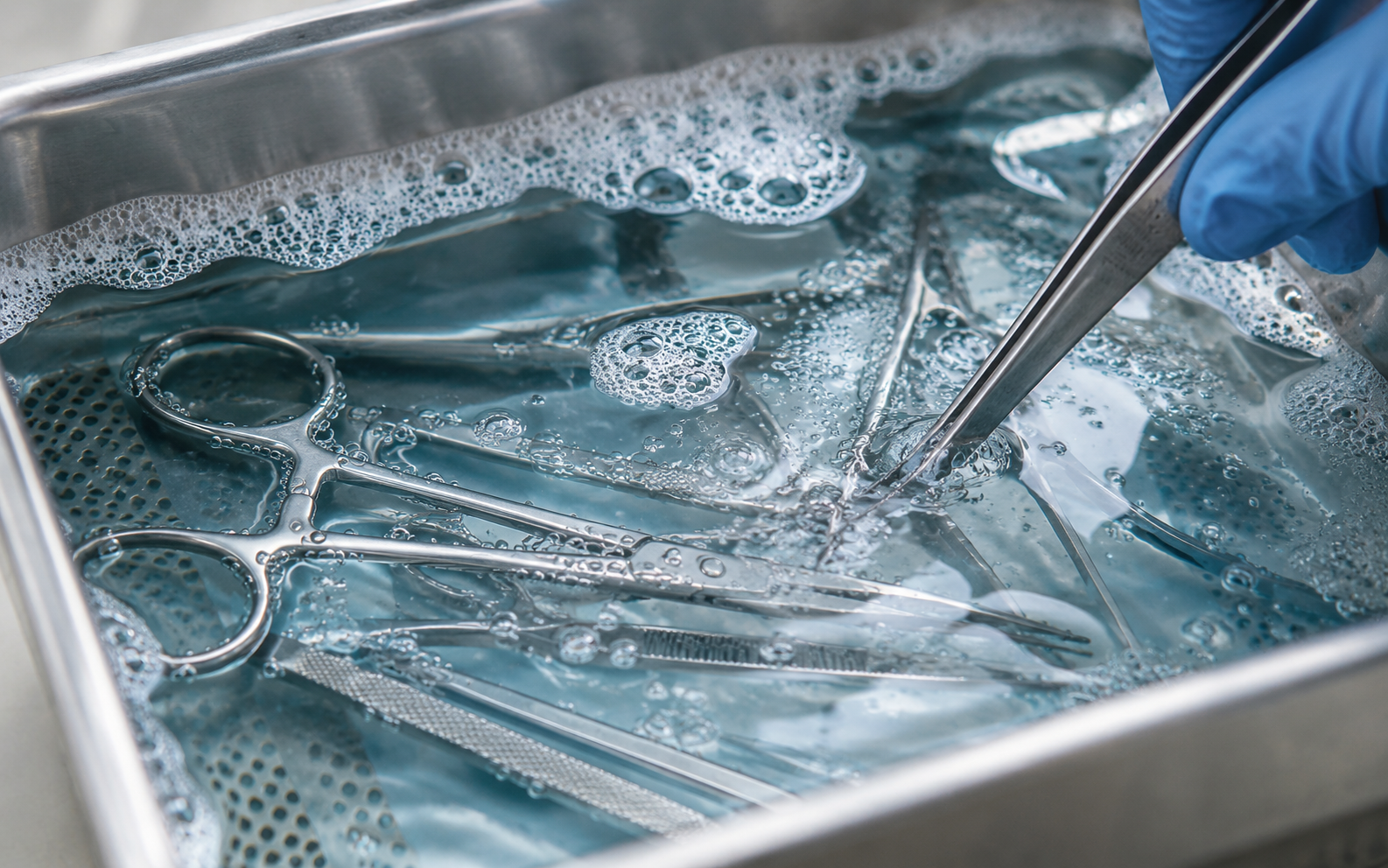
CDC describes proteases as acting on proteinaceous soil, lipases on fats and amylases on starches — while also stating that enzymatic cleaners are not disinfectants and must be rinsed from the device.
“Multi-enzyme” sounds like a performance claim, but technically it describes a formulation strategy: combining enzymes that act on different classes of organic soil. For surgical instruments, that can be useful because clinical contamination is rarely a single substance.
Blood and tissue are rich in protein; fatty material can contain lipids; other residues may contain carbohydrates. A multi-enzyme cleaner is designed to help break those materials into smaller components that detergent, water and mechanical action can remove more easily.
What is an enzymatic instrument cleaner?
An enzymatic instrument cleaner is a detergent formulation containing one or more enzymes used to assist removal of organic soil from reusable medical devices.
CDC notes that enzymes — usually proteases — are added to neutral-pH cleaning solutions to help remove organic material. Formulations can also contain lipases and amylases.
What does “multi-enzyme” mean?
There is no universal rule that every “multi-enzyme” product contains the same enzymes. The term generally means that the cleaner combines more than one enzyme class so it can act on multiple types of organic residue.
| Enzyme | Primary soil target | Examples in instrument contamination |
|---|---|---|
| Protease | Proteins | Blood proteins, tissue, pus and other proteinaceous material |
| Lipase | Fats / lipids | Fatty biological residue and oily soil |
| Amylase | Starches / carbohydrates | Carbohydrate-containing residues where present |
A manufacturer may add other enzymes or surfactants depending on the intended application. The product IFU, rather than the phrase “multi-enzyme”, defines the actual composition and required conditions.
How do enzyme cleaners work?
Enzymes act as biological catalysts. They help split large soil molecules into smaller fragments without being consumed in the same way as a simple reactant.
For example, protease assists the breakdown of protein. Once large protein structures are disrupted, surfactants, water and mechanical action can remove the resulting material more easily from hinges, serrations and other instrument surfaces.
Enzymes do not replace mechanical cleaning
An enzyme cleaner does not seek out every contaminated surface by itself. If a lumen is not flushed, a hinge is not opened or a brush never reaches a recess, the cleaner may not receive adequate access or mechanical help.
WHO describes mechanical action as an essential part of device cleaning and emphasizes brushing, wiping, flushing and spraying as appropriate.
Enzymatic cleaners are not disinfectants
This distinction is explicit in CDC guidance: enzymatic cleaners are not disinfectants. Their role is cleaning.
A surgical instrument that has been treated with enzyme detergent still needs the subsequent validated reprocessing steps required for that device. Critical instruments must still be sterilized before patient use.
Do not use “enzyme” as a synonym for “antimicrobial”. Enzymes help remove soil; the required disinfection or sterilization step is a separate process.
Why dilution matters
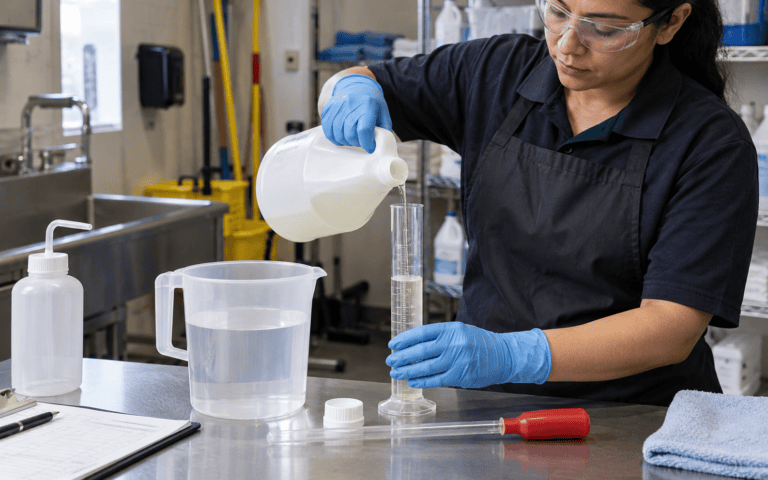
Enzyme concentration is part of the cleaner’s validated working condition. CDC states that enzyme solutions should be used according to manufacturer instructions, including proper detergent dilution and specified contact time.
Under-dosing can reduce soil removal. Over-dosing may increase residues, cost or foaming without producing a proportional cleaning benefit.
Why temperature matters
Enzymes are proteins whose activity depends on their formulation environment. Each commercial product is designed for a particular operating range.
That means staff should not assume that hotter water always cleans better. Temperature must follow the cleaner and device IFUs. Excessively hot water can also make some protein soils harder to remove if they become fixed to the instrument surface.
Why contact time matters
Enzyme-assisted cleaning needs enough time for the formulation to interact with the soil. Cutting the labelled soak or contact time short can reduce the benefit of the enzymatic step.
But extending contact indefinitely is not automatically better either. Longer exposure can create compatibility problems and disrupt workflow. Use the specified time.
Does a multi-enzyme cleaner work better than a single-enzyme cleaner?
Not necessarily in every process. More enzyme types create broader biochemical capability, but cleaning performance also depends on concentration, soil type, temperature, device design and mechanical action.
CDC reviews mixed comparative evidence: some studies found enzymatic cleaners more effective than neutral detergents under specific conditions, while other studies found no significant difference between enzymatic and alkaline-based or non-enzymatic cleaners.
The useful procurement question is therefore not “How many enzymes does it contain?” but “Has this cleaner been shown to remove the soils expected on this device under our validated process?”
Why enzyme products must be rinsed thoroughly
CDC notes that enzymes must be rinsed from equipment. Residual cleaning chemistry should not be carried forward into high-level disinfection, sterilization or patient use.
This is both a process-quality issue and a patient-safety issue. Cleaning residues can interact with later chemistry or remain on device surfaces if the rinse is inadequate.
Worker exposure to enzyme detergents
Enzymes are proteins and can be occupational sensitizers. CDC notes that detergent enzymes can result in asthma or other allergic effects in users.
Facilities should therefore control splashing and aerosols, use the PPE defined by the product SDS and sterile-processing policy, and avoid high-pressure spraying that increases airborne exposure.
Where are enzymatic cleaners especially useful?
They are commonly selected where organic biological soil is expected and material compatibility is important. CDC identifies neutral-pH enzymatic detergent as particularly compatible with many medical-instrument materials and notes its use for delicate medical devices, including flexible endoscopes.
For surgical instruments, the exact selection should still come from the instrument IFU and facility validation rather than from category alone.
Can enzyme cleaner remove dried blood?
Enzyme chemistry can help break down proteinaceous blood soil, but dried soil is harder to remove. CDC recommends cleaning devices as soon as practical because dried or baked material makes cleaning more difficult and can reduce the effectiveness of later disinfection or sterilization.
That makes point-of-use moisture management more important than simply buying a more concentrated enzyme detergent.
What to check on a multi-enzyme cleaner specification
- Device compatibility: does the instrument IFU permit the cleaner class?
- Enzyme system: which enzyme classes are actually present?
- Working dilution: what concentration is required?
- Temperature range: what water temperature is specified?
- Contact time: how long should the instrument remain in contact?
- Foam profile: is the product intended for manual soaking, ultrasonic use or automated washers?
- Rinse requirement: what water quality and rinse method are required?
- Occupational controls: what PPE and ventilation or splash controls are stated?
- Storage and shelf life: how should the concentrate be stored?
Multi-enzyme cleaner vs alkaline detergent
These are not simply “gentle” and “strong” versions of the same cleaner. They use different cleaning strategies. Enzymatic systems use catalytic breakdown of selected organic soils, commonly in neutral formulations. Alkaline systems use chemical conditions that can efficiently solubilize proteins and fats but may be more corrosive to susceptible materials.
The correct choice depends on the device and validated reprocessing system.
Related: Instrument Cleaning Solutions: What They Are and How They’re Used
The practical takeaway
Multi-enzyme cleaners can make complex organic soils easier to remove by combining enzymes such as protease, lipase and amylase. But the enzyme blend is only one part of the process.
Effective instrument cleaning still depends on prompt point-of-use care, correct dilution, validated temperature, enough contact time, mechanical action, complete rinsing and the device manufacturer’s IFU.
Frequently asked questions
What is a multi-enzyme instrument cleaner?
It is a detergent formulation containing multiple enzyme classes intended to help break down different types of organic soil on reusable medical devices.
Which enzymes are used in surgical instrument cleaners?
CDC notes proteases for proteins, lipases for fats and amylases for starches as examples used in cleaning formulations.
Are enzymatic cleaners disinfectants?
No. CDC explicitly states that enzymatic cleaners are not disinfectants.
Does an enzyme cleaner need to be rinsed off?
Yes. CDC states that enzymes must be rinsed from equipment after cleaning.
Are multi-enzyme cleaners always better than non-enzymatic cleaners?
No. CDC reviews mixed evidence and cites studies finding no significant cleaning-efficiency difference in some comparisons with alkaline or non-enzymatic cleaners.
Sources
CDC — Cleaning: Enzymatic products, protease, lipase and amylase.
CDC — Recommendations for Cleaning Patient-Care Devices.
U.S. FDA — Reprocessing Medical Devices in Health Care Settings: Validation Methods and Labeling.
WHO — Decontamination and reprocessing: aide-memoire.
Image: Ptrump16, Wikimedia Commons, CC BY-SA 4.0.