How Sodium Hypochlorite Solutions Are Prepared and Diluted
A practical guide to sodium hypochlorite dilution: the C1V1=C2V2 formula, percent-to-ppm conversion, worked examples from 5% stock, common dilution ratios and the preparation errors facilities should avoid.
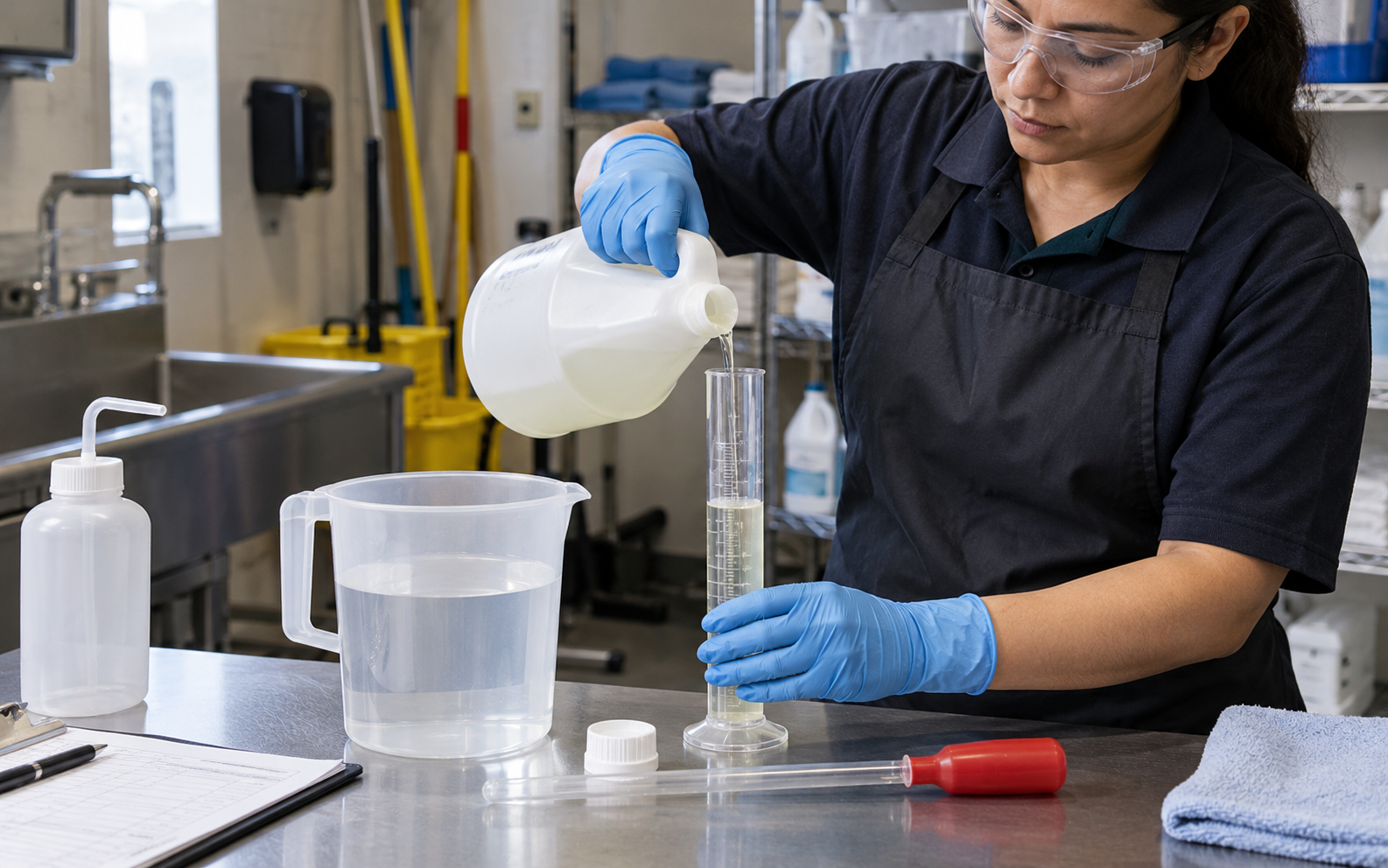
To make 1 litre of 0.5% working solution from 5% sodium-hypochlorite stock, the calculation gives 100 mL stock in a 1 litre final volume — the same 1:9 stock-to-water relationship listed in India’s national IPC guidance.
Sodium-hypochlorite dilution is simple arithmetic with serious operational consequences. A small error in stock strength, ratio interpretation or final volume can create a solution that is too weak to match the intended protocol — or unnecessarily strong, corrosive and hazardous.
The central rule is straightforward: always start with the actual concentration of the stock product and the required final concentration. Do not copy a dilution ratio from another bleach unless the starting strengths are the same.
The basic dilution formula: C₁V₁ = C₂V₂
The most useful formula for preparing a chlorine solution from a stronger stock is:
C₁V₁ = C₂V₂
Where:
- C₁ = concentration of the stock solution
- V₁ = volume of stock solution required
- C₂ = desired working concentration
- V₂ = desired final volume
Rearranged:
V₁ = (C₂ × V₂) ÷ C₁
The concentration units must match. If C₁ is expressed as percent, C₂ should also be percent. If both are ppm, the same equation works.
Example: prepare 1 litre of 0.1% solution from 5% stock
Using C₁V₁ = C₂V₂:
V₁ = (0.1 × 1000 mL) ÷ 5 = 20 mL
Measure 20 mL of 5% stock, then add water to make a final volume of 1,000 mL. That means approximately 980 mL of water when volume additivity is assumed for practical facility preparation.
The equivalent ratio is 1 part 5% bleach to 49 parts water.
Example: prepare 1 litre of 0.5% solution from 5% stock
V₁ = (0.5 × 1000 mL) ÷ 5 = 100 mL
Use 100 mL of 5% stock and add water to a final volume of 1 litre. This is equivalent to 1 part stock to 9 parts water.
India’s National Guidelines for Infection Prevention and Control in Healthcare Facilities give the same 1:9 stock-to-water relationship for preparing 0.5% solution from 5% sodium hypochlorite.
Example: prepare 1 litre of 1% solution from 5% stock
V₁ = (1 × 1000 mL) ÷ 5 = 200 mL
Use 200 mL of 5% stock and add water to a final volume of 1 litre. The equivalent ratio is 1 part stock to 4 parts water.
NCDC guidance lists this same relationship for 5% sodium hypochlorite: one part stock to four parts water for a 1% working solution.
Common 5% stock dilutions
| Target available chlorine | Approx. ppm | 5% stock needed for 1 L final solution | Stock : water ratio |
|---|---|---|---|
| 0.05% | 500 ppm | 10 mL | 1 : 99 |
| 0.1% | 1,000 ppm | 20 mL | 1 : 49 |
| 0.2% | 2,000 ppm | 40 mL | 1 : 24 |
| 0.5% | 5,000 ppm | 100 mL | 1 : 9 |
| 1% | 10,000 ppm | 200 mL | 1 : 4 |
These calculations assume that the stated 5% and the target percentages are expressed on the same relevant concentration basis. Commercial labels can use different conventions, so the product technical data must be checked before applying a generic table.
Percent and ppm: how the conversion works
For dilute aqueous solutions when percentage is expressed as grams per 100 mL on the corresponding basis:
1% = 10,000 ppm
Therefore:
- 0.5% ≈ 5,000 ppm
- 0.1% ≈ 1,000 ppm
- 0.05% ≈ 500 ppm
This conversion is useful because healthcare and disinfection guidance often switches between percent available chlorine and ppm free or available chlorine.
Why “1:10” can be ambiguous
Ratios are one of the most common sources of dilution errors. Some people use “1:10 dilution” to mean one part stock plus nine parts water, giving ten total parts. Others read it as one part stock plus ten parts water, giving eleven total parts.
For high-consequence SOPs, write the instruction explicitly:
100 mL stock + water to 1,000 mL final volume
That is harder to misinterpret than “1:10”.
Stock concentration must be verified first
A 3.5% product, 5% product and 6% product do not use the same dilution ratio. NCDC guidance demonstrates this directly: the stock-to-water ratios change according to starting chlorine concentration.
If the stock strength changes between suppliers or batches, the facility dilution chart must change with it.
What if the stock is 3.5% instead of 5%?
To prepare 0.5% working solution from 3.5% stock:
V₁ = (0.5 × 1000) ÷ 3.5 ≈ 143 mL
NCDC expresses the practical ratio as approximately 1 part 3.5% bleach to 6 parts water for a 0.5% solution.
This example shows why copying the 1:9 ratio from a 5% product would underdose the working solution.
How should sodium-hypochlorite solution be prepared operationally?
- Read the stock label. Confirm concentration and whether it is expressed as sodium hypochlorite or available chlorine.
- Define the target. Use the product label or applicable infection-control protocol.
- Calculate the stock volume. Use C₁V₁ = C₂V₂.
- Use a calibrated measure. Avoid estimating from unmarked caps or arbitrary cups.
- Add stock to an appropriate container. Use compatible plastic or other approved material.
- Add water to the required final volume. This is more precise than simply adding a stated water volume when exact concentration matters.
- Mix carefully. Avoid splashing and aerosol generation.
- Label the working solution. Include concentration, preparation date/time and expiry or discard time.
- Store as directed. Protect from heat and light if required.
Why many protocols require fresh preparation
Hypochlorite loses active chlorine over time. WHO regional guidance notes that chlorine solution becomes unstable rapidly and calls for fresh daily preparation in healthcare settings. CDC also documents substantial decline in free available chlorine under some storage conditions.
The working solution therefore has two specifications: its starting concentration and its usable life.
Operational point: a perfectly calculated solution can still be out of specification if it has degraded in storage.
Why opaque, compatible containers matter
Light and heat accelerate hypochlorite decomposition. CDC describes storage studies using closed opaque plastic containers, and WHO guidance advises suitable non-metallic preparation containers because chlorine is corrosive.
Do not assume any bucket or bottle is acceptable. Chemical compatibility and clear labelling are part of dilution control.
Should facilities verify chlorine concentration?
Where concentration is operationally important, verification is better than assumption. WHO environmental-cleaning guidance states that test strips should ideally be used to confirm correct concentrations of chlorine-based solutions.
This is especially useful where stock ages, supplier concentration varies, dilution is manual or the solution is stored after preparation.
Do not use dilution math to override the product label
The formula tells you how to reach a concentration. It does not tell you which concentration is appropriate for a specific organism, surface or regulatory claim.
For registered or validated disinfectants, the product label and manufacturer’s instructions determine the permitted dilution and contact time. Generic bleach-preparation guidance is not a substitute for a product-specific label where one applies.
Never mix the prepared chlorine solution with other cleaners
Hypochlorite must not be combined with acids, ammonia or unknown cleaning products. Dangerous gases can be released. Prepare the solution only with the water and ingredients specified by the product or protocol.
Related: Sodium Hypochlorite: What It Is, Formula, Uses and Disinfection Applications
The practical takeaway
Sodium-hypochlorite dilution should be treated like a controlled manufacturing step at facility scale: verify the stock, calculate the volume, measure accurately, label the working solution and discard it according to the defined stability period.
The arithmetic is simple. The discipline is making sure the numbers describe the actual product in the container.
Frequently asked questions
What formula is used to dilute sodium hypochlorite?
Use C1V1 = C2V2, where C1 is stock concentration, V1 is stock volume, C2 is target concentration and V2 is final volume.
How much 5% bleach is needed to make 1 litre of 0.1% solution?
20 mL of 5% stock is required, with water added to make a final volume of 1 litre. This is equivalent to 1 part stock to 49 parts water.
How do you make 0.5% solution from 5% sodium hypochlorite?
Use 1 part 5% stock to 9 parts water, equivalent to 100 mL stock in a 1 litre final solution.
Is 0.05% chlorine equal to 500 ppm?
Yes, on the same available-chlorine concentration basis, 0.05% is approximately 500 ppm.
Why should chlorine solutions be prepared fresh?
Hypochlorite loses active chlorine over time, especially with heat, light and unsuitable storage, so many healthcare protocols require fresh working solutions.
Sources
NCDC, Ministry of Health & Family Welfare, Government of India — National Guidelines for Infection Prevention and Control in Healthcare Facilities.
WHO Regional Office for Africa — Infection Prevention and Control Guidelines: Dilution of hypochlorite solution.
WHO — Preparation of chlorine solutions.
CDC — Chemical Disinfectants: Chlorine and Chlorine Compounds.
WHO — Environmental cleaning and infection prevention and control in health care facilities.
Image: Nadina Wiórkiewicz, Wikimedia Commons, CC BY-SA 3.0.