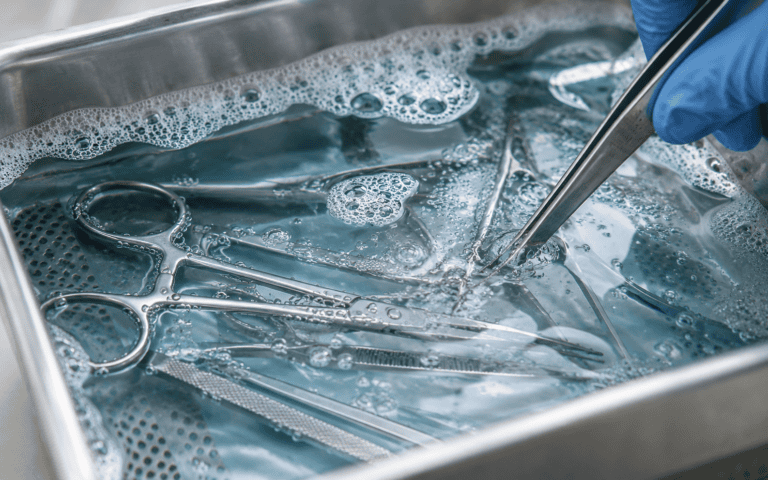
Instrument Cleaning Solutions: What They Are and How They’re Used
A technical guide to medical instrument cleaning solutions: neutral detergents, enzymatic cleaners, alkaline detergents, dosing, temperature, contact time, rinsing and device-material compatibility.
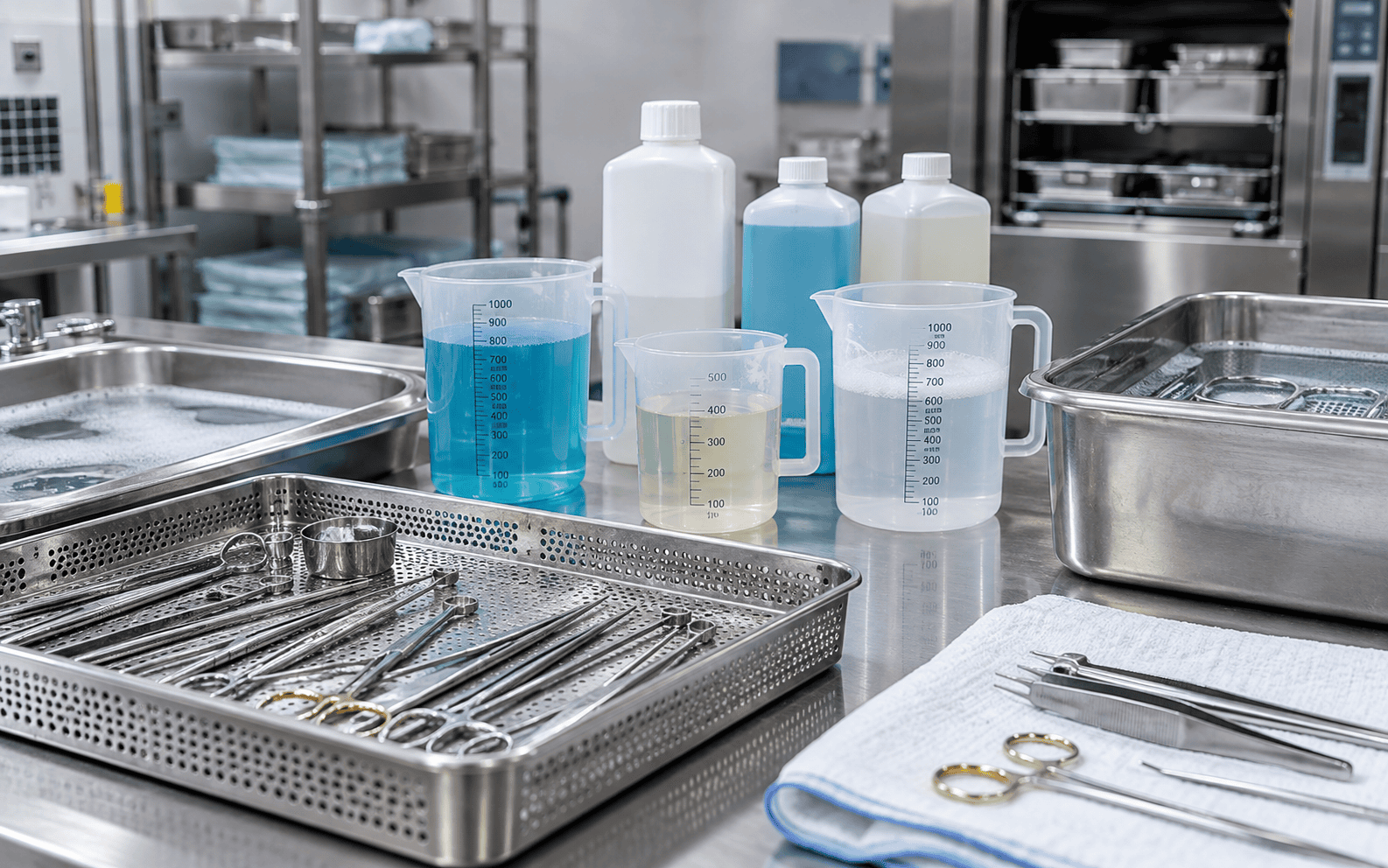
CDC cites automated cleaning studies on laparoscopic devices that achieved more than 99% reduction in measured soil parameters such as protein, carbohydrate and haemoglobin — showing that chemistry and mechanical process have to work together.
An instrument-cleaning solution is not simply “soap for surgical tools”. It is a formulated cleaning system selected to remove clinical soil without damaging the reusable device or interfering with the disinfection or sterilization process that follows.
In sterile processing, the detergent has to work as part of a validated system: water quality, temperature, concentration, mechanical action, contact time, device geometry and rinsing all influence the result.
What is an instrument cleaning solution?
An instrument cleaning solution is a detergent or cleaning formulation intended to remove blood, tissue, protein, fats, salts and other contamination from reusable medical devices before their terminal disinfection or sterilization step.
CDC defines cleaning as removal of foreign and organic material and notes that water with detergents or enzymatic products is normally used. The cleaning solution does not need to sterilize the device; its role is to expose clean surfaces so the validated microbicidal process can work effectively.
The main types of medical instrument cleaners
| Cleaner type | Why it is used | Main consideration |
|---|---|---|
| Neutral / near-neutral detergent | Routine soil removal with broad material compatibility | Must still match device IFU, concentration and temperature |
| Enzymatic detergent | Uses enzymes to help break down organic soils such as protein, fat or starch | Enzymes are not disinfectants; dilution/contact time and rinsing matter |
| Alkaline detergent | Effective removal of protein and fatty residues, often in automated processing | Can be more corrosive or material-sensitive |
| Specialty cleaner | Designed for a particular device, residue or automated washer system | Use only where device and equipment compatibility are validated |
Why neutral detergent is commonly used
CDC states that a neutral or near-neutral pH detergent solution is commonly used for instrument cleaning because it generally provides a strong combination of soil removal and material compatibility.
This matters for reusable instruments because reprocessing happens repeatedly over the device’s service life. A cleaner that removes soil but accelerates corrosion, damages insulation or attacks adhesives is not a successful cleaning system.
What do enzymatic instrument cleaners do?
Enzymatic detergents add biological catalysts that help break large organic soil molecules into smaller, more removable material. CDC notes that proteases are often used for proteinaceous soil such as blood and pus; formulations can also include lipases for fats and amylases for starches.
The enzyme does not “sterilize” the instrument. It supports the cleaning step.
What are alkaline instrument cleaners?
Alkaline cleaning agents are used in medical-device processing because they can dissolve protein and fat residues efficiently. CDC also notes the trade-off: alkaline agents can be corrosive.
That does not make alkaline cleaners inferior. Automated washer systems may be validated around an alkaline formulation. The key is that device, washer and detergent must be compatible as a system.
How is an instrument-cleaning solution selected?
The device manufacturer’s IFU comes first. FDA’s reprocessing guidance recommends using only cleaning agents or cleaning-agent classes that were demonstrated to be compatible with the reusable device and effective during validation.
Selection should consider:
- device material and coatings;
- soil type and expected clinical load;
- manual, ultrasonic or washer-disinfector use;
- required dilution and water temperature;
- contact time;
- water quality;
- rinsing requirements;
- worker exposure and PPE;
- compatibility with later disinfection or sterilization.
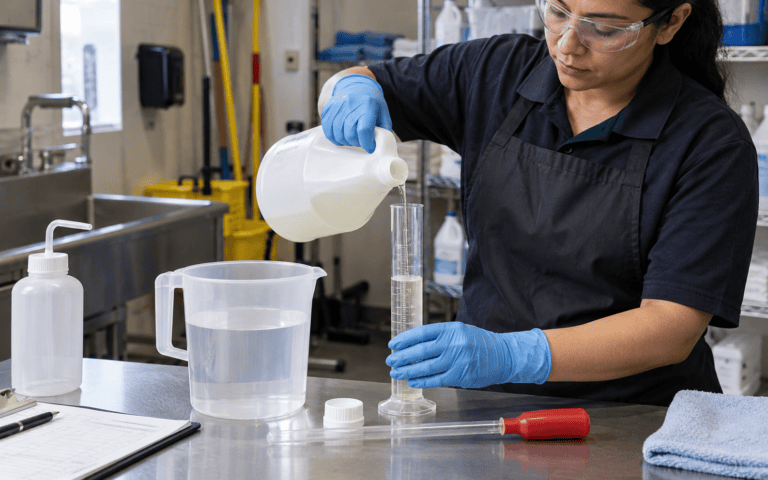
Dilution is part of the validated process
A detergent concentration should not be adjusted by feel. Too little product can reduce cleaning performance; too much can increase residues, foaming, cost or material exposure.
FDA guidance states that reprocessing instructions should provide preparation and use information for cleaning agents or refer to the cleaning-agent manufacturer’s instructions.
Why water temperature matters
Temperature affects soil behaviour and detergent performance. However, there is no universal “best temperature” for every instrument cleaner.
Some enzyme systems are optimized within specified ranges; excessive heat can set proteinaceous soils or reduce enzyme performance depending on the formulation. The correct temperature is the one in the detergent and device IFUs and, where applicable, the automated washer programme.
What does contact time mean for a detergent?
Cleaning chemistry needs time to interact with the soil. WHO’s reprocessing guidance describes detergent contact time as one of the required components of effective cleaning and says the recommended time should be followed rather than rushed.
This is separate from disinfectant contact time. A detergent dwell is intended to facilitate soil removal; it is not a claim that the detergent is disinfecting the device.
Mechanical action still matters
A detergent does not replace brushing, flushing or automated spray action. WHO identifies mechanical action as essential to cleaning and recommends soft nylon brushes that do not damage the device.
For lumens, channels and hinged instruments, chemistry and mechanical access have to reach the same hidden surfaces.
Why automated cleaning can outperform inconsistent manual technique
CDC cites studies in which automated cleaning of certain minimally invasive surgical accessories was more efficient than manual methods and achieved more than 99% reduction in measured soil parameters — including protein, carbohydrate and haemoglobin — on ported and nonported laparoscopic devices.
That does not mean automation is automatically adequate. Incorrect loading, blocked spray arms or the wrong chemistry can still produce a failed process.
Why rinsing matters
The cleaning solution itself becomes a residue if it is not removed. CDC recommends an adequate rinse so detergent or enzymatic residues do not interfere with later processing.
This is particularly important with enzyme products, because residual proteinaceous enzymes have been associated with adverse reactions and should not remain on the device.
Instrument cleaning is a system: chemistry + concentration + time + temperature + mechanical action + rinsing. Changing one variable can change the outcome even when the detergent brand stays the same.
Are enzymatic cleaners always better than ordinary detergents?
No. CDC reviews mixed evidence. Some older studies found enzymatic cleaners more effective than neutral detergents under specific conditions, while more recent studies cited by CDC found no significant difference between enzymatic and alkaline or non-enzymatic cleaners for certain measures.
The correct conclusion is not that enzymes are unnecessary. It is that cleaning performance must be validated for the specific soil, device and process rather than assumed from the word “enzyme”.
Can instrument detergent also disinfect?
Sometimes a product may have both cleaning and antimicrobial claims, but those functions must be clearly validated and labelled. FDA guidance notes that some products can perform both cleaning and disinfection while others perform only one.
For critical surgical devices, even a cleaner-disinfectant step does not replace the required terminal sterilization process.
Common selection mistakes
- Choosing by pH alone. Formulation performance is more than one number.
- Ignoring the device IFU. A detergent that works on stainless forceps may not be permitted for a complex powered device.
- Using household detergent. Foaming, residue, additives and material compatibility may not suit medical-device reprocessing.
- Overdosing. More cleaner can create more residue rather than more cleanliness.
- Using the same solution too long. Soil loading can overwhelm or contaminate the bath; replacement frequency must follow the product/process instruction.
- Skipping rinse quality. A device can be soil-free but still carry detergent residue.
Related: Surgical Instrument Cleaning: From Pre-Cleaning to Sterilization
The practical takeaway
Instrument-cleaning solutions are process chemicals, not commodity soaps. The correct product is the one demonstrated to remove the expected soil while remaining compatible with the device and the cleaning equipment.
For sterile processing, the specification should always include cleaner type, dilution, temperature, contact time, mechanical method, rinse requirement and device compatibility.
Frequently asked questions
What solution is used to clean surgical instruments?
Neutral or near-neutral detergents are commonly used; enzymatic or alkaline detergents may also be used when compatible with the device and validated process.
Are enzymatic instrument cleaners disinfectants?
No. CDC explicitly states that enzymatic cleaners are not disinfectants.
Why are neutral detergents common for instruments?
CDC notes that neutral or near-neutral products generally provide good soil removal with a favorable material-compatibility profile.
Can alkaline cleaners be used on surgical instruments?
Yes, in compatible validated processes. CDC notes they can remove protein and fat effectively but may be corrosive.
Does instrument cleaner need to be rinsed off?
Yes. CDC recommends adequate rinsing so cleaning-agent residues do not interfere with subsequent processing or remain on the device.
Sources
CDC — Cleaning: Detergents and enzymatic products for medical instruments.
CDC — Recommendations for Cleaning Patient-Care Devices.
U.S. FDA — Reprocessing Medical Devices in Health Care Settings: Validation Methods and Labeling.
WHO — Decontamination and reprocessing: aide-memoire.
Image: Dan Bollinger, Wikimedia Commons, CC BY-SA 4.0.