Surgical Instrument Cleaning: From Pre-Cleaning to Sterilization
A step-by-step guide to surgical instrument reprocessing: point-of-use pre-cleaning, transport, manual and mechanical cleaning, inspection, packaging and sterilization — and why sterilization cannot compensate for poor cleaning.
CDC cites one analysis in which median residual protein contamination on reprocessed surgical instruments ranged from 163 to 756 µg per instrument across five trays — evidence that visual cleanliness does not necessarily mean complete soil removal.
Sterilization is the final microbial-control step for most reusable surgical instruments, but the process begins much earlier — at the point of use. Blood and tissue that are allowed to dry onto hinges, serrations, lumens and joints become harder to remove, and anything left behind can interfere with the sterilization process that follows.
That is why modern reprocessing is treated as a linked sequence rather than a single autoclave cycle. FDA describes reusable-device reprocessing as a multistep process: initial treatment at the point of use, thorough cleaning in the reprocessing area, and then disinfection or sterilization according to the device’s intended use.
Why cleaning comes before sterilization
CDC is explicit: thorough cleaning is required before high-level disinfection and sterilization. Organic and inorganic material remaining on an instrument can interfere with those later processes. If soil dries or becomes baked onto the device, removal becomes more difficult and sterilization can become less effective or ineffective.
This is a crucial operational distinction. Sterilization is designed to destroy microorganisms; it is not a substitute for removing blood, tissue, salts and other retained debris.
Step 1: point-of-use pre-cleaning
Reprocessing begins where the device is used. FDA says steps should be taken at the point of use to prevent blood, tissue and other biological debris from drying on the device.
CDC similarly recommends that surgical instruments be presoaked or rinsed as appropriate to prevent blood from drying and to soften or remove contamination. The exact point-of-use procedure must follow the instrument manufacturer’s instructions for use (IFU) and the facility’s sterile-processing policy.
Point-of-use care is not terminal cleaning and it is not sterilization. Its job is to preserve cleanability until the instrument reaches the controlled decontamination area.
Step 2: safe transport to decontamination
Contaminated instruments should be moved to the reprocessing area using the facility’s defined containment and transport system. The purpose is to protect staff and the environment while preventing instruments from drying, becoming damaged or being lost.
Clean and contaminated workflows should remain physically and operationally separated. WHO’s reprocessing guidance describes decontamination as a controlled life cycle, with dirty and clean activities separated so contamination does not move backwards into prepared instruments.
Step 3: disassembly and preparation for cleaning
Devices should be opened or disassembled as directed by their IFU so cleaning chemistry and mechanical action can reach all surfaces. Hinges, box locks, lumens, ports and internal channels are common cleaning challenges because visible external cleanliness does not prove that hidden surfaces are free of soil.
FDA’s reprocessing guidance specifically includes disassembly as a step used to facilitate cleaning and subsequent microbicidal processes.
Step 4: manual or mechanical cleaning
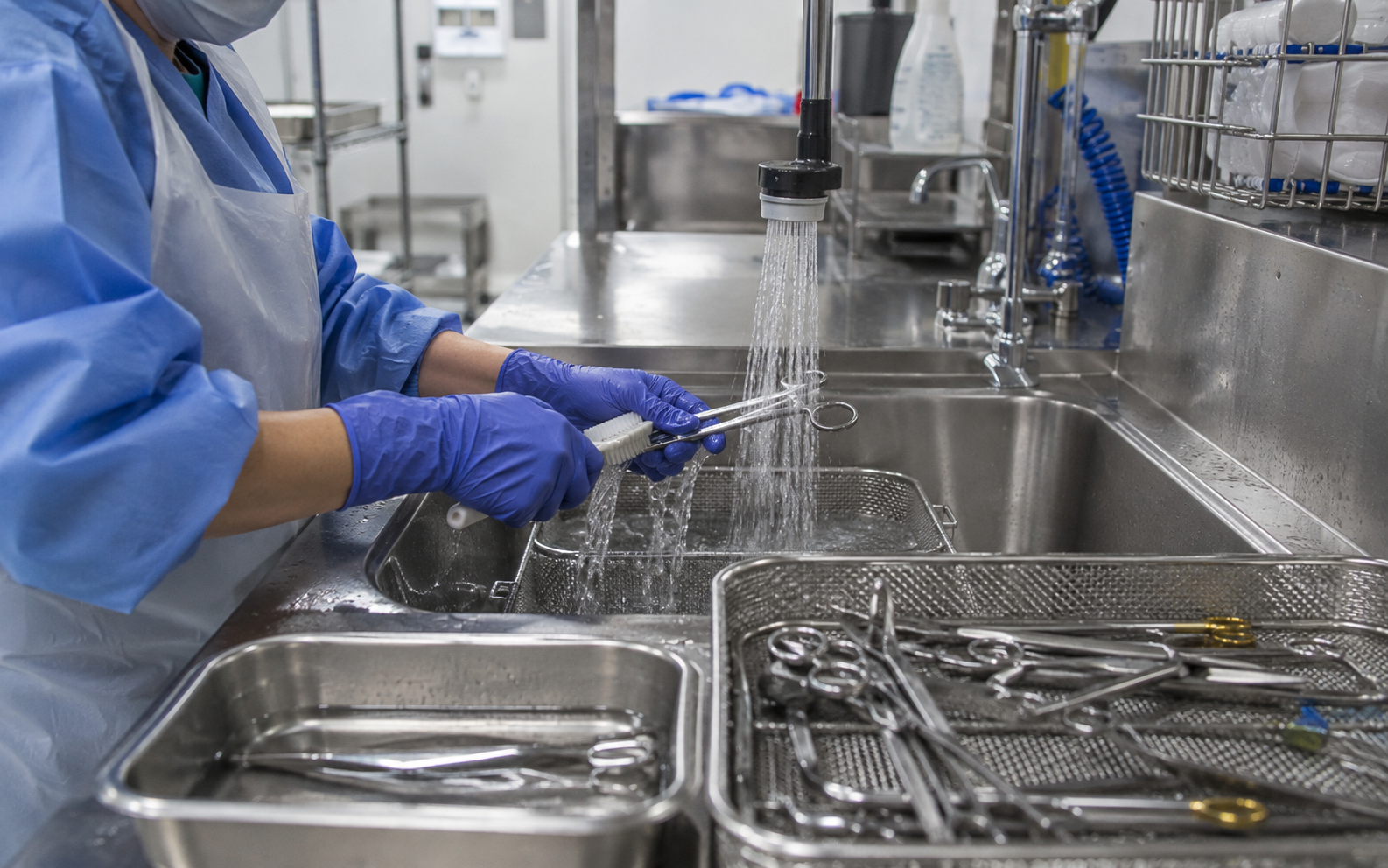
CDC recognizes both manual and mechanical cleaning. Manual cleaning uses friction, flushing and brushing; mechanical methods can include ultrasonic cleaners, automated washers and washer-disinfectors.
WHO guidance describes washer-disinfectors as the most efficient method where suitable and available, while also emphasizing correct manufacturer operation. Mechanical cleaning can improve repeatability and reduce staff exposure, but it does not remove the need for correct loading, device preparation and inspection.
Manual cleaning
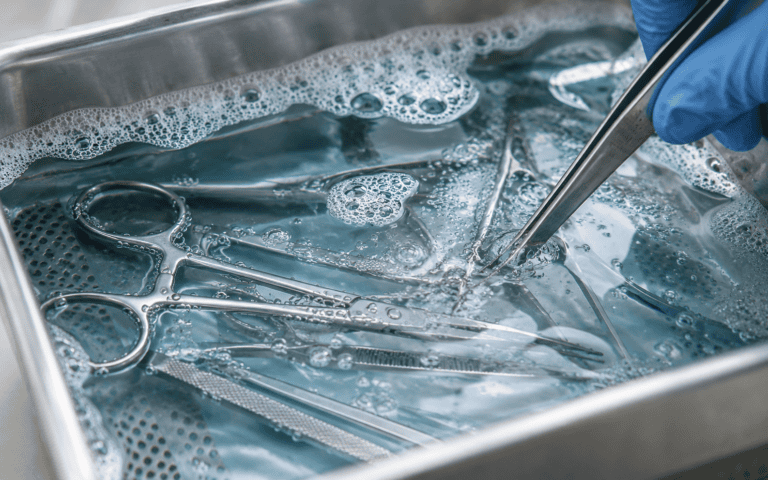
Manual cleaning is important for delicate devices, instruments with complex areas that require specific brushing, and settings where automated systems are unavailable or unsuitable. Brushes should match the device dimensions and should not damage the surface.
WHO advises keeping devices below the detergent-solution level when brushing where feasible to reduce splashes and sprays.
Ultrasonic cleaning
Ultrasonic cleaners use cavitation to help remove soil from joints, serrations and other difficult geometries. The instrument and detergent must both be suitable for ultrasonic processing, and the unit must be operated according to its IFU.
Washer-disinfectors
Automated systems combine controlled time, chemistry, temperature and mechanical action. Their advantage is process consistency, but only if spray arms, racks, water quality, dosing and instrument orientation are correct.
Cleaning itself can produce major microbial reduction
Cleaning is not sterilization, but it is microbiologically significant. CDC cites studies in which manual and mechanical cleaning of endoscopes produced approximately a 4-log10 reduction in contaminating organisms — equivalent to a 10,000-fold reduction.
The point is not to use cleaning as the terminal process for critical instruments. It is to understand why cleaning quality has such a large effect on the microbial challenge that the sterilizer must handle.
Step 5: rinsing and drying
Cleaning chemistry and loosened soil must be removed after the detergent step. CDC recommends an adequate rinse so residues do not interfere with subsequent disinfection or sterilization.
Drying is equally important, especially before inspection, packaging or a process whose IFU requires dry devices. Residual water can interfere with some low-temperature technologies and can contribute to corrosion or storage problems.
Step 6: inspection
Cleaning is not complete until the instrument has been inspected. WHO recommends inspecting medical devices during cleaning to verify that all soil has been removed.
Inspection should also identify damage that compromises cleanability or function: cracks, corrosion, pitting, stiff joints, damaged insulation, blocked lumens or surface defects.
Important: a damaged device that can no longer be reliably cleaned should not simply be passed forward because it looks usable. CDC recommends repairing or discarding equipment whose integrity prevents proper cleaning or subsequent processing.
Step 7: assembly, lubrication and packaging
After cleaning and inspection, instruments may require assembly, lubrication with a process-compatible product and preparation into trays or sets. Packaging must allow sterilant penetration while protecting the device after the cycle.
The exact configuration is device- and sterilizer-specific. Heavy sets, nested instruments, closed ratchets and incorrectly arranged lumens can create processing problems even when the individual instrument is clean.
Step 8: sterilization
CDC classifies surgical instruments that enter sterile tissue or the vascular system as critical devices. These instruments should be sterile before use on each patient.
For heat-resistant critical devices, CDC identifies steam sterilization as the preferred method because of its reliability, consistency and lethality. Heat- or moisture-sensitive devices require an appropriate validated low-temperature process.
What is the difference between disinfection and sterilization?
| Process | Primary purpose | Typical device category |
|---|---|---|
| Cleaning | Remove organic/inorganic soil and reduce microbial load | All reusable devices before further processing |
| High-level disinfection | Destroy all microorganisms except high numbers of bacterial spores | Many semicritical devices contacting mucous membranes |
| Sterilization | Destroy all viable forms of microbial life under the validated process | Critical surgical instruments entering sterile tissue or vascular system |
Why device classification matters
FDA groups reusable devices according to infection risk. Critical devices, such as surgical forceps, contact blood or normally sterile tissue. Semicritical devices, such as many endoscopes, contact mucous membranes. Noncritical devices contact intact skin.
The required terminal process follows that risk. A surface wipe suitable for a blood-pressure cuff is not a reprocessing method for surgical forceps.
Residual protein shows why “looks clean” is not enough
CDC cites quantitative studies of residual protein on reprocessed surgical instruments. In one analysis, median residual protein levels across five instrument trays ranged from 163 to 756 micrograms per instrument. Another study across hospitals reported median values ranging from 8 to 91 micrograms.
Those findings illustrate a basic sterile-processing problem: visually clean and analytically clean are not necessarily the same thing.
Common instrument-cleaning failures
- Allowing soil to dry. Delayed reprocessing makes removal harder.
- Skipping disassembly. Hidden surfaces remain inaccessible.
- Wrong brush size. Lumens and serrations may not receive adequate mechanical action.
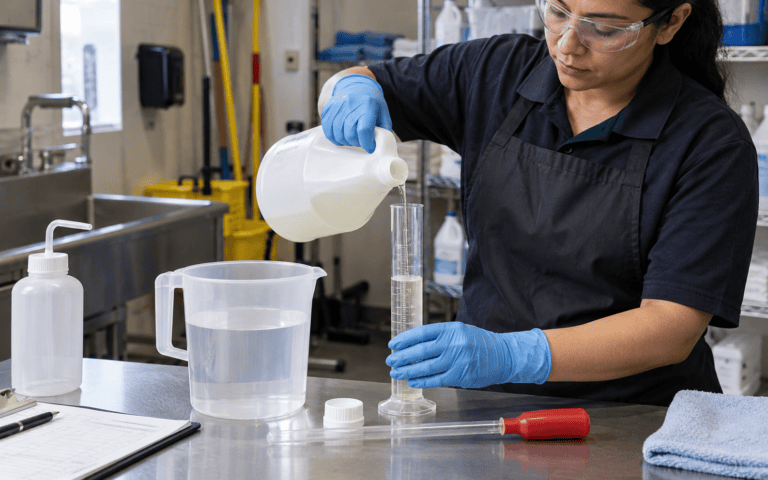
- Incorrect detergent concentration. Too little can reduce cleaning; too much can leave residues.
- Ignoring water temperature. Cleaning-agent IFUs specify the conditions in which they are validated to work.
- Overloading automated equipment. Spray and detergent cannot reach all surfaces.
- Poor rinsing. Detergent or enzyme residues can remain on the device.
- No inspection. Soil or damage passes unnoticed into packaging and sterilization.
Related: Cleaning Chemical Compatibility: How to Prevent Surface and Material Damage
The practical takeaway
Surgical instrument reprocessing is a chain of dependent steps. Point-of-use care protects cleanability; cleaning removes soil; inspection confirms the result; and the validated sterilization process addresses the remaining microbial risk.
The most important rule is simple: sterilization cannot rescue an instrument that was not adequately cleaned first.
Frequently asked questions
Why must surgical instruments be cleaned before sterilization?
Organic and inorganic material can interfere with disinfection and sterilization. CDC states that meticulous cleaning is required before those terminal processes.
What is point-of-use pre-cleaning?
It is the initial care performed immediately after use to prevent blood, tissue and other debris from drying on a reusable device before full cleaning.
Are surgical instruments disinfected or sterilized?
Critical surgical instruments that enter sterile tissue or the vascular system should be sterilized before use on each patient.
What is the preferred sterilization method for heat-resistant surgical instruments?
CDC identifies steam sterilization as the preferred process for heat-resistant critical devices.
Can an autoclave compensate for poor cleaning?
No. Retained soil can interfere with sterilization, so adequate cleaning must occur first.
Sources
U.S. FDA — How are Reusable Medical Devices Reprocessed?.
U.S. FDA — What are Reusable Medical Devices?.
CDC — Cleaning: Guideline for Disinfection and Sterilization in Healthcare Facilities.
CDC — Recommendations for Disinfection and Sterilization in Healthcare Facilities.
CDC — Sterilization.
WHO — Decontamination and reprocessing of medical devices for health-care facilities.