How to Remove Hard Water Stains from Glass
A facility-focused guide to removing hard-water spots, mineral film and limescale from glass — including how to tell removable deposits from surface etching and avoid scratching the glass.
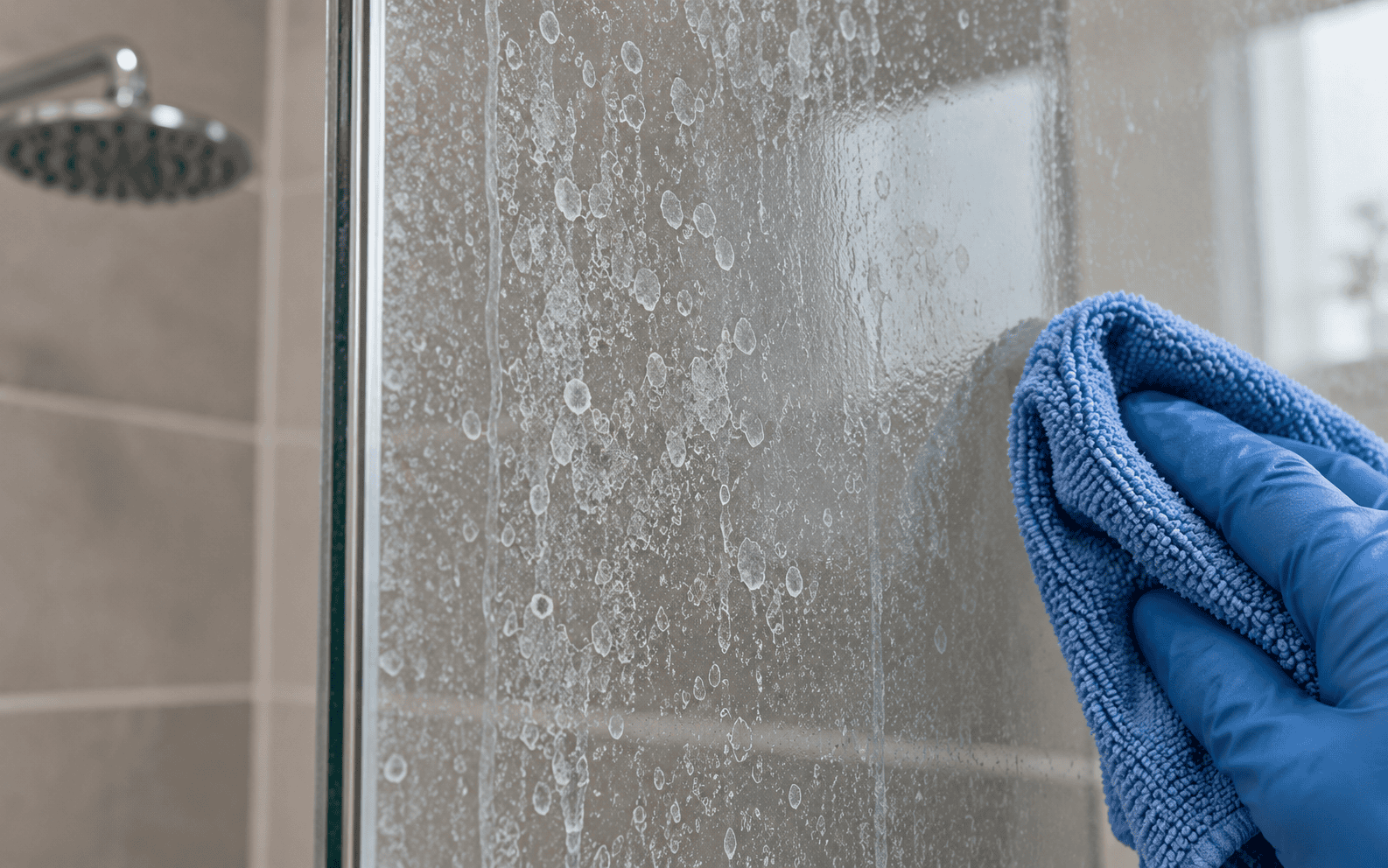
USGS classifies water above 180 mg/L as CaCO₃ as very hard, and identifies hard water as one of the most common causes of cloudy dishes and glassware.
Hard-water marks on glass are usually mineral deposits, not ordinary dirt. Calcium- and magnesium-rich water dries on the surface, the water evaporates, and a residue remains. Repeated wetting and drying turns isolated spots into a cloudy film that ordinary glass cleaner may barely move.
For facilities, the correct response is not simply to scrub harder. The first job is to decide whether the cloudiness is a removable surface deposit, soap-mineral film, or permanent damage to the glass itself.
Why hard water leaves white stains on glass
Water hardness is primarily the concentration of dissolved calcium and magnesium. USGS notes that one of the most common causes of cloudy dishes and glassware is hard water, and that minerals can dry onto glass to create a visible film.
In showers, wash areas, laboratories, commercial kitchens and other wet zones, the process repeats many times a day. Water droplets remain after use, evaporation concentrates the dissolved minerals, and the residue accumulates around the edges of each droplet. What begins as spotting becomes haze.
Hard-water film and etched glass are not the same thing
A useful cleaning test is whether the mark is on the glass or has become damage to the glass. Surface mineral deposits can often be chemically dissolved and rinsed away. Etching, abrasion or chemical attack changes the glass surface itself and may require restoration rather than cleaning.
USGS specifically describes overly hard, high-calcium water as capable of causing film on glassware and illustrates clouded glass as an effect of hard water. In institutional cleaning, that makes early maintenance important: a thin recurring film is easier to manage than a heavily weathered surface.
What chemistry removes hard-water stains from glass?
Many hard-water deposits contain calcium carbonate or related mineral salts. Mild acidic chemistry is commonly used because acid can dissolve carbonate scale and convert the solid deposit into species that can be rinsed away.
The practical cleaning product might be a formulated descaler, mineral-deposit remover or acid-based washroom cleaner that is explicitly compatible with glass and adjacent hardware. The acid type and concentration matter less to the operator than the finished product’s instructions, material compatibility and required dwell time.
Do not turn “acid removes scale” into “stronger acid is better”. Stronger or unsuitable chemistry can damage metal frames, sealants, stone surrounds, protective coatings and other materials around the glass.
How facilities should remove hard-water stains from glass
- Identify the glass system. Confirm whether the surface is plain glass, coated glass, laminated glass, a treated shower enclosure, a mirror or glazing with film.
- Remove loose soil first. Wash away dust, body oils and soap residue so the mineral cleaner reaches the deposit.
- Test a small area. Especially where the glass has an unknown coating or where metal and sealants are adjacent.
- Apply a compatible mineral remover. Use the labelled dilution rather than improvising a stronger solution.
- Allow controlled dwell time. Give the chemistry time to dissolve scale without allowing it to dry on the surface.
- Agitate gently. Use a non-scratch pad or microfiber cloth rather than aggressive abrasives.
- Rinse thoroughly. Remove dissolved minerals and residual cleaner.
- Dry or squeegee. Leaving rinse water to evaporate simply begins the deposition cycle again.
Why ordinary glass cleaner often does not work
Conventional glass cleaner is usually designed for fingerprints, light grease, atmospheric film and streak-free finishing. Mineral scale is chemically different. A product can leave the glass looking less greasy while the calcium-rich film remains almost unchanged.
This is why facilities often report that they “clean the glass every day” but still see permanent-looking haze. The daily chemistry is solving the wrong soil.
What about soap scum on shower glass?
Shower glass often carries two overlapping soils: mineral deposits from water and insoluble soap residues. USGS explains that soap reacts with calcium in hard water to form soap scum. Body oils and surfactant residues can make that deposit feel more waxy than chalky.
Where both soils are present, a single quick spray may not remove everything. A detergent step may be needed for oily or soap residue before the mineral-descaling step.
Can you use abrasive pads or blades?
Mechanical abrasion can speed removal, but it also creates risk. Abrasive powders, harsh scouring pads and poorly controlled scraping can scratch glass or damage coatings.
A professional SOP should specify the permitted pad grade and tool rather than leave the choice to each operator. If the deposit cannot be removed with compatible chemistry and approved light agitation, the next step should be surface assessment — not automatically more force.
How to tell if hard-water marks may be permanent
After the mineral deposit is removed and the glass is clean and dry, persistent cloudiness, roughness or a visible change in reflectivity may indicate etching, scratching or other surface damage. At that point the task has shifted from cleaning to restoration.
That distinction matters for procurement and labour. A chemical-cleaning team should not be expected to “clean away” a surface that has already been physically altered.
What about glass beside marble or natural stone?
This is one of the most important site-specific complications. An acid-compatible glass panel may sit directly beside marble, limestone or travertine. The Natural Stone Institute notes that calcareous stone is mainly calcium carbonate and is sensitive to acidic solutions.
A descaler that is appropriate on the glass can therefore etch the adjacent stone. Edge protection, controlled application and a stone-compatible cleaning method may be necessary.
Preventing hard-water stains on glass
Prevention is fundamentally an evaporation-control problem. If fewer mineral-rich droplets are allowed to dry on the glass, less deposit is left behind.
- Squeegee wet glass routinely. This physically removes mineral-rich water before evaporation.
- Dry high-visibility glass after final rinse. Especially in premium hospitality, healthcare or office environments.
- Use a periodic descaling schedule. Light deposits are easier to remove than thick accumulated scale.
- Monitor water hardness. Recurrent scale across a facility may justify water-treatment assessment.
- Control overspray. Irrigation, showerheads and leaking fittings can create repeated local deposition.
- Separate soil types in the SOP. Daily glass cleaner and periodic mineral remover perform different jobs.
When water treatment becomes a facility issue
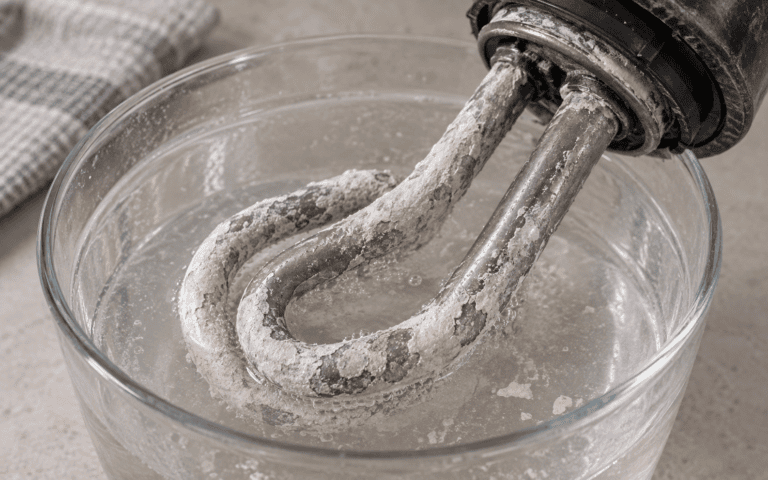
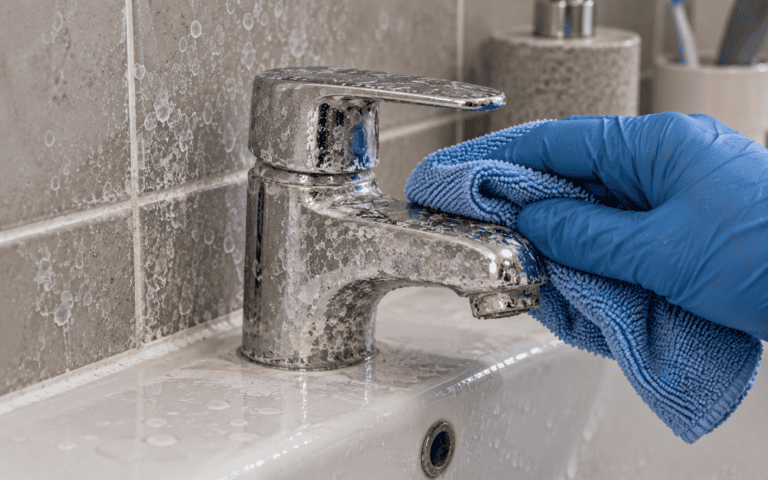
If hard-water spotting appears across many showers, taps, dishwashers, boilers or glass surfaces, the issue is larger than housekeeping. USGS notes that hard water can contribute to scale in plumbing and equipment and can reduce the performance of soaps and detergents.
At that point, facilities may need to compare the recurring cost of descaling and re-cleaning against water-softening or other water-treatment options. That is a maintenance decision, not just a cleaning-chemical decision.
Related: Limescale Removal: What It Is and How Descaling Works
The practical takeaway
Hard-water stains on glass are best treated as a mineral-deposit problem. The cleaning sequence should remove ordinary soil first, dissolve the mineral film with compatible chemistry, rinse it away and then prevent fresh droplets from drying on the surface.
The most important diagnostic question is simple: is the cloudiness a deposit that can be removed, or has the glass itself already been altered?
Frequently asked questions
What removes hard-water stains from glass?
Compatible acidic mineral-removal chemistry can dissolve many calcium-rich hard-water deposits. The glass and all adjacent materials should be checked for compatibility first.
Why does hard water make glass cloudy?
As hard-water droplets dry, dissolved minerals remain on the surface and can build into spots or a cloudy film.
Can hard-water stains permanently damage glass?
Persistent cloudiness after deposits are removed may indicate etching, scratching or other surface damage rather than removable mineral film.
How do facilities prevent water spots on glass?
Routine squeegeeing or drying reduces the amount of mineral-rich water that is allowed to evaporate on the glass.
Sources
U.S. Geological Survey — Hardness of Water.
U.S. Geological Survey — Hard water can etch and cloud glass.
U.S. Geological Survey — Hard water film on glass.
Natural Stone Institute — Care & Cleaning of Natural Stone.