Removing Hard-Water Deposits from Taps, Tiles and Bathroom Fixtures
A practical institutional guide to removing mineral scale from taps, tiles, showerheads and bathroom fixtures while protecting chrome, grout, natural stone, sealants and other sensitive materials.
Natural Stone Institute guidance notes that calcareous stones are composed mainly of calcium carbonate — the same broad mineral chemistry targeted by many acidic limescale removers — so acids can etch marble, limestone and related stone.
Bathroom scale looks like one problem, but it can sit across five or six different materials at once: chrome plating, stainless steel, ceramic glaze, cement grout, silicone sealant, glass and natural stone. The deposit may be similar; the safe cleaning chemistry is not.
That is why institutional washroom descaling should be written around substrates, not around a single instruction to “apply acid cleaner everywhere”.
What are hard-water deposits on bathroom fixtures?
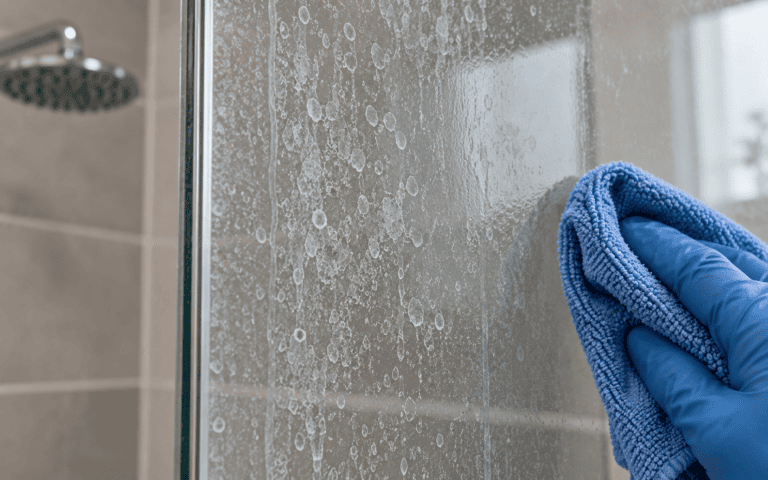
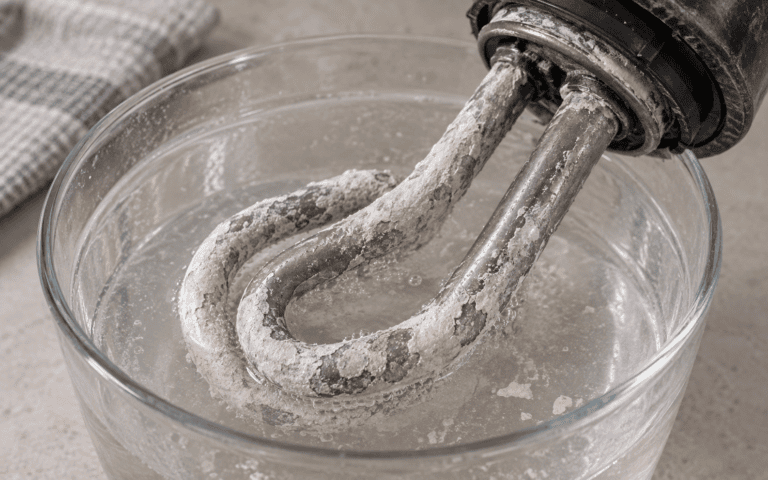
Hard-water deposits are mineral residues left by water containing dissolved calcium and magnesium. Around taps and showerheads they often accumulate as a white or grey crust. On tiles and glass they may appear as spots, rings or a dull haze.
USGS notes that hard water can cause mineral buildup in plumbing and fixtures and that heated hard water can form solid calcium-carbonate scale. The same water can also react with soap to form insoluble soap scum, so bathroom deposits often contain more than one soil type.
Why taps accumulate scale around the aerator and base
Taps are repeatedly wetted and then allowed to dry. Small leaks, splashing and water retained around joints keep supplying minerals to the same location. Aerators create additional wet surface area and can trap scale internally.
As deposits build, the problem can shift from appearance to function: aerator openings become partially blocked, spray patterns change and moving components become harder to service.
How to remove scale from chrome-plated taps
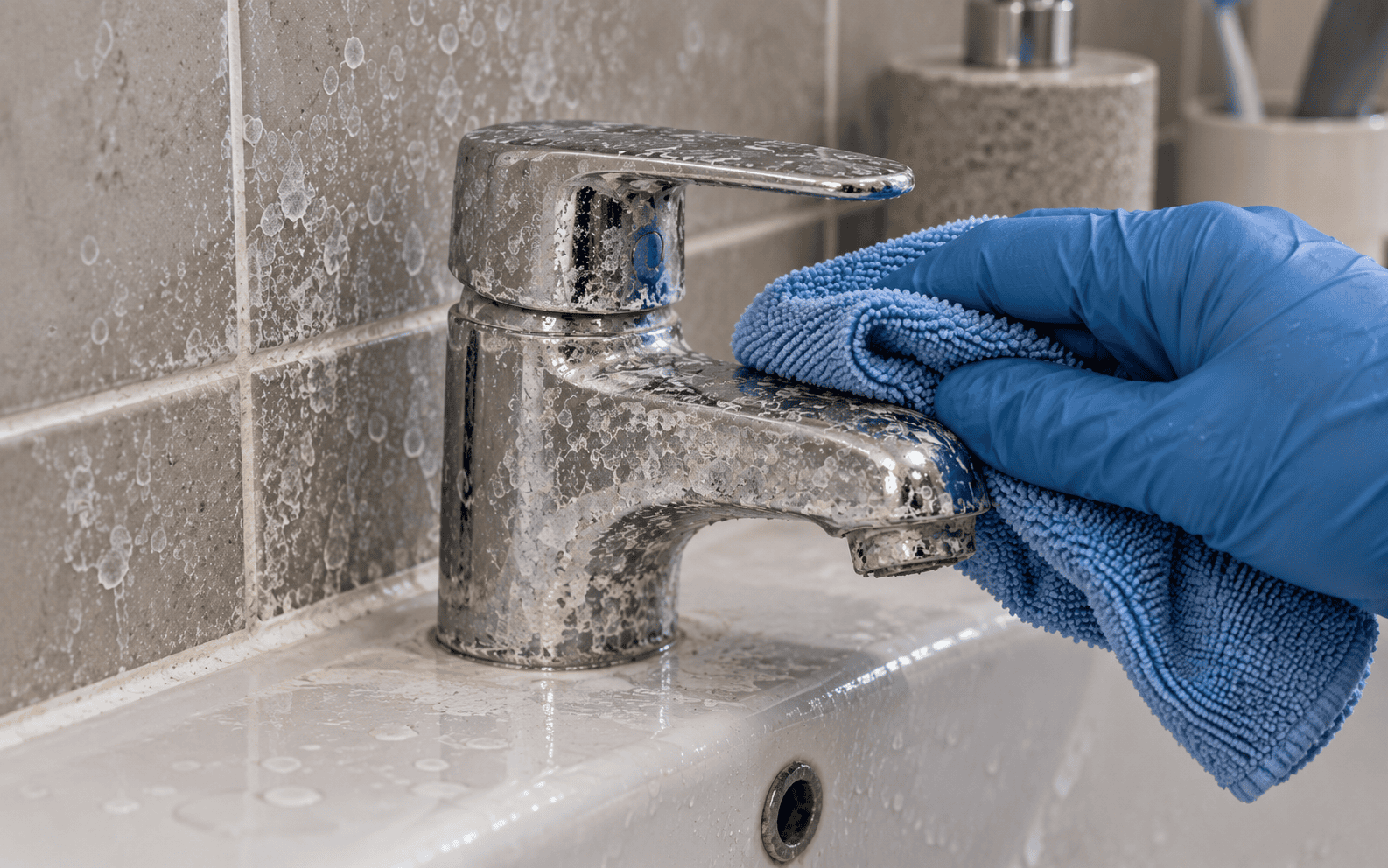
Chrome is a finish, not an unlimited chemical barrier. A controlled mineral remover may be suitable, but prolonged acid exposure or abrasive scrubbing can damage plating or the surface beneath it.
- Remove loose soil and soap residue with a compatible detergent.
- Apply a descaler that is approved for chrome or the specific fixture finish.
- Keep the dwell time short and controlled.
- Use a soft cloth or non-scratch pad around the base and joints.
- Rinse thoroughly with clean water.
- Dry the fixture to prevent immediate water spotting.
Where scale is concentrated on a removable aerator, it is often more controllable to remove the component and clean it separately according to the manufacturer’s instructions rather than flooding the whole fixture with descaler.
How to clean stainless-steel fixtures
Stainless steel generally tolerates a broader range of cleaning conditions than decorative plating, but it can still stain, pit or discolour under unsuitable chemistry. Chloride exposure, strong acids and prolonged contact are common concerns.
Use a stainless-compatible descaler, work with the grain where a brushed finish is present, rinse thoroughly and avoid leaving concentrated chemical trapped under fittings.
How to remove deposits from ceramic and porcelain tiles
Glazed ceramic surfaces are often more acid-resistant than natural stone, which is why acidic washroom cleaners are commonly used on compatible ceramic tile systems. The complication is the grout and surrounding construction.
Cement-based grout can be more acid-sensitive than the tile face. Strong or repeated acidic cleaning may roughen joints, change appearance or accelerate deterioration. The SOP therefore needs to consider the whole installation, not just the glazed tile.
Natural stone changes the entire cleaning decision
The Natural Stone Institute states that calcareous stone is composed mainly of calcium carbonate and is sensitive to acidic solutions. Marble, limestone and travertine therefore cannot be treated like ordinary acid-compatible tile.
This creates an important paradox: the same type of acid chemistry that dissolves calcium-carbonate limescale can also attack a calcium-carbonate stone surface.
Facility rule: if the washroom contains marble, limestone, travertine or an unidentified natural stone, do not assume the standard acidic washroom descaler is safe. Use a stone-compatible process or involve a stone-maintenance specialist.
What about granite?
Granite is generally siliceous rather than calcareous, but that does not make every acid safe on every granite installation. Natural Stone Institute guidance still recommends neutral cleaners for routine care and notes that trace minerals, sealers or treatments may be acid-sensitive.
For facilities, the safest policy is not “granite can take acid”; it is “use the approved chemistry for this exact stone and finish”.
Removing scale from showerheads
Scale often blocks showerhead outlets and changes spray direction. Removable components can sometimes be descaled separately, which gives better control over chemical contact and rinsing.
Before soaking any part, confirm the material and finish. Decorative coatings, rubber nozzles and plastic internals may have different compatibility limits from the visible metal body.
How soap scum changes the cleaning sequence
USGS explains that calcium in hard water reacts with soap to form soap scum. In a shower, that insoluble residue can combine with body oils and mineral scale.
If an acid descaler is applied directly over a greasy soap film, it may not reach the mineral deposit evenly. A detergent pre-clean can therefore improve the descaling step.
Bathroom deposit by surface: a quick guide
| Surface | Typical approach | Main risk |
|---|---|---|
| Chrome-plated tap | Short controlled contact with compatible descaler, soft agitation, rinse and dry | Plating damage from strong acid or abrasion |
| Stainless steel | Stainless-compatible mineral remover, controlled dwell, thorough rinse | Staining, pitting or trapped chemical |
| Glazed ceramic tile | Compatible acidic cleaner where permitted | Grout or adjacent material may be less acid-resistant |
| Glass | Mineral remover plus non-scratch agitation | Coatings, adjacent metal and stone |
| Marble / limestone / travertine | Stone-specific non-acid process or professional restoration | Acid etching |
| Silicone / sealants | Limit chemical contact; follow sealant compatibility guidance | Softening, discoloration or adhesion loss |
Why dwell time should be controlled
A mineral remover needs enough time to react with scale, but “more time” is not automatically “more cleaning”. Once the required chemical reaction has occurred, longer exposure mainly increases the opportunity for the cleaner to attack the underlying material.
Institutional SOPs should therefore specify a working dilution and a maximum dwell time rather than instructions such as “leave until the scale disappears”.
Never mix bathroom descaler with chlorine bleach
Many washrooms also use hypochlorite-based products for selected disinfection tasks. Acidic descaler and hypochlorite must never be combined. Acidification of hypochlorite can release chlorine gas.
Operationally, this means separate bottles, separate buckets, clear labelling and preferably separate steps in the cleaning sequence. Rinsing between incompatible chemistries is essential.
How to prevent deposits from returning
- Repair drips. A slowly leaking tap continuously feeds minerals to one spot.
- Dry high-visibility fixtures. Water that is physically removed cannot evaporate into a mineral ring.
- Clean aerators on a schedule. Do not wait for flow to become visibly restricted.
- Separate daily cleaning from periodic descaling. Neutral detergent and mineral remover have different jobs.
- Know the room finishes. Record which washrooms contain natural stone or special coatings.
- Measure recurring scale. If deposits return unusually quickly across the site, assess the water hardness and treatment strategy.
What an institutional washroom SOP should specify
A mature SOP should name the surface categories, product dilution, dwell time, permitted pad or cloth, rinse requirement, PPE and incompatible chemicals. It should also identify surfaces on which the standard descaler must not be used.
This reduces a common form of facility damage: a cleaner choosing a chemically effective product for the deposit but an incompatible product for the substrate.
Related: How to Remove Hard Water Stains from Glass
The practical takeaway
Hard-water deposits may look uniform, but bathroom fixtures are not. The safest removal method changes as soon as the substrate changes from chrome to tile, from tile to grout, or from ceramic to marble.
The facility rule is simple: identify the deposit, identify every material it touches, then choose the descaling chemistry.
Frequently asked questions
How do you remove hard-water deposits from taps?
Use a descaler that is compatible with the tap finish, keep contact time controlled, agitate gently, rinse thoroughly and dry the fixture.
Can acidic descaler be used on bathroom tiles?
It may be suitable for some glazed ceramic tiles, but grout, natural stone and adjacent materials can be acid-sensitive and must be checked separately.
Why should vinegar or acid not be used on marble?
Marble is a calcareous stone composed largely of calcium carbonate, which is sensitive to acidic solutions and can etch.
Why do showerheads clog in hard-water areas?
Repeated wetting and evaporation can deposit scale around small outlets and internal passages, progressively restricting or redirecting flow.
Can bathroom descaler be mixed with bleach?
No. Acidic descalers can react with hypochlorite bleach and release toxic chlorine gas.
Sources
U.S. Geological Survey — Hardness of Water.
U.S. Geological Survey — Hard water, soap scum and residue.
Natural Stone Institute — Care & Cleaning of Natural Stone.
Natural Stone Institute — Removing Stains from Stone Applications.