Description
Highlights—
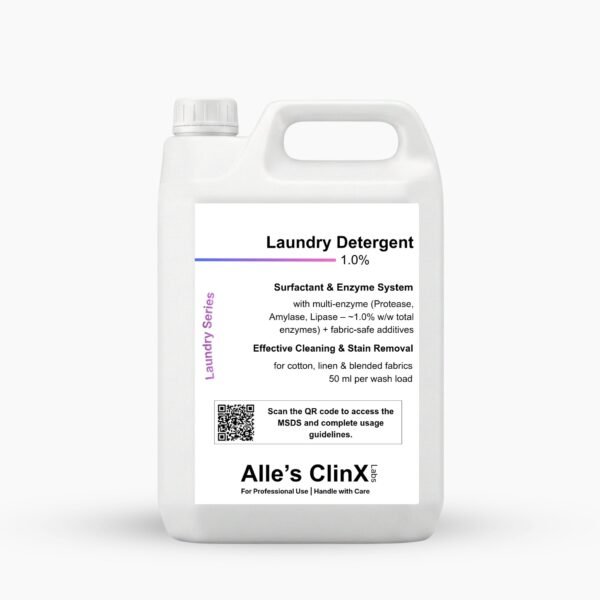
Enzyme-surfactant system. protease, lipase, and amylase activity targets protein, fat, and starch stains — the full soiling spectrum of healthcare linen, industrial uniforms, and educational facility textile loads.
Alkaline pH 9–11. optimises enzyme activity and enhances surfactant penetration simultaneously — the dual mechanism that delivers first-pass clean rates that reduce rewash frequency.
50 ml per load. precise, auditable dosing — eliminates the silent over-dosing that adds 30–50% to detergent cost in unmonitored institutional laundry operations.
Industrial machine compatible. front-load, top-load, and continuous batch washer deployment without foam management complications.
Hard water stable. maintains full enzyme and surfactant efficacy in facilities with water TDS above 500 ppm — the standard condition across most Indian institutional water supplies.
The chemistry—
How do laundry enzymes work, and why does alkaline pH enhance their performance? Laundry enzymes are biological catalysts — proteins that accelerate specific chemical reactions without being consumed in the process. Each enzyme class targets a specific molecular structure: protease enzymes cleave peptide bonds in protein molecules (blood, egg, dairy, body fluid residues), breaking complex protein structures into smaller, water-soluble peptides that can be rinsed from fabric.
Lipase enzymes target ester bonds in triglyceride fats, converting cooking oils and body fats into glycerol and fatty acids that are more easily solubilised. Amylase targets the glycosidic bonds in starch, breaking down food starch deposits that bind other soil types to fabric surfaces. Enzyme activity is pH-dependent: each enzyme class has an optimal pH range within which its three-dimensional active site is correctly configured for substrate binding and catalysis.
The protease and lipase enzymes used in laundry formulations are typically alkalophilic — their activity peaks in the pH 8–11 range, which is why institutional laundry detergents are formulated alkaline rather than neutral. At pH 9–11, these enzymes deliver 2–4x the catalytic activity they achieve at neutral pH, translating directly into faster stain breakdown and higher first-pass clean rates. Alkaline pH also provides a complementary cleaning mechanism through saponification: the alkaline environment converts surface fats and oils into water-soluble soap-like compounds independently of enzyme action. The combined enzyme and saponification mechanism is why alkaline enzyme detergents outperform neutral products on the mixed soiling loads characteristic of healthcare and industrial institutional laundry — the two mechanisms address different components of the soil matrix simultaneously.
Did you know—
The enzymes in institutional laundry detergent are biological catalysts that work at lower temperatures than purely chemical cleaners. Protease breaks down blood and food protein. Lipase converts cooking oils into water-soluble compounds. Your linen gets cleaner, your energy bill goes down — and the enzymes cost less per gram than the heat they replace.
Application & usage—
Dosing Add 50 ml to the detergent drawer or directly to the drum before loading.
Use measured dispensing equipment in high-volume operations to ensure consistent dosing.
Usage economy—
50 ml per load. One 5-litre pack. 100 complete wash cycles.
At 50 ml per load, a single 5L pack delivers 100 complete laundry treatments. For a hospital laundry running 30 loads daily, one pack covers approximately 3.5 days of continuous operation.
The first-pass clean rate improvement versus standard neutral detergents reduces rewash load — in operations tracking rewash rate, the reduction in water, energy, and labour cost per week will exceed the incremental detergent cost difference within the first month. For industrial uniform laundry services and educational institutional linen programmes, the 50 ml dosing specification provides the cost-per-load transparency required for service contract pricing and procurement budget management.
Product specifications—
Active system
Enzyme + surfactant blend (protease, lipase, amylase active)
pH
9.0–11.0 (alkaline)
Specific gravity
1.03–1.06 at 25°C
Formulation type
Aqueous concentrate
Appearance
Clear to slightly amber liquid
Fragrance
Fresh / neutral — institutional laundry appropriate
Dose per load
50 ml
Application
Detergent drawer or drum addition
Machine compatibility
Front-load, top-load, continuous batch washers
Wash temperature
40–90°C
Safe on
Cotton, poly-cotton, synthetics, institutional linen and uniforms
Avoid on
Wool, silk, cashmere — use Woollen Wash
PPE
None at working dose
Shelf life
18 months from date of manufacture, unopened
Pack size
5 Litres concentrate
MSDS / TDS
QR code on label · Available on request
Caution & storage—
- Contains enzymes — individuals with known enzyme sensitivity should wear gloves when handling concentrate.
- Avoid inhalation of concentrate aerosol during dispensing.
- In case of eye contact, rinse immediately with water.
- Keep out of reach of children.
- Store in original sealed container below 30°C, away from direct sunlight.
- Enzyme activity degrades above 40°C in storage — do not store near heat sources.
- Keep container tightly closed when not in use.
- Shelf life 18 months from manufacture date, unopened.
Resources & documentation—
Material Safety Data Sheets (MSDS) and Technical Data Sheets (TDS) are available on request and accessible via the QR code printed on the product label. These documents provide full hazard classification, first-aid procedures, disposal guidance, and technical performance data for compliance and audit purposes.
MSDS / TDS requests: care@allesclinx.com
Bulk & institutional supply enquiries: procurement@allesclinx.com