Description
Highlights—
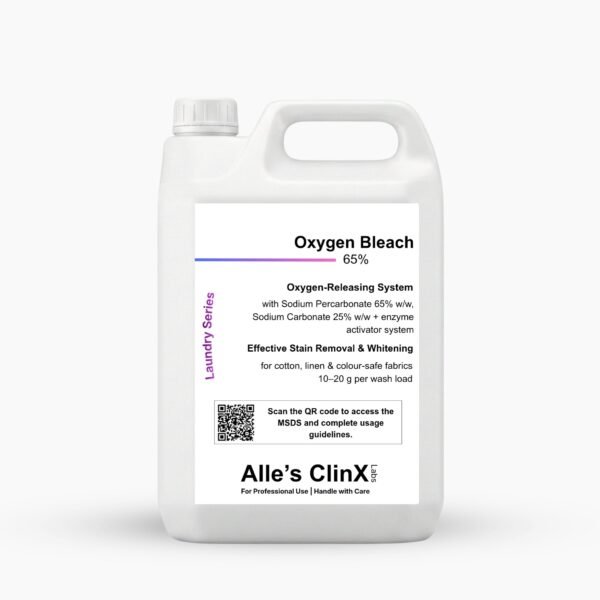
Active oxygen stain removal. sodium percarbonate releases hydrogen peroxide in water — breaks down protein, food, and organic stains through oxidation without the colour-destructive chemistry of chlorine bleach.
Colour-safe. non-chlorine formulation means no dye damage, no fabric degradation, and no colour stripping across mixed institutional linen loads containing coloured uniforms and patterned items.
pH 10–11 alkaline activation. optimises hydrogen peroxide release — effective stain treatment even in cold-water wash cycles without hot water activation.
10–20 gm per load. precise, low-dose stain treatment for institutional laundry cost control.
Pre-soak protocol. 30–60 minute warm-water pre-soak capability for heavily stained items — blood, food contamination, and organic residues characteristic of healthcare and industrial laundry.
The chemistry—
How does oxygen bleaching work, and why is it safe for colours when chlorine bleach is not? Sodium percarbonate (2Na₂CO₃·3H₂O₂) dissolves in water to release sodium carbonate and hydrogen peroxide. The hydrogen peroxide in alkaline solution decomposes to release hydroperoxyl anions (HOO⁻) — the active oxidising species responsible for stain breakdown.
These species react with the chromophore groups (the molecular structures responsible for colour) of organic stain molecules — blood haem groups, food pigments, wine tannins — converting them to colourless oxidation products. The stain’s colour is destroyed without removing the stain molecule from the fabric. Chlorine bleach operates through a fundamentally different mechanism: sodium hypochlorite releases hypochlorous acid (HOCl), which chlorinates organic molecules rather than oxidising them.
This halogenation reaction is far less selective than oxidation — it attacks the chromophore groups of textile dyes with comparable efficiency to those of stain molecules, causing colour fading and stripping. It also reacts with the protein components of natural fibres, progressively degrading the keratin in wool and the cellulose structure of cotton under repeated application. The colour-safety of oxygen bleach is therefore not a marketing claim but a consequence of the chemistry: the hydroperoxyl anion is a selective oxidant with insufficient reactivity to attack the sulphonate and azo dye structures used in modern textile dyeing, while being highly reactive with the simpler chromophore groups in food, blood, and organic stains. This selectivity makes oxygen bleach the appropriate stain treatment specification for mixed institutional linen loads containing coloured and patterned items.
Application & usage—
Standard. wash addition add 10–20 gm to the washing machine drum with linen before the main wash cycle. Alternatively, add to the detergent compartment.
Usage economy—
15 gm average dose.
One 5-litre pack. 330+ stain treatment cycles.
At 15 gm average dose per load, a single 5L (5,000 gm) pack delivers approximately 333 complete wash treatments. For a hospital laundry running 50 stain-treatment loads per week, one pack covers approximately 6–7 weeks of stain management protocol. The elimination of chlorine bleach from the laundry programme reduces chemical handling risk, removes colour damage liability from mixed linen loads, and simplifies the COSHH documentation for laundry chemical management.
Product specifications—
Active system
Sodium percarbonate — active oxygen release bleaching
Active release
Hydrogen peroxide (H₂O₂) in aqueous solution
pH
10.0–11.0 (alkaline activation)
Specific gravity
Powder — not applicable
Formulation type
Free-flowing powder concentrate
Appearance
White granular powder
Dose per load
10–20 gm
Effective temperature
30°C and above (increase dose for cold water)
Safe on
Coloured and white cotton, poly-cotton, synthetics, institutional linen
Avoid on
Silk, wool, cashmere, leather
PPE
Gloves recommended for powder handling
Shelf life
18 months from date of manufacture, in sealed container
Pack size
5 Litres (by volume) / 5 kg (by weight)
MSDS / TDS
Available on request
Caution & storage—
- Keep away from combustible materials, reducing agents, and acids — contact with incompatible materials can cause fire or release of oxygen.
- Avoid inhalation of powder dust during dispensing — use in ventilated areas.
- In case of eye contact, rinse immediately with water for 15 minutes.
- Keep out of reach of children.
- Store in original sealed container in a cool, dry location below 30°C, away from moisture, heat sources, and incompatible chemicals.
- Exposure to moisture in storage causes premature oxygen release and product degradation — keep container tightly sealed.
- Do not store in metal containers.
- Shelf life 18 months from manufacture date, in sealed storage.
Resources & documentation—
Material Safety Data Sheets (MSDS) and Technical Data Sheets (TDS) are available on request and accessible via the QR code printed on the product label. These documents provide full hazard classification, first-aid procedures, disposal guidance, and technical performance data for compliance and audit purposes.
MSDS / TDS requests: care@allesclinx.com
Bulk & institutional supply enquiries: procurement@allesclinx.com