Description
Highlights—
Odour-neutralising chemistry. active neutralising agents react with and reduce malodour compounds at the molecular level — not a fragrance layer applied over an existing smell, but a chemical reduction of the odour source.
Non-alcoholic carrier system. safe for routine use in occupied spaces including healthcare wards, classrooms, and food-handling areas — no flammability risk, no alcohol-related surface compatibility concerns.
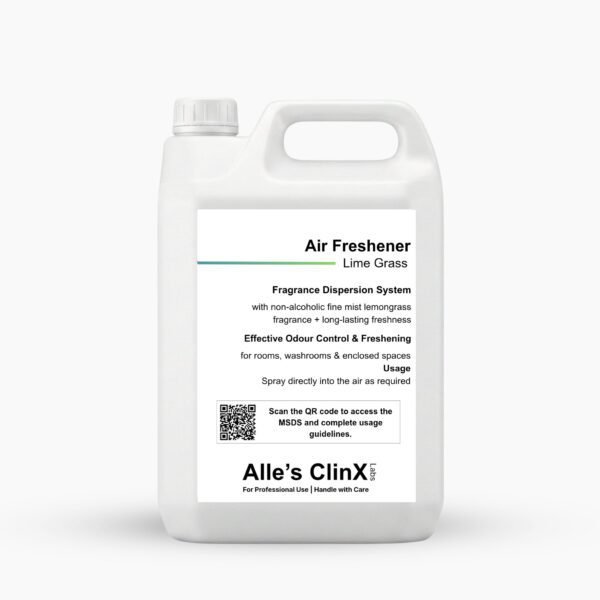
Lemongrass fragrance. clean, natural scent profile associated with freshness and hygiene — performs well in institutional perception environments where synthetic or heavy fragrances create occupant complaints.
Ready-to-use format. no dilution, no preparation — direct spray application by housekeeping staff with no training requirement and no dosing error risk.
Enclosed-space rated. formulated for use in occupied rooms, corridors, washrooms, and common areas without requiring ventilation clearance prior to re-entry.
The chemistry—
Why do conventional air fresheners fail in institutional environments, and how does odour-neutralisation solve the problem? Conventional consumer air fresheners function by fragrance dominance: a high-concentration scent compound is delivered into the air in sufficient quantity to override the perception of a malodour. The malodour compound remains present in the air. At the moment the fragrance concentration drops — through ventilation, diffusion, or time — the original odour reasserts.
In institutional environments with continuous occupancy and persistent odour sources, this mechanism produces the characteristic cycle of brief freshness followed by reassertion of the underlying smell. Occupants learn to associate the freshening product itself with the underlying problem. Odour-neutralising chemistry operates on a different mechanism. Active neutralising agents — typically aldehyde-reactive compounds, zinc ricinoleate complexes, or cyclodextrin encapsulants depending on the formulation — interact directly with the molecular structure of the malodour compound.
Aldehyde and amine-based odour molecules, which account for the majority of human-perceived malodours in institutional environments, are either chemically modified to reduce their vapour pressure or encapsulated to prevent volatilisation. The odour source is reduced, not overlaid. The fragrance component then functions at a lower concentration on genuinely cleaner air, producing a more credible clean air perception. The non-alcoholic carrier delivers the active chemistry into the air in fine droplet form without the rapid evaporation of alcohol-based systems, which can cause uneven distribution and hot-spot deposition. The result is more even odour control across the treated space.
Did you know—
Human olfactory perception evaluates a space in under 400 milliseconds — faster than any visual assessment. In studies of patient satisfaction in healthcare facilities, air quality consistently ranks among the top three factors affecting perceived cleanliness — ahead of floor condition and surface appearance. Most institutional air fresheners are masking products. Neutralising products operate on a different chemical mechanism entirely. The difference is not subjective — it is measurable in malodour compound concentration after treatment.
Application & usage—
Preparation. Ready to use. No dilution required. Shake gently before use if the product has been in storage.
Usage economy—
2–3 bursts per room. One 500 ml bottle. 150+ applications per pack.
At 2–3 bursts per application, a single 500 ml bottle delivers over 150 room treatments under standard use conditions. For a mid-size institutional facility with 20 rooms on a twice-daily housekeeping schedule, one bottle covers approximately 3–4 days of routine air-care operations.
The non-alcoholic formulation produces no additional waste stream or flammable-storage compliance cost versus alcohol-based alternatives — a meaningful operational consideration at institutional procurement volume. Per-treatment cost at standard institutional pricing is lower than most comparable ready-to-use institutional air freshener formats in the Delhi NCR market.
Product specifications—
Active system
Odour-neutralising agent + fragrance blend — non-alcoholic aqueous system
pH
6.0–7.0 (near-neutral)
Specific gravity
0.99–1.01 at 25°C
Formulation type
Ready-to-use aqueous spray
Appearance
Clear to slightly hazy liquid
Fragrance
Lemongrass — natural scent profile
Dilution
Ready to use — no dilution required
Application
Trigger spray — into air from standing height
Safe in
Occupied rooms, corridors, washrooms, common areas, food-handling environments (indirect air use)
Avoid
Direct spray onto food contact surfaces, open food, electronic equipment, and polished wood finishes
Rinse after use
Not applicable
PPE
None required under normal use conditions
Shelf life
24 months from date of manufacture, unopened
Pack size
500 ml ready-to-use trigger spray
MSDS / TDS
QR code on label · Available on request
Caution & storage—
- Do not spray directly onto skin, into eyes, or at the face at close range.
- Avoid prolonged inhalation of concentrated mist in fully enclosed spaces with no air movement — ventilate if applying in high frequency to a small enclosed area.
- In case of eye contact, rinse immediately with clean water.
- Keep out of reach of children.
- Store in original sealed container below 30°C, away from direct sunlight and heat sources.
- Do not puncture or incinerate container.
- Keep the trigger mechanism locked when not in use to prevent accidental discharge during storage or transport.
- Shelf life 24 months from manufacture date, unopened.
Resources & documentation—
Material Safety Data Sheets (MSDS) and Technical Data Sheets (TDS) are available on request and accessible via the QR code printed on the product label. These documents provide full hazard classification, first-aid procedures, disposal guidance, and technical performance data for compliance and audit purposes.
MSDS / TDS requests: care@allesclinx.com
Bulk & institutional supply enquiries: procurement@allesclinx.com