Institutional Cleaning Chemicals: Types, Names and Where They Are Used
A facility-focused guide to the main types of institutional cleaning chemicals, the names used for them, what each chemistry does, and where hospitals, factories, campuses and commercial buildings use them.
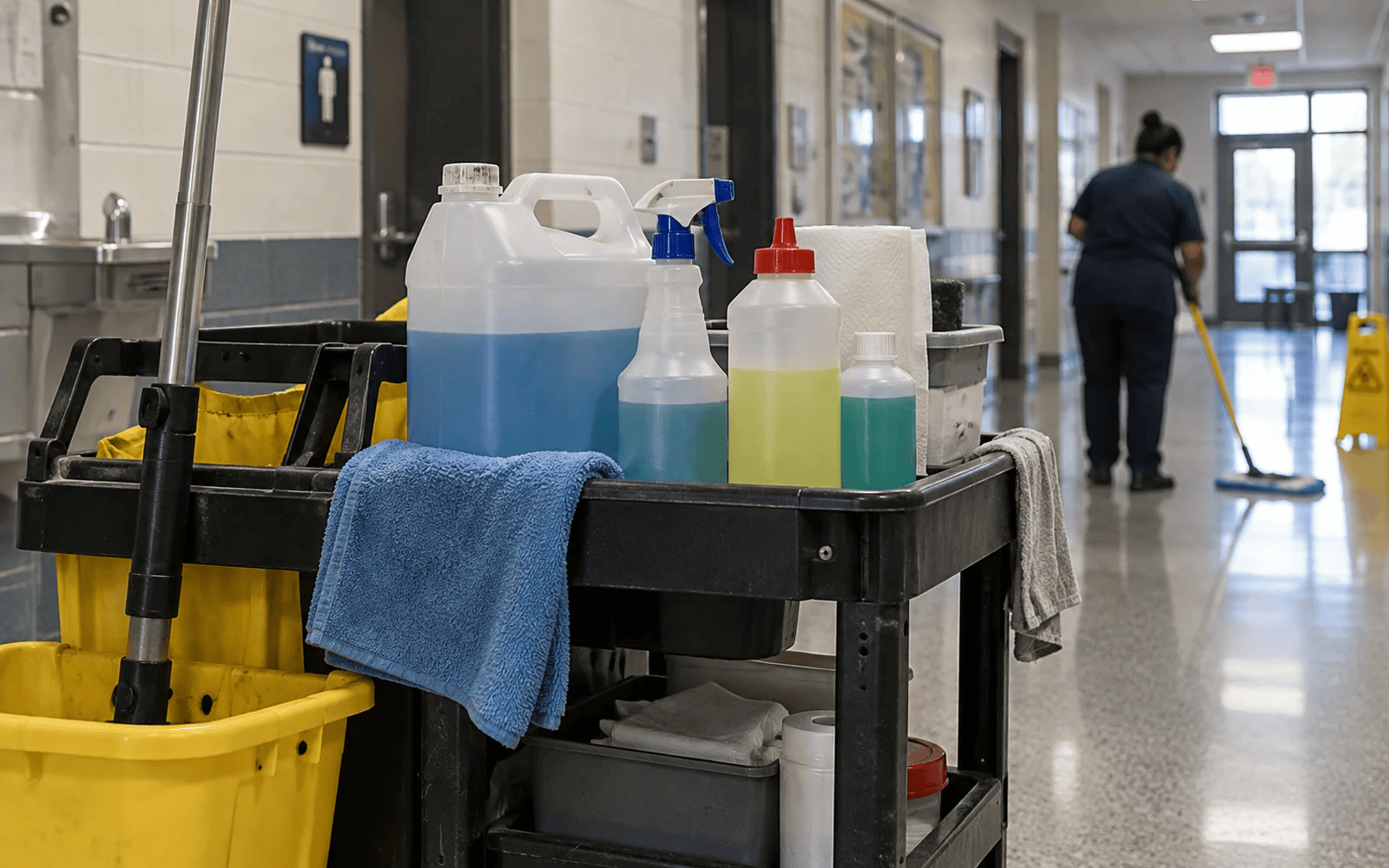
WHO and UNICEF reported in 2026 that fewer than six in ten health-care facilities worldwide met the basic service level for environmental cleaning.
Institutional cleaning is not one chemical and it is not one job. A facility may need a neutral detergent for daily floors, an alkaline degreaser for oily production soil, an acidic descaler for mineral deposits and a disinfectant for selected high-risk surfaces — sometimes all in the same building.
The most reliable way to understand institutional cleaning chemicals is therefore by function: what soil they remove, what surface they are used on and whether the task is cleaning, sanitising, disinfecting or specialised maintenance.
What are institutional cleaning chemicals?
Institutional cleaning chemicals are products formulated for professional cleaning and hygiene operations in places such as hospitals, factories, schools, universities, hotels, kitchens, warehouses, offices and public facilities.
They differ from a simple consumer “all-purpose cleaner” because facilities often need controlled dilution, documented procedures, larger pack sizes, safety data, material compatibility and repeatable performance across many rooms, shifts or sites.
The main types of institutional cleaning chemicals
| Type | Main job | Typical use areas |
|---|---|---|
| Neutral detergent | Routine removal of light soil with low material aggressiveness | Floors, walls, desks, general hard surfaces |
| Alkaline cleaner / degreaser | Break down fats, oils and heavy organic soils | Kitchens, workshops, production areas, exhaust surfaces |
| Acidic cleaner / descaler | Dissolve mineral scale and certain inorganic deposits | Washrooms, fixtures, tiles, equipment where the substrate is acid-compatible |
| Disinfectant | Kill or inactivate microorganisms according to a validated claim | High-touch surfaces, selected healthcare and hygiene-critical areas |
| Glass cleaner | Remove fingerprints, light oils and film with low residue | Glass partitions, mirrors, windows |
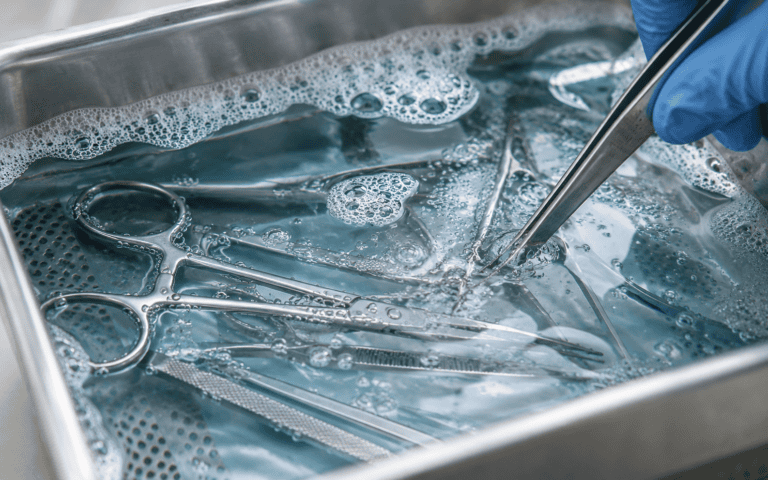
| Enzymatic cleaner | Break down protein, fat or carbohydrate soils using enzymes | Medical-instrument pre-cleaning and other specialised soil-removal tasks |
| Floor-care chemical | Clean, strip, maintain or protect resilient floor finishes | Large corridors, lobbies, institutional floor systems |
Neutral detergents: the routine-cleaning workhorse
A neutral detergent is usually the default chemistry for routine cleaning where the main requirement is soil removal without unnecessary chemical aggression. WHO guidance for healthcare environmental cleaning specifically notes that detergents are suitable for routine cleaning and that many healthcare detergents are pH-neutral and designed for compatibility with facility surfaces.
Typical uses include damp mopping, wall cleaning, furniture cleaning and general surface maintenance. A neutral detergent is not automatically a disinfectant, and that distinction matters.
Alkaline cleaners and degreasers
Alkaline chemistry is commonly selected when the soil is oily, fatty or otherwise difficult for a neutral cleaner to remove. Commercial kitchens, food-production areas, machine shops and industrial maintenance zones often generate this kind of soil.
The stronger the alkalinity, however, the more important material compatibility becomes. Painted finishes, aluminium, certain polymers and sensitive coatings may not tolerate the same chemistry that works well on a robust industrial floor.
Acidic cleaners and descalers
Acid cleaners are used where the contamination is primarily mineral rather than oily — for example limescale, hard-water deposits and some inorganic films. See also our guide to hard-water stains and mineral deposits.
The chemistry that dissolves calcium carbonate can also attack calcium-carbonate-based stone. That is why acidic washroom cleaner should never be treated as a universal cleaner for marble, limestone or travertine.
Disinfectants: QACs, chlorine, alcohol and oxidising systems
Disinfectants are selected for microbial control, not merely visible cleanliness. CDC lists several disinfectant classes used in healthcare, including quaternary ammonium compounds, chlorine-releasing agents, alcohols, hydrogen peroxide and peracetic acid.
Those actives are not interchangeable. Each finished product has its own surface compatibility, target organisms, dilution and contact time. CDC also states that disinfectants are not substitutes for cleaning unless the product is specifically formulated as a combined detergent-disinfectant.
Quaternary ammonium compounds
QACs are widely used as low-level environmental disinfectants. They are common on noncritical hard surfaces, but product claims and limitations must be checked carefully. For a deeper chemistry reference, see our guide to benzalkonium chloride (BKC).
Chlorine-releasing disinfectants
Sodium hypochlorite and other chlorine-releasing systems are useful where chlorine chemistry is appropriate. They can be fast acting and broad in antimicrobial activity, but higher concentrations may be corrosive to metals and chlorine can be inactivated by organic matter.
Alcohol-based products
Ethanol and isopropyl alcohol are useful for selected small surfaces and equipment when compatible with the material and product instructions. Their rapid evaporation can make them less suitable for large-area routine cleaning.
Hydrogen peroxide and peracetic acid
Oxidising disinfectants are used in various environmental and equipment applications, but concentration and use case matter significantly. A facility should distinguish between environmental-surface products and high-level disinfection or sterilant chemistries intended for medical devices.
Important distinction: CDC advises against using high-level disinfectants or liquid chemical sterilants for ordinary environmental surfaces. “Stronger” is not automatically more appropriate.
Glass cleaners
Glass cleaners are designed to remove fingerprints, light oils and atmospheric film without leaving the residue that a general-purpose detergent can leave on transparent surfaces.
In a facility, this chemistry is typically used on mirrors, partitions, display glass and windows. It should not be assumed suitable for coated screens, specialised glazing or every polymer surface.
Enzymatic cleaners
Enzymatic cleaners use enzymes to help break down specific classes of organic soil. Protease, lipase and amylase systems may target proteins, fats and starches respectively.
They are especially important in medical-device cleaning because thorough soil removal is required before high-level disinfection or sterilisation. CDC notes that retained organic and inorganic material can interfere with those later processes.
Why facilities should separate cleaning from disinfection
One of the most common procurement mistakes is asking one chemical to perform every task. Routine soil removal and microbial disinfection are different outcomes.
CDC’s environmental-cleaning guidance says disinfectants should be used after cleaning and are not a replacement for cleaning unless a combined detergent-disinfectant product is specifically being used. This is a useful purchasing principle far beyond hospitals.
How to choose the right chemical for a facility
- Identify the soil. Oil, protein, mineral scale, dust and microbial contamination require different chemistry.
- Identify the surface. Stainless steel, marble, epoxy, glass, aluminium and coated flooring do not have the same chemical tolerance.
- Define the outcome. Is the task routine cleaning, sanitising, disinfection, descaling or specialised restoration?
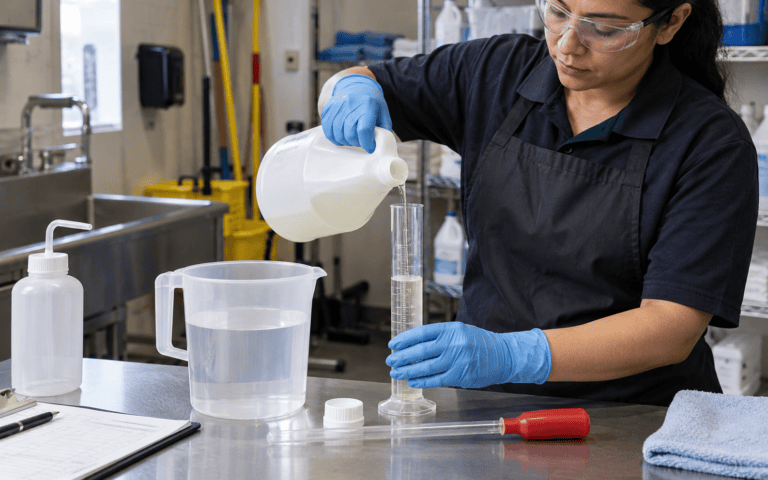
- Check dilution and contact time. Concentrates need controlled working solutions; disinfectants may require a specified wet dwell time.
- Review SDS and compatibility. Worker safety and material protection are part of product selection, not an afterthought.
- Standardise the SOP. A correct product used inconsistently is still an inconsistent cleaning system.
Why chemical names alone are not enough
Terms such as “phenyl”, “floor cleaner”, “toilet cleaner”, “sanitiser” and “disinfectant” are often used loosely in procurement. They tell you less than a specification that identifies active chemistry, pH, dilution, surface compatibility and intended performance.
Institutional buyers should therefore move from product-name procurement to function-and-specification procurement. The result is usually a smaller, clearer chemical set with fewer overlaps and easier staff training.
The practical takeaway
A mature institutional cleaning programme does not need the maximum number of chemicals. It needs the right chemistry for each soil and surface, with enough documentation to make the result repeatable.
The core system is simple: detergent for soil, specialised chemistry for specialised deposits, and disinfectant only where microbial control is actually required.
Frequently asked questions
What are the main types of institutional cleaning chemicals?
Common categories include neutral detergents, alkaline degreasers, acidic descalers, disinfectants, glass cleaners, enzymatic cleaners and floor-care chemicals.
Is a disinfectant also a cleaner?
Not necessarily. CDC states that disinfectants are not substitutes for cleaning unless the product is formulated as a combined detergent-disinfectant.
Which chemicals are used for hospital surface disinfection?
Depending on the product and use case, common classes include quaternary ammonium compounds, chlorine-releasing agents, alcohols, hydrogen peroxide and other approved disinfectant systems.
How should facilities choose cleaning chemicals?
Selection should be based on the soil, surface, required hygiene outcome, dilution, contact time, compatibility and worker-safety requirements.
Sources
WHO & UNICEF — Progress on WASH, environmental cleaning and waste management in health-care facilities, 2015–2025.
WHO — Environmental cleaning and infection prevention and control in health care facilities.
CDC — Cleaning Supplies and Equipment.
CDC — Disinfection methods.