Cleaning Chemical Compatibility: How to Prevent Surface and Material Damage
A practical guide to cleaning-chemical compatibility: how pH, oxidizers, solvents, disinfectants and application materials interact with stone, metals, plastics, coatings and staff safety.
WHO reports that cleaning agents and disinfectants have been associated with a 67% increased risk of new-onset asthma in nurses in cited evidence, making chemical selection an occupational-health issue as well as a surface-care issue.
A cleaning chemical can be effective against the soil and still be wrong for the surface. That is the core compatibility problem in institutional cleaning: performance has to be judged against both what the product removes and what it touches.
Compatibility is therefore not a minor technical note in the SDS. It is part of the cleaning specification. Floors, natural stone, metals, coatings, plastics, sealants, textiles and medical equipment all respond differently to acids, alkalis, oxidizers, solvents and disinfectants.
What does cleaning-chemical compatibility mean?
Chemical compatibility is the ability of a material, surface or application system to tolerate a cleaning chemical under the intended concentration, temperature, contact time and frequency of use.
A product can be compatible during a one-minute wipe but damaging when left wet for twenty minutes. It may be safe at 1:100 dilution but aggressive at 1:10. Compatibility is therefore a set of operating conditions, not a yes-or-no property.
Why pH matters
pH is one of the quickest indicators of how chemically aggressive a cleaner may be toward certain materials, although it is not the only factor.
Acidic cleaners are useful for mineral scale but can attack calcareous stone and some metals. Strong alkaline cleaners can remove heavy grease but may damage aluminium, certain coatings or sensitive finishes. Neutral products are generally preferred for broad routine cleaning because they reduce unnecessary material stress.
WHO regional IPC guidance says the majority of routine cleaning should be done with clean water and a neutral healthcare-grade detergent, and specifically states that detergents should be compatible with the material being cleaned.
Acid cleaners and natural stone
Marble, limestone and travertine are particularly important compatibility examples because they contain calcium carbonate. The Natural Stone Institute states that calcareous stone is sensitive to acidic solutions.
That means vinegar, acidic washroom cleaner and limescale remover can chemically etch the stone. Once etched, the dullness is surface damage rather than removable residue.
Chlorine disinfectants and metals
CDC lists corrosion of metals as one of the disadvantages of hypochlorite disinfectants, especially at higher concentrations. Repeated chlorine exposure can affect metal fixtures, equipment components and finishes.
For a facility, the answer is not necessarily to avoid chlorine entirely. It is to define where chlorine is necessary, use the specified concentration and contact time, and follow rinsing or post-treatment instructions where applicable.
Never mix bleach with acids or ammonia
This is compatibility in its most serious form: chemical-to-chemical incompatibility. WHO and CDC warn against mixing disinfectants such as bleach and ammonia, and CDC notes that hypochlorite mixed with acid can release toxic chlorine gas.
A site should therefore treat cleaning chemicals like controlled chemicals, not interchangeable liquids. Dedicated bottles, clear labels, segregation and staff training prevent accidental mixing.
Facility rule: never create a “stronger cleaner” by combining products. Mixtures can neutralise active ingredients, damage surfaces or release dangerous gases.
Quaternary ammonium compounds and application materials
Compatibility is not limited to the surface being cleaned. CDC notes that cotton and gauze can absorb quaternary ammonium active ingredients. A cloth can therefore alter the disinfectant dose delivered to the surface.
Hard water can also reduce the microbicidal activity of some QACs. The same chemical used with a different mop, cloth or dilution water can perform differently.
Alcohol and plastics
Alcohol-based products are widely used on small hard surfaces and some equipment, but not every plastic, screen, coating or adhesive tolerates repeated alcohol exposure. Stress cracking, clouding, softening or coating damage can occur in susceptible materials.
For electronics and medical devices, follow the device manufacturer’s compatibility instructions rather than assuming that a disinfectant suitable for stainless steel is automatically suitable for polycarbonate, acrylic or touch-screen coatings.
Oxidizers and coloured or coated surfaces
Oxidizing disinfectants such as chlorine and peroxide systems can change dyes, organic coatings and some finishes. The risk depends on concentration and contact time.
This is why an inconspicuous-area test is valuable when a chemical is introduced onto an unfamiliar finish, especially for furniture, painted surfaces, upholstery, decorative metals and architectural coatings.
Contact time is also a compatibility variable
Contact time is usually discussed as an efficacy requirement, but it is also a material-exposure variable. A product may need to remain visibly wet long enough to meet its disinfectant claim, which means the surface must tolerate that entire wet period.
Where the device or surface manufacturer cannot tolerate the required wet time, the disinfectant and the surface are operationally incompatible even if a quick wipe causes no visible damage.
Dilution errors cause both performance and damage problems
Over-concentrating a product can increase corrosion, residue, odour, worker exposure and surface attack. Under-concentrating can reduce cleaning or disinfection performance.
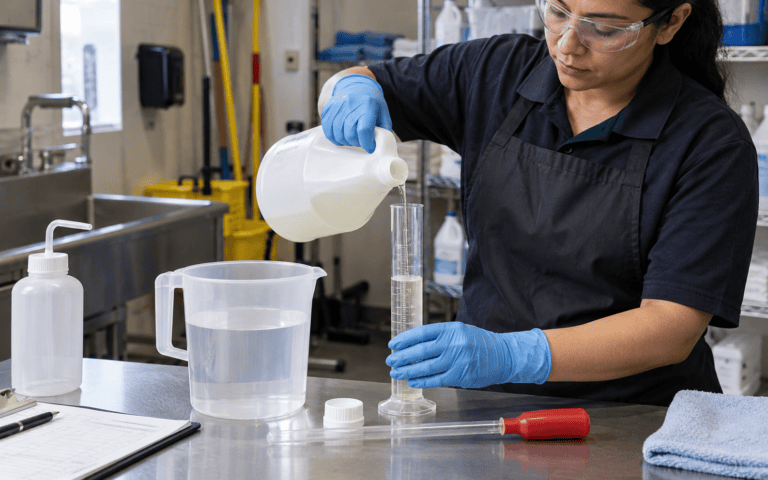
Compatibility therefore begins at the dilution station. Calibrated dosing, correctly labelled bottles and written dilution instructions are material-protection controls as much as they are quality controls.
Compatibility matrix for common facility materials
| Material / surface | Common compatibility concern | Better control |
|---|---|---|
| Marble / limestone | Acid etching | Neutral stone-approved chemistry |
| Chrome / decorative metal | Acid attack, abrasion, oxidizer damage | Short controlled contact and approved product |
| Stainless steel | Chloride exposure, staining, pitting under unsuitable conditions | Material-compatible disinfectant, controlled dwell and rinse where specified |
| Aluminium | Attack by strong alkali or some acidic systems | Manufacturer-approved mild chemistry |
| Polycarbonate / acrylic | Stress cracking or clouding from incompatible solvents/disinfectants | Device/surface-manufacturer approved product |
| Painted / coated surfaces | Colour change, softening, loss of gloss | Spot test and controlled concentration |
| Rubber / seals | Swelling, hardening or loss of elasticity | Check elastomer compatibility and exposure time |
Why worker health belongs in compatibility decisions
The “material” being exposed is not only the floor or equipment. Workers breathe vapours, handle concentrates and may have repeated skin exposure.
WHO’s occupational-hazard guidance reports that cleaning agents and disinfectants have been associated with a 67% increased risk of new-onset asthma in nurses, and that bleach and glutaraldehyde have been associated with roughly double the risk of asthma in nurses in the cited evidence.
That is a strong reason to eliminate unnecessary chemical steps, use the least hazardous effective product, ventilate appropriately and control dilution rather than routinely choosing the most aggressive chemistry available.
How to test a new cleaning chemical before rollout
- Identify every material in the area. Include sealants, grout, coatings and hardware, not just the main floor or wall.
- Read the surface and equipment manufacturer guidance. Device instructions override assumptions based on appearance.
- Review the chemical TDS and SDS. Look for incompatible materials, pH, oxidizing properties and PPE requirements.
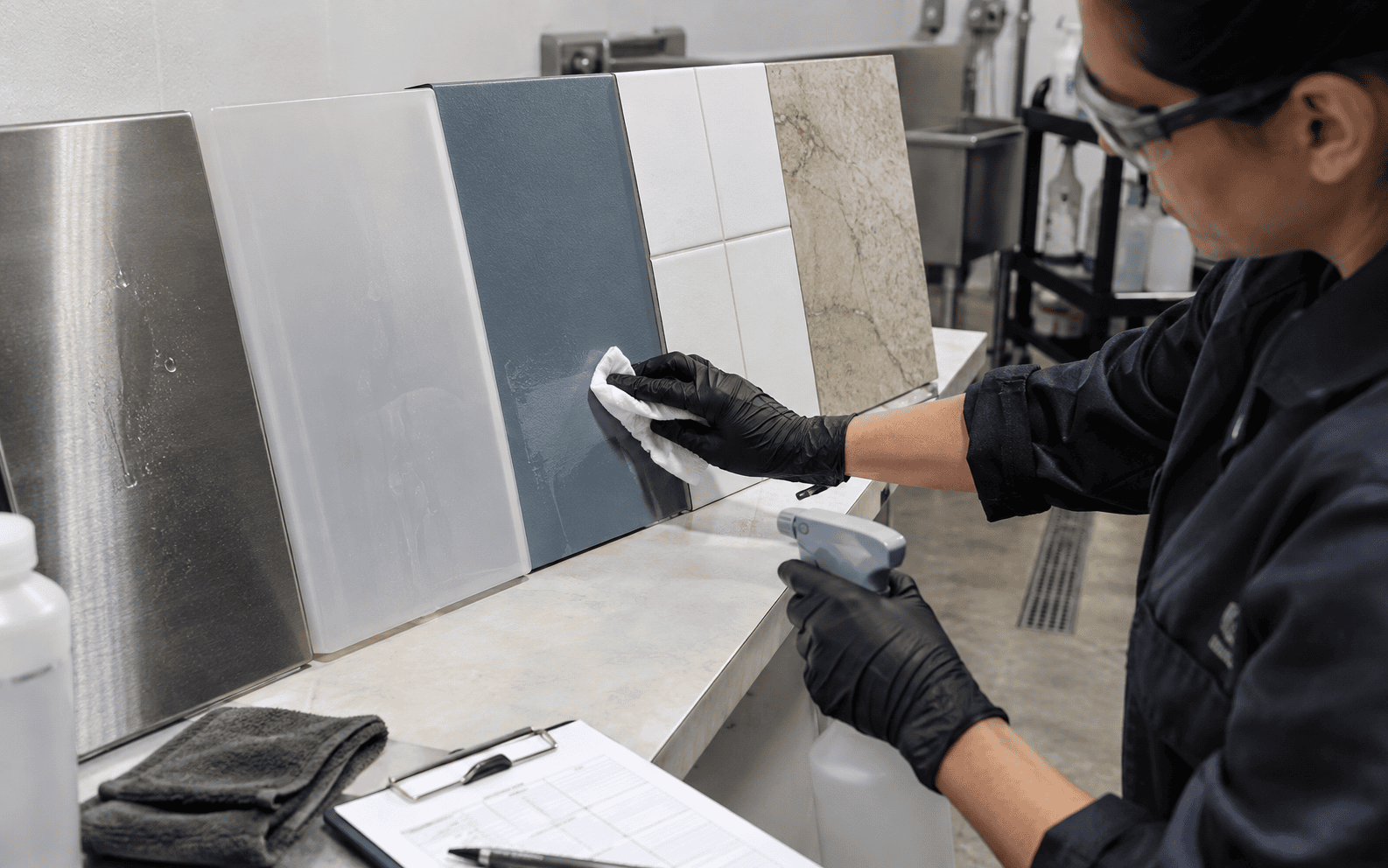
- Test an inconspicuous area. Use the actual dilution and full intended contact time.
- Inspect after drying. Look for colour change, loss of gloss, softening, tackiness, haze or corrosion.
- Repeat if the product will be used frequently. Some damage is cumulative rather than immediate.
- Document the approved use. Record the surface, dilution, method and prohibited applications in the SOP.
Why “safe on surfaces” is too vague
No facility contains one generic material called “surface”. A washroom can combine ceramic glaze, cement grout, chrome, stainless steel, silicone, plastic, glass and natural stone in less than a square metre.
A mature compatibility statement therefore names the material and the conditions: compatible with glazed ceramic at 1:50 dilution for five minutes is far more useful than safe on most surfaces.
How procurement can reduce compatibility failures
- Ask suppliers for a material-compatibility list or test data.
- Prefer fewer well-specified products over many overlapping chemicals.
- Standardise dilution and bottles across sites.
- Require SDS and TDS before approval.
- Keep incompatible chemistries segregated.
- Train staff on where a product must not be used.
- Create a surface register for high-value finishes and equipment.
Related: How to Clean Marble, Granite and Natural Stone Without Damaging It
The practical takeaway
Cleaning compatibility is a systems problem. The correct product is the one that removes the soil or delivers the disinfectant claim without degrading the material, application system or worker environment under the actual conditions of use.
Facilities prevent damage by controlling five variables: chemistry, concentration, contact time, material and frequency. Ignore any one of them and a technically effective cleaner can become an expensive maintenance problem.
Frequently asked questions
What does cleaning chemical compatibility mean?
It means a material or surface can tolerate the chemical at the intended concentration, contact time, temperature and frequency without unacceptable damage.
Why can acid cleaners damage marble?
Marble is largely calcium carbonate, which reacts with acids and can etch.
Can bleach be mixed with other cleaning chemicals?
No. In particular, bleach should not be mixed with acids or ammonia because dangerous gases can be released.
Can disinfectant cloth type affect performance?
Yes. CDC notes that cotton and gauze can absorb quaternary ammonium active ingredients.
Why should a facility test a new cleaning chemical?
Compatibility damage can depend on concentration, dwell time, coating, material and repeated exposure, so an inconspicuous test under real use conditions helps prevent costly damage.
Sources
WHO Regional Office for Africa — IPC Guidelines: Chemicals used in cleaning.
WHO — Exposure to hazardous chemicals in the health sector.
WHO — Cleaning and disinfecting surfaces: chemical selection and mixing precautions.
CDC — Chemical Disinfectants.
CDC — Factors Affecting Disinfection Efficacy.
Natural Stone Institute — Care & Cleaning of Natural Stone.