Benzalkonium Chloride (BKC): What It Is, Uses, Formula and Solution Types
A practical technical guide to benzalkonium chloride: what BKC is, why its formula can vary, where it is used, how BKC solutions differ, and what facilities should know before specifying it.
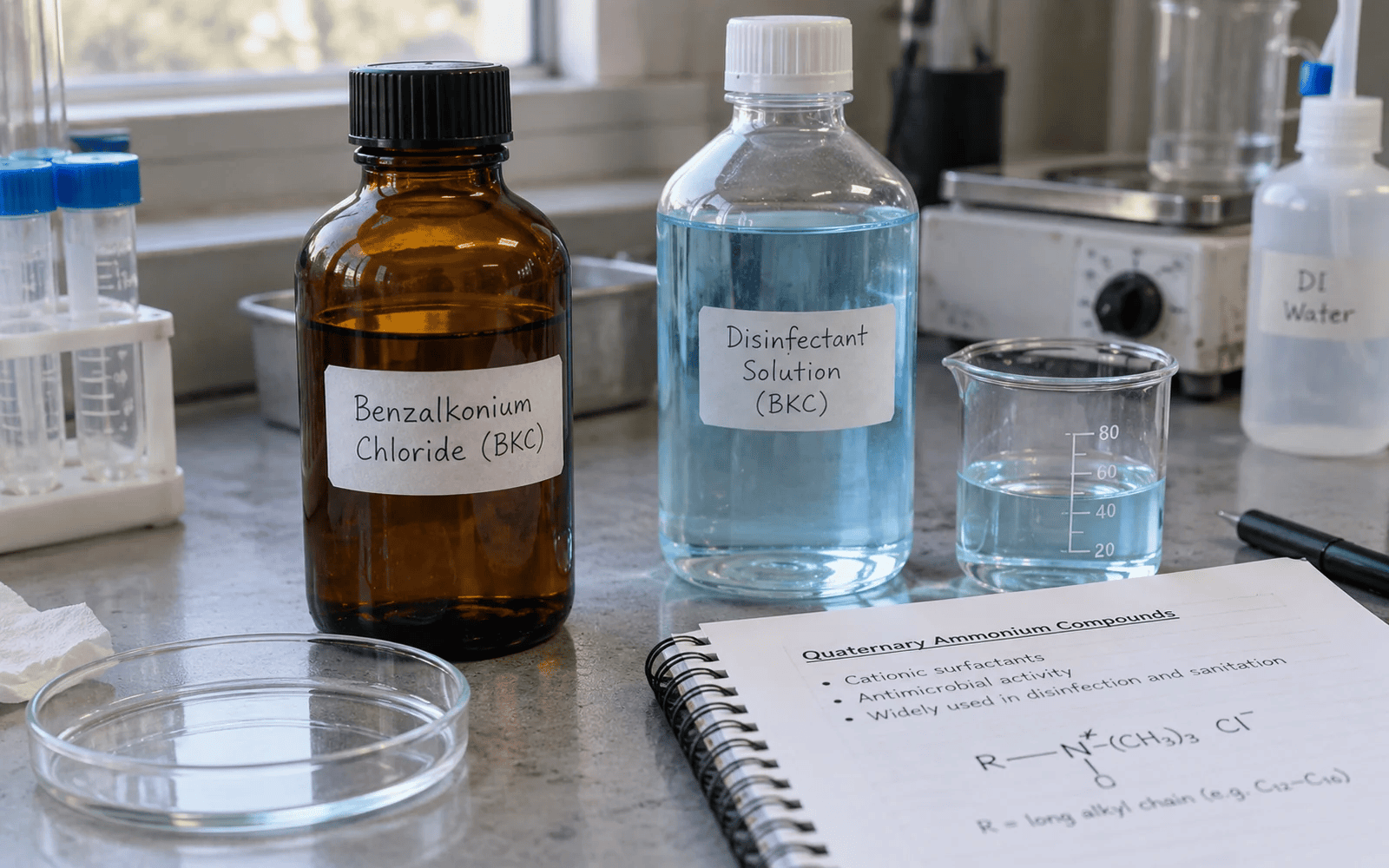
BKC does not always have one fixed molecular formula: commercial benzalkonium chloride can contain related alkylbenzyldimethylammonium chlorides with different alkyl-chain lengths.
Benzalkonium chloride is one of the best-known quaternary ammonium compounds used in disinfectant chemistry, but the name can be misleading. BKC is commonly discussed as though it were one single molecule with one fixed formula. In commercial chemistry, it is often better understood as a family or mixture of closely related alkylbenzyldimethylammonium chlorides.
That distinction matters when a procurement specification says “BKC 50%”, “BKC 80%”, “benzalkonium chloride disinfectant” or simply “quaternary disinfectant”. Those descriptions do not necessarily refer to the same finished product, the same use concentration or the same microbiological claim.
What is benzalkonium chloride?
Benzalkonium chloride, commonly abbreviated BKC, BAC or BAK, is a cationic surfactant in the quaternary ammonium compound (QAC) class. “Cationic” means that its active surface-associated ion carries a positive charge. That electrical character is central to both its surfactant behaviour and its antimicrobial activity.
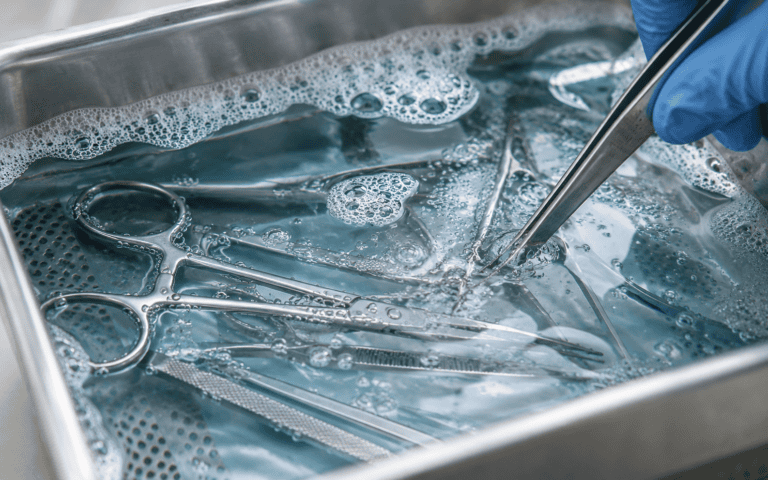
In practical formulation work, BKC may appear as the active component in disinfectant concentrates, ready-to-use products, wipes and other antimicrobial systems. CDC guidance lists quaternary ammonium compounds among the chemical disinfectant classes used in health-care settings, particularly for ordinary environmental sanitation of noncritical surfaces.
What is the chemical formula of BKC?
This is where a simple search result can become misleading. Benzalkonium chloride does not always have one universal molecular formula because the alkyl chain can vary. A useful general structural expression is:
[C6H5CH2N(CH3)2R]+ Cl−
Here, R represents an alkyl chain. Regulatory and chemical databases include benzyl-C12–16 and C12–18 alkyldimethylammonium chlorides under the broader benzalkonium chloride family. This is why different BKC records can show different exact molecular formulas.
For example, PubChem’s record for CAS 8001-54-5 presents a representative molecular formula of C22H40ClN. That should not be interpreted to mean that every commercial benzalkonium chloride blend consists exclusively of that single chain length.
Specification point: when purchasing BKC raw material or a BKC-based disinfectant, the meaningful specification is not just the name “benzalkonium chloride”. Check the active content, alkyl-chain distribution where relevant, finished-product formulation, intended use and validated efficacy claim.
How does BKC work?
Quaternary ammonium compounds are surface-active chemicals. Their positively charged head group interacts with negatively charged microbial cell surfaces and membranes. In susceptible organisms, that interaction can disturb membrane integrity and contribute to loss of essential cellular contents.
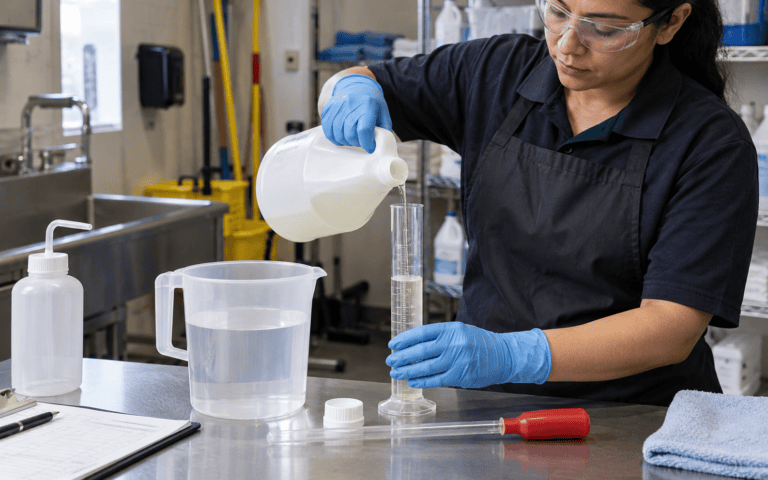
The practical result depends on the complete formulation and use conditions. Concentration, soil load, water quality, contact time, temperature, surface type and interfering materials can all influence performance. A raw BKC concentration therefore cannot be translated directly into a universal disinfection dilution.
Where is benzalkonium chloride used?
CDC guidance notes that quaternary ammonium compounds are commonly used for environmental sanitation of noncritical surfaces such as floors, furniture and walls. EPA-registered QAC formulations can also be appropriate for some noncritical medical equipment that contacts intact skin, such as blood-pressure cuffs, when the product label permits that use.
Outside health care, BKC-based systems are used across institutional, industrial and commercial environments where a formulated QAC disinfectant is appropriate for the target surface and required microbial claim.
| BKC product form | What it means | Typical procurement question |
|---|---|---|
| Raw active concentrate | BKC supplied primarily as an active chemical for formulation. | What is the active percentage and exact specification? |
| Formulated disinfectant concentrate | BKC combined with other formulation components and intended to be diluted before use. | What use dilution and contact time support the stated claim? |
| Ready-to-use solution | A finished product supplied at its intended use strength. | Which surfaces and organisms are covered by the label? |
| Pre-saturated wipe | Fabric or nonwoven material dosed with a formulated solution. | Does the wipe deliver enough liquid for the required wet contact time? |
What do “BKC 50” and “BKC 80” mean?
In chemical trade, terms such as BKC 50 or BKC 80 are generally used to describe raw-material grades with different active contents. They should not be confused with the final in-use concentration of a disinfectant. The raw active may be only one component of a much more dilute finished formulation.
For facility buyers, this distinction is important. Buying a stronger raw concentrate is not the same as buying a better disinfectant. A finished disinfectant has to be assessed against its intended use, label directions, compatibility and validated efficacy.
Is BKC effective against every microorganism?
No disinfectant class should be treated as universal. CDC describes QACs as widely used disinfectants but also notes important limitations, including poor mycobactericidal activity. Routine QAC products are not automatically sporicidal.
This is why facilities should select disinfectants by the organisms of concern and the actual claim carried by the finished product, rather than by active-ingredient familiarity alone.
Hard water, cotton and other factors can affect QAC performance
An unusually useful operational detail in CDC guidance is that high water hardness can make quaternary ammonium compounds less microbicidal. Cotton and gauze can also absorb active ingredients, reducing the amount available on the treated surface.
For a facility, that means product performance is not only a chemistry question. The dilution water, wiping material and method of application can alter the real delivered dose.
BKC is a QAC — but not every QAC is BKC
“Quaternary ammonium compound” describes a broader chemical class. Benzalkonium chloride is one member of that class. Other QAC structures are used in disinfectant and surfactant chemistry, and different generations or blends can behave differently.
Related: Institutional Cleaning Chemicals: Types, Names and Where They Are Used
So the terms should not be used as perfect synonyms. A specification that calls for “QAC” is broader than one that specifically calls for benzalkonium chloride.
What facilities should check before buying a BKC-based disinfectant
- Active ingredient and concentration: what form of benzalkonium chloride is present, and at what concentration?
- Use dilution: is it ready to use or a concentrate?
- Contact time: how long must the surface remain wet?
- Microbial claim: which organisms or test standards support the product?
- Surface compatibility: is the formulation suitable for the material being treated?
- Water quality: does the facility’s dilution water create hardness-related performance concerns?
- Application material: is the wipe or cloth compatible with QAC chemistry?
- SDS and handling controls: what PPE, storage and spill precautions are required?
The practical takeaway
Benzalkonium chloride is not simply “a disinfectant chemical”. It is a family of quaternary ammonium compounds used as an active building block in many formulations. Its exact chemical identity can vary with alkyl-chain composition, and its real-world performance depends on the finished product and the way that product is used.
For institutional procurement, the better question is therefore not “Does this product contain BKC?” but “What BKC system is this, what claim is it designed to deliver, and under what operating conditions?”
Frequently asked questions
Is benzalkonium chloride the same as a quaternary ammonium compound?
Benzalkonium chloride is a quaternary ammonium compound, but the QAC class includes other chemicals as well.
What is the formula of benzalkonium chloride?
BKC is often a mixture of related alkylbenzyldimethylammonium chlorides, so its exact molecular formula can vary. A general structure is [C6H5CH2N(CH3)2R]+Cl−, where R is an alkyl chain.
What is BKC used for?
Formulated BKC-based products are used for environmental disinfection and sanitation of suitable noncritical surfaces, among other applications, when supported by the finished product label.
Does hard water affect BKC?
CDC notes that high water hardness can reduce the microbicidal activity of quaternary ammonium compounds.
Sources
PubChem — Benzalkonium Chloride, CAS 8001-54-5.
PubChem / ChemIDplus — N-Alkyl dimethyl benzyl ammonium chloride (C12-C18).
European Chemicals Agency — Benzyl-C12-16-alkyldimethyl chlorides substance information.
CDC — Chemical Disinfectants: Quaternary Ammonium Compounds.