The Fixture Fallacy
Why School Hygiene Is a Service, Not an Installation
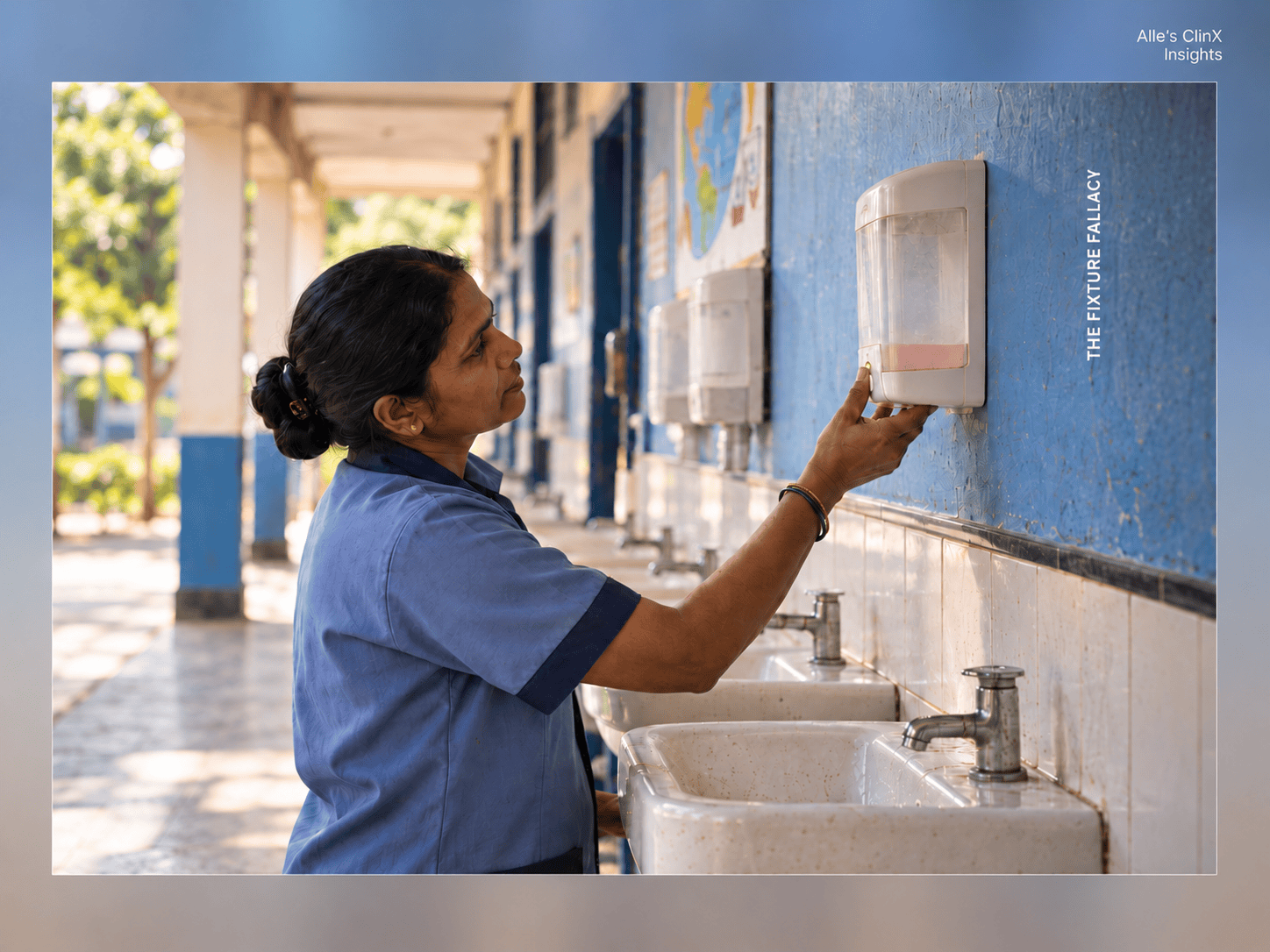
A school can have a sink and still not have a basic hygiene service. That sounds contradictory until you look at what the service actually requires: a handwashing facility, water and soap available when the school is surveyed.
That definition is more important than it first appears. It separates installation from availability.
A sink is an asset. A dispenser is an asset. A pipe is an asset. None of them, on its own, creates a hygiene service. The service only exists when the operating inputs around those assets are present at the point of need.
This is the fixture fallacy: the tendency to treat a visible installation as if the service it was meant to provide is automatically functioning.
A new global signal from schools
On 22 September 2026, the WHO/UNICEF Joint Monitoring Programme released its latest progress report on drinking water, sanitation and hygiene in schools. For 2025, it estimates that 72% of schools had a basic hygiene service, meaning handwashing facilities with both soap and water available.
Another 9% had a limited service: the handwashing facility and water were present, but soap was not. Eighteen per cent had no hygiene service, meaning either there was no handwashing facility or water was not available.
UNICEF reports that 545 million school-age children lacked a basic hygiene service at school. Of these, 183 million attended schools with handwashing facilities and water but no soap, while 362 million attended schools with no hygiene service.
The coverage needs to be read carefully. For its 2025 hygiene estimate, the JMP reports data from 136 countries and all SDG regions except Central and Southern Asia, representing 40% of the global school-age population. That scope matters when interpreting the figures.
of schools had a basic hygiene service in 2025: handwashing facilities with soap and water available.
had water available for handwashing but no soap, so the service remained limited.
had no hygiene service because there was no handwashing facility or no water available.
school-age children lacked a basic hygiene service at school in 2025.
A facility can be physically installed and still fail to provide the service it was built for. The difference is not architecture. It is operations.
Why facilities naturally focus on fixtures
The conventional model has a logic.
Fixtures are visible, countable and easy to specify. A school can budget for a sink, approve a dispenser model, install taps, commission a wash area and physically inspect the result. Capital projects have a beginning, an installation phase and a handover.
Operating services are less tidy. Soap is consumed. Water supply can fail. Pumps and taps break. Dispensers empty. Store inventory moves. Responsibility changes with shifts, contractors and staff turnover. The service has to be recreated every day.
That makes installation easier to celebrate than continuity.
The problem begins when the installation becomes the proxy for the service. Once the sink exists, everyone assumes handwashing exists with it.
One missing input can collapse the service
The JMP hygiene ladder makes this unusually visible.
If a school has a handwashing facility and water, but no soap, it does not meet the basic service standard. The physical fixture can be intact. The plumbing can be working. The installation can look complete. One missing consumable changes the service classification.
That is not a technicality. It tells facility managers something important about service design: the reliability of the system is constrained by the least available required input.
The same pattern appears across institutional operations. A dosing system without concentrate, a toilet without water, a cleaning SOP without trained staff, or a dispenser without replenishment can each leave infrastructure present while the intended service disappears.
The missing part is often cheaper than the installed asset. Operationally, it can be just as decisive.
The fixture has to exist
Sinks, taps, dispensers or other designated handwashing facilities create the physical point at which the service can occur.
Water has to be available
A fixture with no usable water does not provide the hygiene service the installation was meant to support.
Soap has to be present
The JMP definition makes replenishment operationally visible: water without soap remains a limited service.
Someone has to own availability
Refilling, inspection and escalation cannot remain an assumed responsibility if the service is expected to remain continuously usable.
Installation is capex. Availability is operations.
This distinction changes how school hygiene should be managed.
A capital decision asks whether the school has enough handwashing points, whether they are correctly located, whether the plumbing works and whether the chosen fixtures are suitable.
An operating decision asks different questions. Was soap available this morning? Who checks each dispenser? What happens when stores run low? How quickly is a failed tap escalated? Does the housekeeping or facility team know which locations repeatedly run out first? Can the school distinguish a supply problem from a maintenance problem?
Those are not glamorous questions, but they determine whether infrastructure remains a service after the installation team leaves.
Replenishment is part of hygiene design
Consumables are often treated as a procurement problem that begins after infrastructure has been designed. The JMP definition suggests the opposite: if the consumable is required for the service to exist, replenishment is part of the service architecture.
This does not mean every school needs sophisticated software or automated stock systems. It means the supply loop has to be explicit.
Someone should know the expected consumption, the storage point, the refill responsibility, the reorder trigger and the response when availability fails. The level of formality can scale with the institution, but the ownership cannot disappear.
In a large campus, this may involve several buildings, hostels, washroom blocks and housekeeping teams. In a smaller school, the same logic may fit on a simple inspection sheet. The principle is identical: the service is not restored by owning stock somewhere on campus. It is restored when the required input reaches the point of use.
Do not ask only, “Do we have handwashing facilities?” Ask, “What percentage of those facilities are service-ready when students need them?”
Measure the service, not only the asset
The JMP indicator is designed for global monitoring, not as a school-level operations dashboard. Facilities can still learn from its logic.
An installation metric counts sinks or dispensers. A service metric asks whether the required conditions are available at the point of use.
For internal operations, a school could therefore track practical measures such as the share of handwashing points found with both water and soap during inspection, repeated stockout locations, time taken to restore an unavailable point, or the frequency of fixture failures. These are operating suggestions, not WHO reporting requirements.
The purpose is not to create another reporting burden. It is to stop a broken service from hiding behind a completed installation.
Is the physical handwashing point installed where it is needed?
Are water and soap actually present when the facility is expected to be used?
How quickly does the school restore the service when water, soap or a fixture fails?
Is responsibility for inspection, replenishment and escalation explicit rather than assumed?
Procurement should buy continuity, not only units
Procurement naturally works in units: dispensers, litres, cases, cartons, monthly orders. Those units are necessary for purchasing. They are not necessarily the best unit for managing the service.
A lower-priced soap that repeatedly runs out because consumption was underestimated is not a reliably available hygiene service. A premium dispenser with no clear refill responsibility is not one either.
The better procurement question is therefore broader: what combination of fixture, consumable, refill method, stock level and operating ownership keeps the service available at the required points?
That can lead to simpler decisions. Standardised dispensers may reduce refill complexity. Concentrated or bulk formats may alter storage and replenishment economics. Smaller packs may improve handling in one environment while creating too much packaging in another. There is no universal answer.
The useful comparison is not product versus product in isolation. It is operating model versus operating model.
What this means for institutional hygiene suppliers
The same lesson applies to suppliers. Delivering a consumable is necessary, but it is not the same as helping a facility maintain the service that consumable supports.
At Alle’s ClinX, we think this makes usage guidance, supply planning and execution support more important than treating each chemical order as an isolated transaction.
The role is not to take ownership away from the facility. It is to make the operating requirements easier to see: what is used, where it is used, how it is replenished and what information staff need at the point of work.
For schools and campuses, that shift matters because hygiene is distributed. One procurement team may support dozens or hundreds of points of use. A central store can be fully stocked while individual dispensers remain empty.
The service begins where the installation ends
Between 2015 and 2025, global coverage of basic hygiene services in schools increased from 59% to 72%. That is meaningful progress.
But the remaining gap contains a useful lesson for every facility, including those far better resourced than the global average.
A fixture can be installed once. A service has to be maintained continuously.
That means handwashing infrastructure should not be evaluated only by what has been built. It should also be evaluated by whether the required conditions remain available when the user arrives.
The most useful question may be the simplest one:
When a student reaches the handwashing point, does the service actually exist?
If water or soap is missing, the answer is already clear—no matter how good the installation looks.
Research and guidance used in this analysis
- WHO/UNICEF — Progress on drinking-water, sanitation and hygiene in schools 2015–2025Published 22 September 2026. The latest JMP technical report covering national, regional and global WASH estimates for schools through 2025.
- UNICEF Data — Progress on drinking water, sanitation and hygiene in schools 2015–2025Key 2025 estimates for school water, sanitation and hygiene services, including the population and country coverage behind the hygiene estimates.
- WHO/UNICEF Joint Monitoring Programme — SchoolsOfficial WASH in schools service ladders and definitions for basic, limited and no hygiene service.
- WHO/UNICEF Joint Monitoring Programme — Methods for WASH in schoolsMethodology used to classify and estimate school water, sanitation and hygiene service levels.
Design for availability, not only installation.
Institutional hygiene works when the right inputs, instructions and replenishment process reach the point of use consistently.