The Hand-Hygiene Blind Spot
Why the equipment beside the sink may deserve as much attention as the sink itself
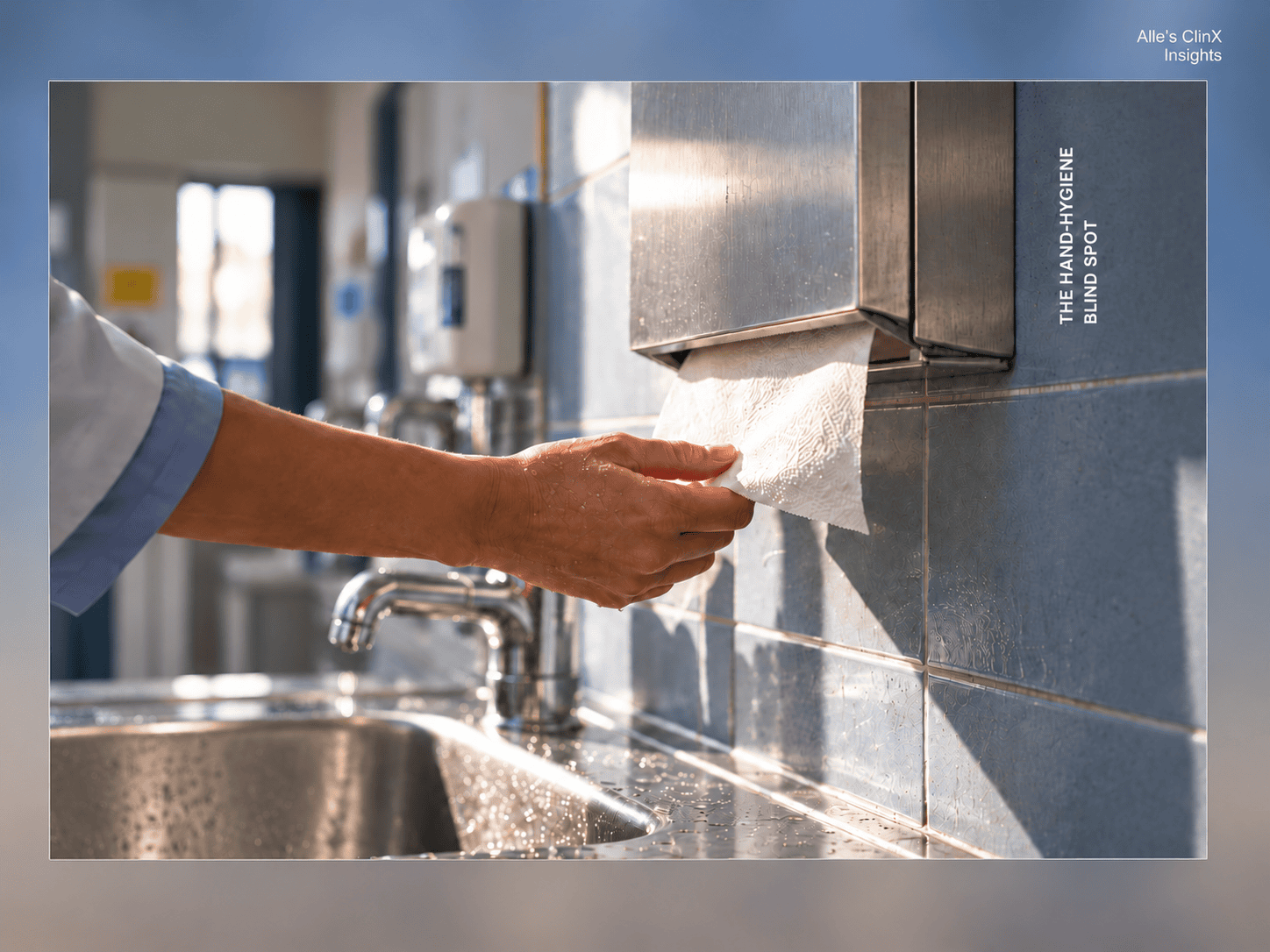
A handwashing station can look complete: running water, soap, a clean basin and a paper-towel dispenser mounted beside it. Yet one of those objects may sit outside the facility’s mental model of hand hygiene even though almost every user touches or reaches into it immediately after washing.
That distinction matters. This is not an argument that paper-towel dispensers are uniquely dangerous, nor that facilities should react to one small study with a new disinfection programme.
The more useful question is operational: which surfaces sit directly inside a hygiene workflow but outside the ownership, inspection or surveillance system built around that workflow?
Paper-towel dispensers make that question visible because they occupy an awkward boundary. They are not the hands being cleaned. They are not the sink. They are not always treated like an obvious high-touch handle. Yet they can be part of the final movement between washing and returning to care, work or circulation.
A new signal from the hand-hygiene interface
Researchers from Brown University and Brown University Health published a cross-sectional environmental surveillance study in the Journal of Hospital Infection in September 2026. They sampled the apertures of 40 paper-towel dispensers at one tertiary-care hospital: 30 manual units and 10 touch-free units located across public and staff bathrooms, hallway sinks, kitchenette or nutrition-station areas and break areas.
Bacterial contamination was detected on 28 of the 40 dispensers. Contamination was more frequent among the manual dispensers in this sample: 80% compared with 40% of touch-free units. The authors reported a relative risk of 2.0, but with a wide 95% confidence interval of 0.92–4.36, and they explicitly described the analysis as exploratory.
The most commonly recovered organisms were Bacillus species and coagulase-negative staphylococci. Organisms considered of clinical or infection-prevention concern were identified on 14% of dispensers, with most of those findings in the emergency department. No multidrug-resistant organisms were detected.
Those details narrow the conclusion. The study found contamination. It did not demonstrate transmission from a dispenser to a patient, nor did it measure healthcare-associated infections resulting from the sampled surfaces.
28 of 40 sampled paper-towel dispensers yielded bacterial contamination.
Contamination was observed more often on manual than touch-free dispensers in this sample.
Organisms of clinical or IPC concern were identified on a minority of sampled dispensers.
The evidence comes from one exploratory, cross-sectional hospital study and should stay within that scope.
Why blind spots appear in otherwise sensible cleaning systems
Facilities do not ignore surfaces because people do not care about hygiene. Blind spots often emerge because responsibilities are organised around categories.
The housekeeping schedule may specify wash basins, taps, handles and floors. The infection-prevention programme may focus on hand-hygiene compliance. Engineering may own the fixture. Stores may own the paper supply. A contractor may refill the dispenser. Each part can have an owner while the interface itself has none.
This is a predictable consequence of specialisation. The conventional model exists because responsibilities need to be divided. Housekeeping teams cannot treat every object in a facility as equally important; cleaning frequencies have to reflect risk, touch and contamination. Procurement needs separate ownership from maintenance. Infection-prevention teams cannot directly execute every environmental task.
The weakness appears at the boundaries: the places where one workflow hands off to another.
A hygiene process can be well designed in each individual department and still leave an unowned surface between departments. The problem is not necessarily inadequate cleaning. It can be inadequate definition of the system boundary.
Handwashing is not finished when the hands leave the water
WHO guidance treats drying as part of handwashing, recommending thorough drying with a single-use towel and a method that does not recontaminate the hands. CDC healthcare guidance likewise includes drying with disposable towels after soap-and-water handwashing.
That makes the drying interface operationally important. If the hand has to contact a lever, reach into an aperture or touch part of a dispenser immediately after washing, the dispenser is no longer merely a consumable holder. It becomes part of the sequence through which the hygiene action is completed.
This does not mean every dispenser should automatically be classified as a critical surface. Risk still depends on design, touch pattern, location, patient population, visible soil, maintenance and the facility’s own infection-prevention assessment.
But it does mean the object deserves to be evaluated inside the workflow rather than outside it.
The cleaning list should follow the hand, not only the room
CDC environmental-cleaning guidance for healthcare facilities emphasises routine cleaning and, where appropriate, disinfection of high-touch and frequently contaminated surfaces. In toilet areas, examples include handwashing sinks, faucets and handles.
A practical facility audit can extend that logic by tracing what the user touches during and immediately after the hygiene event.
Start at the approach to the sink. Follow the tap or sensor, soap dispenser, basin, drying method, paper-towel aperture or lever, waste-bin lid if touched, and the door hardware used on exit. The objective is not to turn every surface into a maximum-frequency disinfection point. It is to identify whether any surface with meaningful touch or contamination potential has disappeared between SOP categories.
The operating question becomes: is every relevant interface deliberately included, deliberately excluded, or simply assumed?
Map the complete hand-hygiene sequence
Observe the actual movement from soap and water through drying and exit. Do not stop the process map at the sink.
Identify touch, proximity and contamination potential
Distinguish surfaces that are repeatedly touched from those that are merely nearby. Local risk should determine the control.
Make ownership explicit
Clarify who cleans the unit, who replenishes it, who reports damage and who verifies that the interface remains usable.
Check whether the SOP matches reality
Periodically inspect actual touch points and workflow changes instead of assuming the original cleaning list still describes the environment.
The study does not settle the manual-versus-touch-free question
The difference between manual and touch-free dispensers is eye-catching, but it needs careful interpretation.
Only 10 touch-free units were included, compared with 30 manual units. The confidence interval around the reported relative risk was wide, and the authors themselves cautioned that the analysis was exploratory. The study therefore gives facilities a reason to inspect design and touch patterns; it does not provide a universal procurement rule that touch-free dispensers are always safer.
Procurement decisions should also account for reliability, refill method, maintenance, waste, battery or power requirements where applicable, paper compatibility, user behaviour and lifecycle cost. A touch-free unit that is frequently empty or out of service can fail operationally even if it reduces one contact point.
Design can remove a touch. It cannot replace maintenance.
Surveillance should answer a question, not generate a ritual
The study used microbiological sampling because its purpose was research. That does not mean routine environmental culturing of towel dispensers is automatically appropriate for every healthcare facility.
For most operations teams, the first useful step is simpler: verify that the surface is in the cleaning scope, assess its touch pattern, inspect visible condition, review cleaning frequency, check the refill method and confirm responsibility.
Microbiological or other environmental monitoring should be used where justified by the facility’s infection-prevention programme, investigation needs, patient risk or applicable guidance—not because a new paper has made one object interesting.
The lesson is therefore about surveillance design: use evidence to find a blind spot, then choose a control proportionate to the risk.
What this means for facility and housekeeping leaders
Hand hygiene is usually discussed as human behaviour: whether people clean their hands at the right moments and use the correct technique. Environmental cleaning is usually discussed as surface management. The dispenser study sits between those two disciplines.
That boundary is precisely why it is useful.
Facilities should periodically examine the objects that connect one controlled process to the next: the towel dispenser after handwashing, the container used after dilution, the trolley handle between rooms, the refill point between stores and use, or the shared device between a clean task and the next user.
These interfaces are where a well-written SOP can become incomplete without technically being wrong.
The Alle’s ClinX view: define the whole workflow before choosing the control
At Alle’s ClinX, we think environmental hygiene decisions become more reliable when the facility defines the workflow first and the chemical or tool second.
A dispenser aperture may require routine cleaning, a revised frequency, a design change or simply explicit ownership. Which response is appropriate depends on the surface, material, touch pattern, contamination risk and local SOP. The answer should not be invented from a generic product recommendation.
The supplier’s useful role is therefore narrower: help the facility make the cleaning method, product suitability, instructions and documentation clear once the operational requirement has been established.
The blind spot is usually at the boundary
The September study should not make facilities afraid of paper-towel dispensers. It should make them curious about boundaries.
A hygiene system is not only the collection of things explicitly labelled “hand hygiene” or “environmental cleaning.” It is the sequence of surfaces, people, consumables and decisions through which the work actually happens.
When responsibilities are divided, some interfaces will naturally sit between categories. Those are the places worth testing.
The useful question is not only, “Is the sink clean?” It is, “What does the hand touch next—and who owns that surface?”
Research and guidance used in this analysis
- Shaikh YB, Gibas KM, Geffert SF, Mermel LA — Bacterial Contamination of Paper-Towel Dispensers in Healthcare SettingsJournal of Hospital Infection, available online 2 September 2026. Cross-sectional environmental surveillance of 40 paper-towel dispensers at one tertiary-care hospital. Checked 4 October 2026.
- PubMed — PMID 42685913Bibliographic record and abstract for the September 2026 study, including the sample, contamination prevalence, manual-versus-touch-free comparison and study limitations. Checked 4 October 2026.
- WHO Guidelines on Hand Hygiene in Health Care — consensus recommendationsWHO recommends thorough hand drying with a single-use towel and a method that avoids recontaminating hands after washing.
- CDC — Environmental Cleaning ProceduresHealthcare environmental-cleaning guidance covering high-touch and frequently contaminated surfaces, including handwashing-area surfaces in toilet environments. Checked 4 October 2026.
- CDC — Environmental ServicesBackground guidance on environmental surfaces, hand contact and the role of appropriate cleaning and disinfection in healthcare facilities.
Inspect the interfaces, not only the obvious surfaces.
Clear SOPs begin by mapping where the actual hygiene workflow moves between hands, fixtures, consumables and cleaning ownership.