The 59% Problem
Why Environmental Cleaning Should Be Managed as Infrastructure, Not Inventory
59%. That is the share of health-care facilities globally that met the basic environmental-cleaning standard in 2025, according to the first WHO/UNICEF global estimate for the service. The more interesting question is what “basic” actually means.
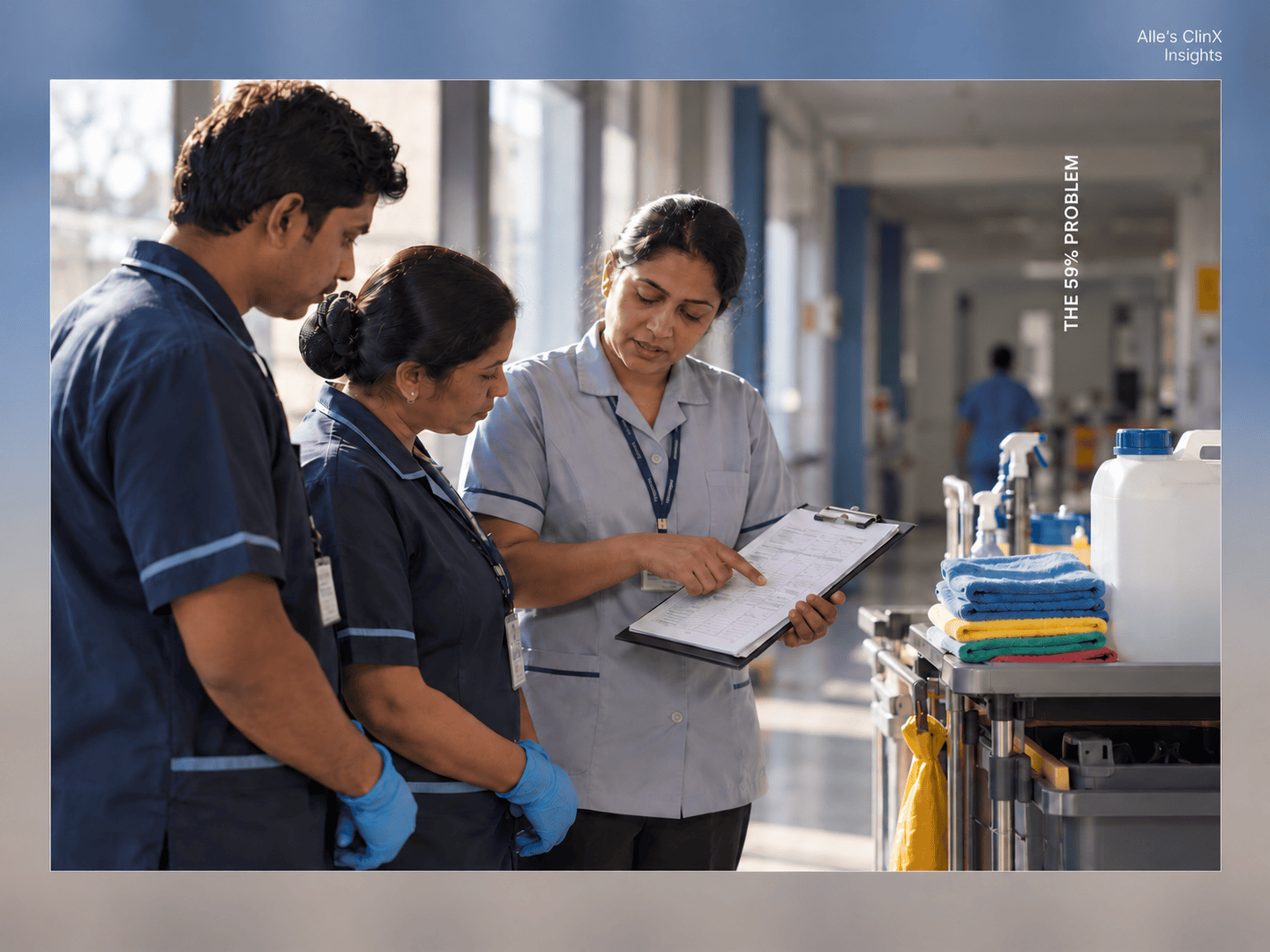
A facility can have detergent, disinfectant, buckets, mops, PPE and an approved supplier and still fail to meet that basic definition. The threshold is not a premium chemical, a dosing machine or a larger chemical budget. It is more fundamental: a documented way of cleaning and people trained to carry it out.
That makes the new 59% figure useful beyond global-health monitoring. It exposes a management distinction institutional hygiene often misses. Inventory is what a facility owns. Infrastructure is what allows the facility to turn those inputs into a repeatable cleaning process.
If environmental cleaning is treated only as a consumables category, the visible parts of the system get purchased while the less visible parts—protocols, competency, supervision, verification and feedback—can remain fragile.
What the 59% actually measures
The WHO/UNICEF Joint Monitoring Programme classifies a health-care facility as having a basic environmental-cleaning service when cleaning protocols are available and all staff with cleaning responsibilities have received training. If protocols exist and/or at least some staff have been trained, the service is classified as limited. If neither protocols nor trained staff are present, it is classified as no service.
The 2026 progress report provides the first global estimate for this indicator. In 2025, 59% of health-care facilities met the basic standard. WHO and UNICEF also reported that 18% met neither requirement, corresponding to facilities serving approximately 1.5 billion people. In least developed countries, only 24% met the basic standard.
The Joint Monitoring Programme separately estimates that 2.4 billion people lacked access to a health-care facility with a basic environmental-cleaning service.
These are service-level measures. They do not tell us whether a particular disinfectant works, whether a specific hospital is clean or whether environmental surfaces passed a microbiological audit. They tell us something more foundational: whether the minimum operating structure for environmental cleaning is present.
of health-care facilities had a basic environmental-cleaning service in 2025.
met neither requirement: no cleaning protocols and no trained cleaning staff.
of facilities in least developed countries met the basic environmental-cleaning standard.
people still lacked access to a health-care facility with a basic environmental-cleaning service.
A stocked chemical room proves that products were purchased. It does not prove that the intended cleaning process exists, is understood or can be reproduced consistently.
The stocked-room fallacy
Cleaning inputs are visible. Cleaning capability is not.
A procurement review can count approved SKUs, verify purchase orders, inspect invoices and confirm that stock is physically present. Those controls matter. They also make it easy to confuse product availability with operational readiness.
The actual cleaning result is created later. Someone has to know which product belongs to which task. The procedure has to describe how the area is cleaned, how often, by whom and under which precautions. Where dilution, contact time or surface compatibility matter, those instructions have to survive the journey from technical documentation to the point of use.
They also have to survive staff turnover, contractor changes, new surfaces, equipment failure and the simple pressure of a busy shift.
The bottle enters the system once. The process has to work every day.
Why protocols and training belong together
A protocol without trained staff can become a document nobody executes. Training without a protocol can become a collection of remembered habits that changes as it passes from one person to another.
That is why the WHO/UNICEF indicator requires both.
WHO’s environmental-cleaning training package follows the same logic. It is designed around practical competencies for people who clean health-care facilities, using structured instructions and adult-learning methods rather than assuming a written SOP is enough.
WHO’s evaluation methodology goes further by treating environmental-cleaning training as a complex intervention and recommending evaluation of both process and impact.
The distinction is important: training is an activity; competence is the operating objective.
Protocol
Make the expected process explicit: what is cleaned, by whom, how, with which products, at what frequency and under which precautions.
Competence
Make sure the people doing the work can convert the written process into consistent execution at the point of use.
Feedback
Observe, verify and correct. A system without feedback can repeat the same incorrect process very consistently.
Basic is the floor, not the ceiling
The JMP definition is deliberately simple enough for global monitoring. It should not be mistaken for a complete audit of cleaning quality.
The programme notes that an advanced environmental-cleaning level could consider questions such as whether disinfectants are available or whether cleanliness is observed at points of care. Other infection-prevention and facility-quality frameworks go further again into supplies, supervision, monitoring, maintenance and quality improvement.
So a facility that meets the basic threshold has crossed an important floor. It has not automatically demonstrated excellent environmental cleaning.
This is also why the 59% figure should not be converted into a dramatic product claim. The evidence does not say that 41% of facilities are dirty, that 41% use the wrong chemicals, or that buying a different disinfectant would close the gap.
It says that environmental cleaning cannot be understood through products alone.
The invisible infrastructure around chemistry
WHO and UNICEF’s WASH FIT framework treats environmental cleaning as part of a broader risk-based quality-improvement system. Its scope extends beyond physical infrastructure to behaviours, operations, maintenance, monitoring and continuous improvement.
That is closer to how institutional hygiene actually behaves.
The chemical may be the most tangible input, but a facility also needs a way to identify the correct product, communicate its use, train the person handling it, maintain any dispensing or measuring equipment, replenish stock, manage exceptions and verify that the intended procedure has not drifted.
Not every facility needs the same level of sophistication. A tertiary hospital and a small primary-care centre have different risk profiles and resources. But both benefit from making the operating system visible.
Chemistry is an input. Cleaning capability is an organisational asset. Procurement can buy the first. The second has to be designed, trained, monitored and maintained.
Procurement’s missing columns
Institutional chemical evaluations are usually strongest in the areas that are easiest to specify: concentration, pack size, price, technical data, supplier terms and documentation.
Those criteria remain necessary. The 59% finding suggests that facility leaders should add two more questions: can this product be executed reliably inside our operating environment, and how will we know whether the intended process is still being followed after implementation?
A useful evaluation therefore has four dimensions.
Is the product appropriate for the task, surface, soil, hygiene objective and applicable requirements?
What is the real cost after dilution, packaging, transport, storage, dispensing, wastage and replenishment?
Can staff understand and reproduce the procedure across shifts, contractors and different facility zones?
How will the facility detect drift, equipment failure, training gaps or repeated deviations from the intended process?
Move beyond presence
The 2026 WHO/UNICEF report makes a broader recommendation that is relevant to facility management: monitoring needs to move beyond whether infrastructure is merely present and increasingly assess reliability, safety, accessibility and cleanliness, as well as whether services meet the needs of patients and health workers.
The same logic applies to environmental cleaning.
“SOP available” is a presence metric. “Staff trained” is a stronger capability metric. The next level asks whether the process is still working reliably after implementation.
The method can vary by facility: supervisor observations, competency reassessment, dilution or dispensing checks, cleaning audits, replenishment reviews, complaints, incident records or other appropriate controls.
The principle should remain the same. A cleaning system should generate enough feedback to distinguish between a chemistry problem, an equipment problem and an execution problem.
What changes when cleaning is treated as infrastructure
The purchasing conversation changes first.
The question is no longer only, “Which chemical should we buy?” It becomes, “What operating capability has to exist around this chemistry for the facility to get the intended result?”
That makes supplier support easier to define. Training material matters because it reduces interpretation. Product labels and point-of-use instructions matter because they carry the procedure closer to the work. Dispensing and mixing support matter where concentrated chemistry is used. Documentation matters because procedures need to remain reconstructable when staff change. Replenishment matters because a correct process cannot run without the correct input.
At Alle’s ClinX, this is increasingly how we think about institutional hygiene systems. The chemistry still has to be technically right. But the system should also make correct use easier to teach, easier to repeat and easier to review.
That is why usage guidance, documentation, planning tools and execution support belong close to the product rather than being treated as optional material around it.
Inventory is visible. Infrastructure is what makes it work.
The 59% figure should not be used to dramatise a global cleaning failure. It is more valuable as a management signal.
It gives institutional leaders a clean definition of the floor: a basic environmental-cleaning service requires both a documented process and trained people.
For procurement, that means the product list is only part of the system.
For operations, it means the SOP matters only when it survives contact with real work.
For suppliers, it means performance does not end when the container reaches the facility.
And for facility leadership, it creates a useful question:
If the chemical room disappeared from view, could we still describe the cleaning system clearly?
If the answer is no, the facility may own cleaning inventory without yet having built cleaning infrastructure.
Research and guidance used in this analysis
- WHO/UNICEF — Progress on water, sanitation, hygiene, environmental cleaning and waste management in health care facilities 2015–2025Published 18 August 2026; first global estimates for basic environmental cleaning in health-care facilities.
- WHO/UNICEF Joint Monitoring Programme — Health care facilitiesEnvironmental-cleaning service definitions and current global estimates.
- WHO/UNICEF Joint Monitoring Programme — 2026 progress reportReport highlights and global WASH service estimates for health-care facilities.
- WHO — Environmental cleaning and infection prevention and control in health-care facilitiesCompetency-based training package for people responsible for environmental cleaning.
- WHO — Environmental cleaning training package: evaluation methodology guideFramework for evaluating environmental-cleaning training as an intervention.
- WHO/UNICEF — WASH FIT, second editionRisk-based quality-improvement framework for WASH and environmental cleaning in health-care facilities.
Treat environmental cleaning as a system.
Alle’s ClinX combines institutional cleaning chemistry with usage guidance, documentation, planning tools and execution support designed to make facility hygiene easier to implement consistently.