The Wiping-Trajectory Problem
Why a disinfectant claim is not the same thing as performance once the wipe starts moving
A wipe can carry an impressive claim before it ever touches a surface. Once it starts moving, however, the result depends on more than the chemistry inside the packet.
The finding is easy to misuse. It does not mean that a laboratory claim is meaningless, nor that one particular wiping motion should now replace another in hospital SOPs.
The more useful lesson is narrower and more important: surface-disinfection efficacy is produced by a system of chemistry, test conditions, mechanical action, wipe substrate, soil load and contact time. A claim is evidence about performance under defined conditions. It is not a guarantee that every real-world use pattern will reproduce those conditions.
For procurement and infection-prevention teams, that distinction changes the question from “Does this wipe say sporicidal?” to “Under what test method, organism, contact time and use conditions was that performance demonstrated?”
What the new study actually tested
Researchers from German and Austrian institutions evaluated five ready-to-use disinfectant wipes with sporicidal claims against Clostridioides difficile spores. The study was published online by the Journal of Hospital Infection on 30 September 2026.
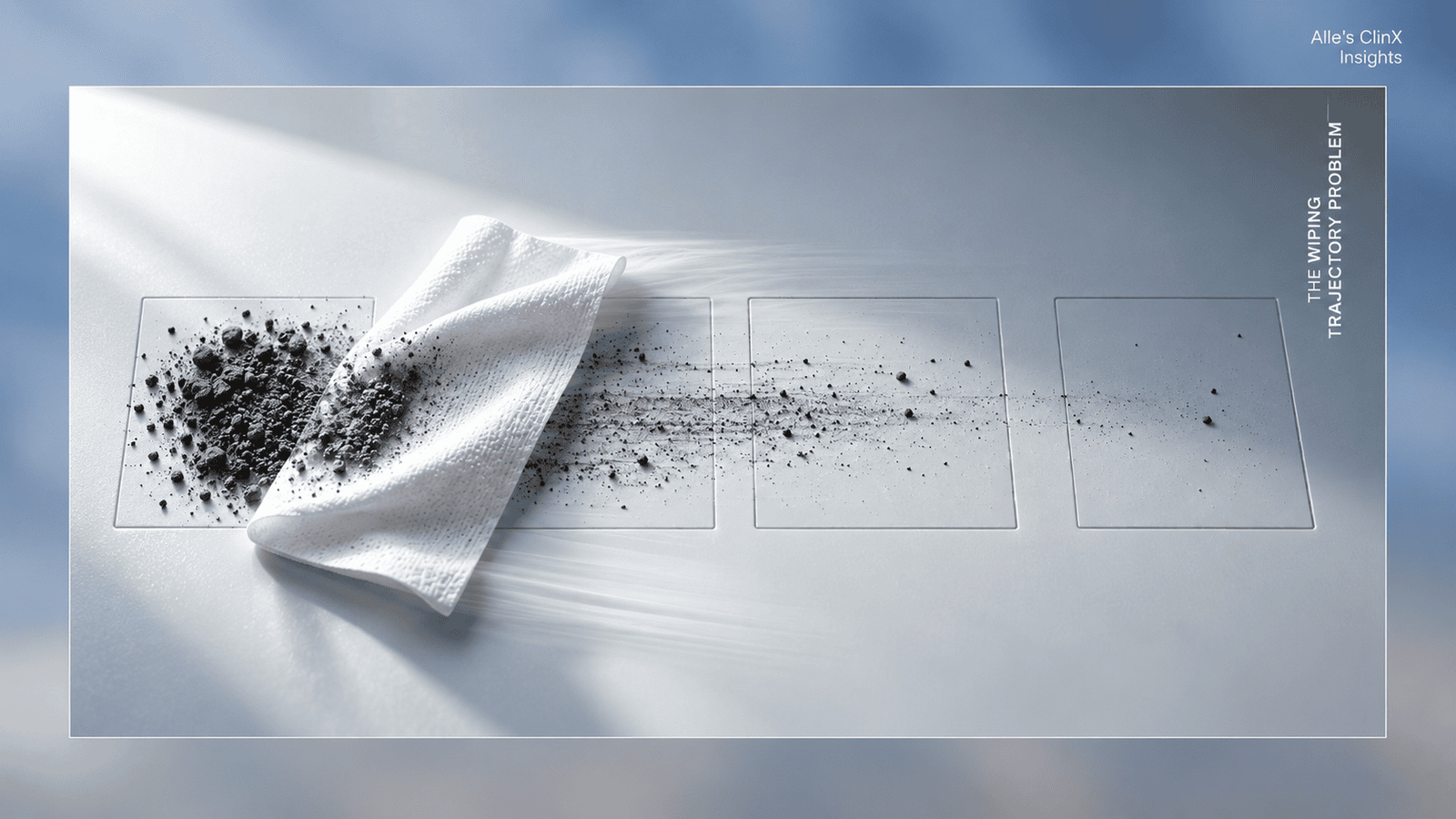
The products were evaluated using two established types of efficacy testing: EN 17126 quantitative suspension testing and EN 17846, the practice-oriented four-field surface test that includes mechanical wiping. For the surface test, researchers compared the standard EN 17846 wiping trajectory with a modified linear trajectory.
Products whose sporicidal efficacy had been confirmed in two independent laboratories met the relevant efficacy criteria in both suspension and surface testing. Other products produced mixed results: some demonstrated activity under certain conditions, while others did not meet the requirements.
The important change appeared when the wiping method became more stringent. In the water control, the modified trajectory left more spores on the initially contaminated field and transferred more spores to the secondary fields. Products that were clearly effective remained effective, and clearly ineffective products remained ineffective. The products closest to the pass/fail boundary were the ones whose classification became more sensitive to the changed method.
Five ready-to-use disinfectant wipes with sporicidal claims were included in the 2026 comparison.
The standard EN 17846 wiping path was compared with a modified linear wiping procedure.
EN 17846 uses a four-field non-porous surface test that combines chemistry with mechanical wiping.
The methodological change mattered most for products performing close to the efficacy threshold.
Why the standard wiping path exists
A standardised test cannot reproduce every movement made by every housekeeping worker on every surface. That is not its purpose.
Standards exist to control variables. EN 17846 specifies a quantitative phase 2, step 2 test for sporicidal activity against C. difficile on non-porous surfaces when disinfectants are applied with mechanical action using wipes in the medical area. The method gives laboratories a reproducible way to compare products under defined conditions.
That controlled structure is a strength. Without a standard trajectory, surface, organism, load and procedure, it becomes difficult to know whether one product outperformed another or whether the test itself changed.
The limitation is different: a reproducible test method is still a model of use. Real facilities introduce different surfaces, hand pressure, wipe folding, surface area, direction changes, interruptions, soil, drying and human judgement.
A useful efficacy claim tells you what a product demonstrated under a defined method. It does not remove the need to understand the method, the contact time and the operating conditions under which the product will actually be used.
Mechanical action is part of the disinfection system
Facilities often think about wiping as a delivery mechanism: the wipe carries the disinfectant to the surface, and the chemistry does the rest.
The four-field test makes the relationship more complicated. Wiping can physically remove contamination from one location, but it can also move material across the surface. The study’s water controls illustrate this clearly: altering the wiping trajectory changed both residual contamination on the primary field and transfer to the secondary fields even though there was no active disinfectant chemistry in the water control.
That means mechanical action cannot be treated as neutral. It influences where contamination goes while the chemistry is acting.
For a clearly effective product, the study suggests that this methodological change may not alter the overall classification. For a product operating close to the threshold, however, the mechanical conditions can expose how little margin exists between passing and failing the test.
Contact time is not a decorative number on the label
Surface disinfection also depends on the product remaining in contact with the surface for the required period under the specified conditions. CDC guidance similarly emphasises following product instructions and ensuring that a disinfectant remains on the surface for its required contact time.
Operationally, this matters because the wiping action and the contact-time requirement interact. A worker may cover too much surface with one wipe, use a wipe that has become too dry, re-wipe an area before the required period is complete, or move directly from one surface to the next without preserving the conditions used to establish efficacy.
The correct response is not to invent a universal wiping rule from one laboratory study. It is to make the facility’s approved use instructions explicit enough that the field process has a realistic chance of matching the conditions behind the claim.
Read beyond the word “sporicidal”
Identify the organism, test standard, formulation, use concentration where relevant and the exact contact time attached to the claim.
Understand how the claim was demonstrated
Distinguish suspension efficacy from a surface test that also includes wiping, transfer and mechanical action.
Translate the claim into a usable SOP
Define wipe coverage, handling, surface wetness, contact time, disposal and any product-specific instructions without inventing steps unsupported by the label or technical documentation.
Check whether practice still resembles the approved method
Observe real use periodically. The gap between a validated claim and field execution is an operating problem, not a reason to rewrite the chemistry.
The procurement problem is specification without context
A procurement sheet can easily reduce a complex performance claim to a binary field: sporicidal—yes or no.
That may be useful for initial screening, but it is not enough for technical evaluation. Two products can both use the same broad claim while differing in active system, validated contact time, test evidence, wipe substrate, compatibility, handling and the conditions under which efficacy was demonstrated.
The better procurement question is not simply whether the claim exists. It is whether the evidence behind the claim matches the facility’s actual requirement and whether the operating team can reproduce the approved use conditions reliably.
In an Indian facility, a European EN 17846 result can be useful technical evidence, but it should not be confused with an India-specific regulatory approval or with a universal instruction for hospital use. Regulatory status, label claims and locally applicable requirements still need to be checked separately.
What this study does not say
The modified linear trajectory was introduced as a methodological comparison. The paper does not establish that hospital staff should replace existing wiping SOPs with that trajectory.
It also does not show that every product marketed as sporicidal is unreliable. In fact, the products with clearly established efficacy remained consistently effective under both wiping procedures.
Nor does the study establish that EN 17846 is inadequate. Its conclusion is narrower: wiping trajectory is a relevant test parameter, particularly when a product performs near the efficacy threshold.
That precision matters because the useful facility lesson is not distrust. It is specification discipline.
The funding disclosure belongs in the interpretation
The authors state that the methodological study received research funding from Schülke & Mayr GmbH as well as internal university research funds. They report that the sponsor had no role in study design, conduct, data collection, analysis, interpretation or the decision to publish. The sponsor requested inclusion of one of its own products, represented anonymously as Product A; the investigators commercially obtained the other products.
The paper also discloses consulting and speaker relationships between several authors and Schülke & Mayr outside the submitted work.
Those disclosures do not invalidate the study. They are part of the evidence context and should travel with the findings when the paper is used to inform procurement or technical discussion.
What a facility should change after reading this
Probably not the wipe itself—at least not on the basis of this paper alone.
The immediate opportunity is to audit the decision chain around surface-disinfection claims. Ask whether approved products have accessible technical evidence, whether staff know the required contact time, whether the SOP describes how much surface one wipe should cover where the manufacturer specifies it, whether incompatible shortcuts have entered practice and whether procurement compares like with like.
For C. difficile specifically, current CDC guidance for acute-care facilities emphasises daily and terminal environmental cleaning with an appropriate sporicidal agent in patient-care areas and shared equipment when managing confirmed infection. The same guidance also makes the larger point: chemistry works inside a cleaning programme, not outside one.
The Alle’s ClinX view: claims need an execution margin
At Alle’s ClinX, we think technical claims are most useful when they are translated into an operating system that gives staff enough margin to reproduce them consistently.
A product performing just at the edge of a laboratory threshold may deserve closer scrutiny than one with robust evidence across methods and conditions. But the same principle applies to the facility: an SOP that only works when every user remembers every detail is also operating too close to its threshold.
The objective should therefore be twofold: buy evidence that fits the task, and design execution so the claim does not depend on perfect human memory.
The wipe starts where the claim ends
A package can state an efficacy claim in a few words. The performance behind those words may depend on dozens of controlled details.
The new EN 17846 comparison makes one of those details visible: trajectory. Change the mechanical path and the most robust products may remain robust, while borderline products become easier to distinguish.
That is not a reason to distrust standards. It is a reason to understand what standards are for.
A claim tells you what was demonstrated. Operations determine whether the conditions behind that demonstration survive contact with the real surface.
Research and guidance used in this analysis
- Rausch M, Berreßem B, Mosel K-M, et al. — Efficacy of ‘sporicidal’ ready-to-use disinfectant wipes against Clostridioides difficile: comparison of standard and modified EN 17846 wiping proceduresJournal of Hospital Infection. Published online 30 September 2026. Open-access methodological study of five ready-to-use wipes. Checked 13 October 2026.
- PubMed — PMID 42822780Abstract, bibliographic record, funding and conflict-of-interest disclosure for the 2026 study. Checked 13 October 2026.
- BSI — BS EN 17846:2023Current standard describing the four-field phase 2, step 2 test for sporicidal activity against Clostridioides difficile on non-porous surfaces with mechanical action using wipes in the medical area.
- CDC — Clinical Guidance for C. diff Infection Prevention in Acute Care FacilitiesCurrent U.S. healthcare guidance on environmental cleaning, sporicidal agents and facility infrastructure for C. difficile prevention. Updated May 2026.
- CDC — Environmental Cleaning ProceduresGuidance describing rigorous mechanical cleaning and sporicidal disinfection for C. difficile environmental cleaning. Checked 13 October 2026.
Read the claim. Then read the conditions behind it.
Technical procurement becomes stronger when efficacy evidence, contact time, test method and field execution are evaluated as one system.