The Last-Meter Problem
Why Good Cleaning Chemistry Can Fail Between the Drum and the Surface
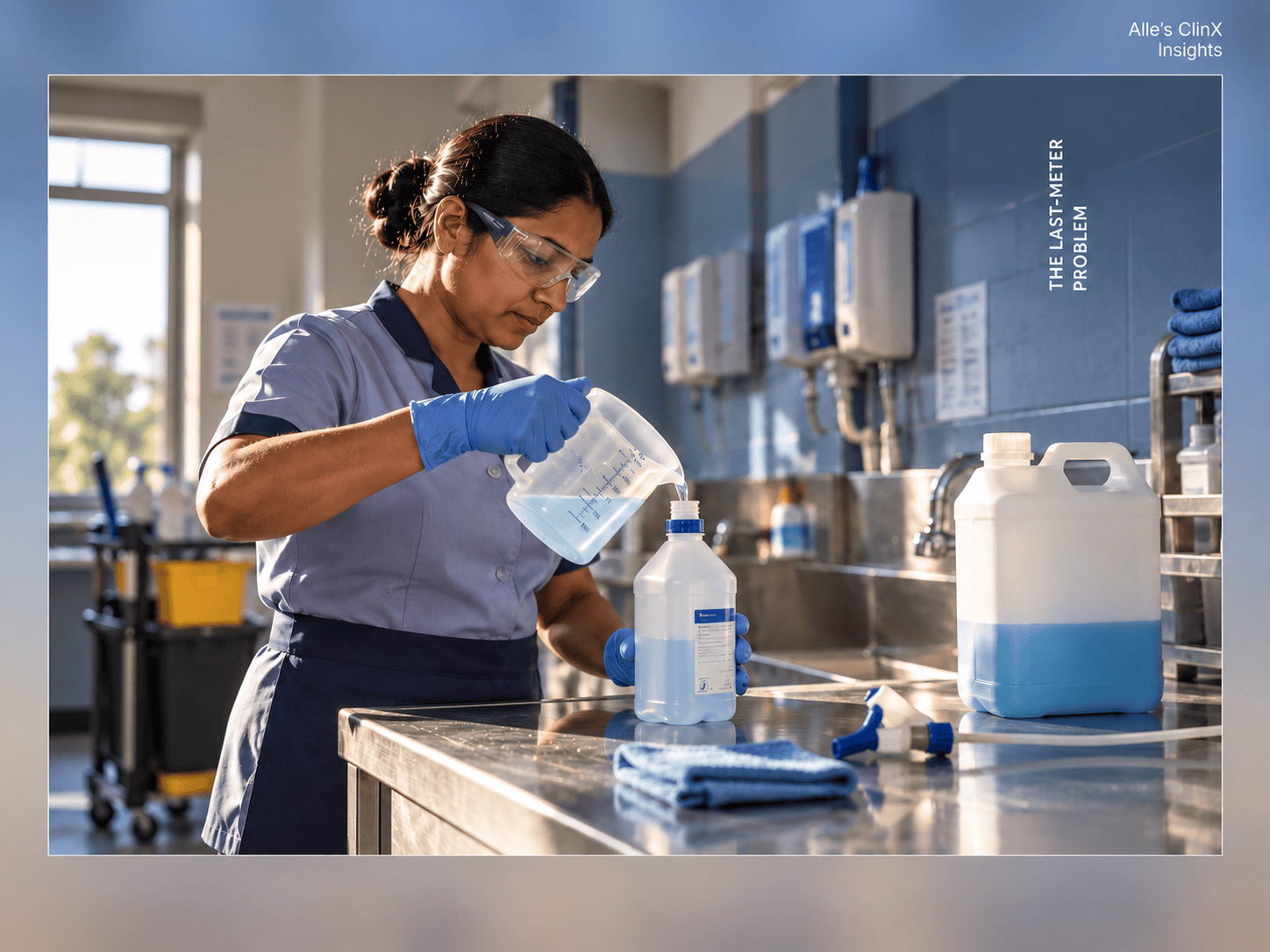
A disinfectant can leave a manufacturer with a defined concentration, a validated formulation and precise instructions for use. None of that guarantees that the same chemistry reaches the surface. The last meter is where specification becomes execution.
Between the original container and a bed rail, washroom floor, production area or housekeeping trolley sits a chain of small operational decisions. The product may be measured, dispensed, diluted, transferred, relabelled and applied by different people across different shifts. Each transition can introduce variance.
Institutional hygiene often treats this as a chemical-selection problem. Sometimes it is. But a surprising number of failures occur after the product has already been selected correctly. The chemistry has not changed; the process around it has.
That distinction matters because a facility can spend more on chemistry, buy a higher concentration or automate dispensing while leaving the most fragile part of the system untouched: the final distance between specification and execution.
A specification is not an outcome
Cleaning chemicals are unusual operational inputs because they are frequently purchased in one state and used in another. A concentrate may arrive in a five-litre pack, become tens or hundreds of litres of use solution, move through different containers and then be applied repeatedly across a facility.
The manufacturer’s specification controls the beginning of that journey. Facility operations control almost everything that follows.
CDC guidance for healthcare environmental cleaning makes the basic chemistry clear: many cleaning products work at an optimum dilution, and preparing a solution too weak or too strong can affect performance and create unnecessary risk. The same guidance recommends manufacturer-specified preparation, standardised measuring containers, clear job aids and training for the people preparing solutions.
That sounds elementary. Operationally, it is not.
Source: Cadnum JL et al., Infection Control & Hospital Epidemiology, 2024. The study evaluated automated disinfectant dispenser systems; it does not imply that all dispensing systems perform this way.
Automation moves the control point. It does not remove it.
A 2024 evaluation of automated disinfectant dilution systems across ten hospitals found that nine of the ten hospitals using dilutable disinfectants had at least one malfunctioning dispenser. Of 107 systems evaluated, 29 delivered concentrations below what was expected; 15 produced solution in which no disinfectant was detectable.
These were automated systems. That is precisely why the finding is useful.
The lesson is not that automation is unreliable, or that concentrates are inherently problematic. It is that removing a manual step does not remove the need for process control. Automation changes where variation can enter. A dosing system can reduce operator variation and still introduce equipment variation if calibration, water pressure, maintenance or verification are ignored.
A strong formulation can deliver excellent laboratory performance while being used incorrectly in the field.
The last meter changes shape. It does not disappear.
Control the journey, not only the product. Product selection, dilution, application and verification are one operating chain. Treating them as separate responsibilities makes invisible variance easier to miss.
Stronger chemistry cannot compensate for a weak process
When cleaning outcomes disappoint, there is a natural temptation to change the product. Use something stronger. Increase the concentration. Add another disinfectant. Shorten the dilution. Buy a chemistry positioned for a more demanding application.
Sometimes the product really is the problem. But increasing chemical strength is a poor substitute for understanding where execution broke.
A disinfectant has to be used at its intended dilution, on a compatible surface and for the required contact time. CDC guidance specifically calls for allowing disinfectant to remain wet for the required period and asks facilities to consider material compatibility, stability at use dilution and the ability of the product to remain wet long enough to complete disinfection.
A facility can therefore have the right chemical at the wrong concentration. It can have the right concentration with insufficient contact time. It can maintain contact time but use the chemical on an incompatible surface. And it can get all three right on one shift and execute them differently on another.
The physical product has not changed. The operating conditions have.
The people doing the work are part of the system
There is another easy explanation for execution variance: workers need more training. Training matters, but that explanation can become an excuse for processes that are badly designed.
A systematic review of environmental service worker practices found that disinfection performance was associated with multiple factors, including knowledge and exposure to education and training. Importantly, the review reported significant improvement when training was combined with performance evaluation and feedback, and concluded that sustained improvement requires continuous education and organisational commitment.
WHO’s environmental-cleaning training package takes a similarly operational view. It is built around developing competencies in the people who clean rather than simply handing them instructions. WHO’s later evaluation methodology also emphasises process and impact measurement instead of assuming that training was effective merely because it was delivered.
The frontline worker should not be expected to compensate for a system that makes correct execution unnecessarily difficult.
Define the intended condition
Application, concentration, compatibility, contact time, PPE and use-solution stability should be explicit.
Make correct preparation easy
Measuring systems, containers, labels, dispensing equipment and instructions should remove unnecessary interpretation.
Close the loop with feedback
Spot checks, test strips where relevant, dispenser maintenance, observation or structured audits make drift visible.
The chemical room is a small production environment
Most facilities treat the chemical room as storage: drums, bottles, mops, buckets, dispensers and housekeeping equipment.
Functionally, however, it behaves more like a small production environment.
There are inputs. There are ratios. There is equipment. There are operators. There are intermediate solutions. There are storage conditions. There are outputs. And there are consequences when the process drifts outside specification.
Viewed this way, preparing a 1:20 solution is not merely “mixing chemical.” It is a repeatable process that should produce approximately the same output regardless of who is working the shift.
Healthcare standards already point in this direction. NABH’s sixth-edition hospital accreditation standards require infection-prevention surveillance to include monitoring the effectiveness of housekeeping services and regular feedback on surveillance findings. The point is broader than accreditation: an operating system needs a way to notice when actual execution has moved away from intended execution.
Good operations make the correct behaviour the easiest behaviour
If three different measuring vessels are available, the organisation has created ambiguity. If the use dilution is buried inside a long document, it has created friction. If containers move without clear identification, it has created uncertainty. If the dispensing system is never checked, it has created an invisible failure point.
And if a supervisor can only tell whether a floor “looks clean,” the organisation may have no meaningful way to distinguish product performance from process performance.
This is where standardisation earns its value. Not by turning every cleaning task into bureaucracy, but by reducing the number of decisions that have to be improvised during the shift.
The strongest systems are often quiet. A correctly sized measuring container. A clear dilution instruction. A labelled use bottle. A calibration check. A defined contact time. A supervisor who knows what to verify. None is glamorous on its own. Together they protect the chemistry from operational drift.
Ask whether two trained operators, working different shifts, would produce materially the same use solution and apply it under the same essential conditions. If the answer depends heavily on memory or judgement, the process is carrying more variance than the product specification reveals.
Procurement should ask a different question
Procurement understandably looks at price, concentration, pack size, specifications and supplier terms. Those are necessary questions.
Concentrated chemistry introduces another one: how reliably can this facility convert what it purchases into what the manufacturer intended to be used?
That question changes supplier evaluation. Dilution instructions become part of product performance. Container design matters. Dispensing support matters. Use-solution stability matters. Surface compatibility matters. Training material matters. Labelling matters. The ability to verify concentration may matter. The number of decisions expected from a frontline operator matters.
A lower price per litre of concentrate can be economically attractive while still creating poor economics if the resulting system produces overdosing, underdosing, surface damage, avoidable consumption or inconsistent outcomes.
Conversely, a controlled facility may be able to extract substantial value from concentrates precisely because it can reproduce the intended use conditions reliably.
The correct choice is therefore not universally “concentrate” or “ready to use.” It is the combination of chemistry and operating system that produces the outcome.
Design for the last meter
At Alle’s ClinX, this is increasingly how we think about institutional hygiene. Product specification remains fundamental. Chemistry has to do what it claims to do. But the product should not be considered finished simply because it has left the manufacturing environment.
Instructions, dilution logic, documentation, training, dispensing and verification influence whether that chemistry survives contact with real facility operations. Digital instructions and usage tools can help, but only when they remove ambiguity rather than adding another interface to the process.
The objective is not to make housekeeping more complicated. It is the opposite.
A good system should require fewer interpretations, fewer improvised decisions and fewer opportunities for invisible variation.
A facility does not ultimately consume a five-litre drum, a technical data sheet or a dilution ratio. It consumes the result produced at the surface.
And between the two sits an operating system that deserves at least as much attention as the chemical inside the container.
Research and guidance used in this analysis
- CDC — Cleaning Supplies and EquipmentGuidance on product selection, dilution, standardised preparation, dispensing and concentration verification in healthcare environmental cleaning.
- CDC — Environmental Cleaning ProceduresGuidance covering application procedures and required disinfectant contact time.
- Cadnum JL et al. — “Dilution dysfunction”Infection Control & Hospital Epidemiology, 2024. Evaluation of automated disinfectant dispenser systems in ten hospitals.
- Hewage SCN et al. — Factors associated with environmental service worker cleaning practicesAmerican Journal of Infection Control, 2021. Systematic review of training, feedback and other factors associated with disinfection practices.
- WHO — Environmental cleaning and infection prevention and control in health care facilitiesTrainer’s guide for developing and sustaining competency-based environmental-cleaning training.
- WHO — Training package on environmental cleaning: evaluation methodology guideFramework for evaluating process, outcomes and impact of environmental-cleaning training.
- NABH — Hospital Accreditation Standards, 6th EditionIPC.6 includes monitoring the effectiveness of housekeeping services and feedback on surveillance findings.
Make the last meter easier to control.
Alle’s ClinX develops institutional hygiene systems around chemistry, clearer usage instructions, documentation and execution support for professional facilities.