India Is Quietly Redefining What Hospital Hygiene Is Bought For
Outcome-based procurement, NQAS, Kayakalp and digital compliance are beginning to converge around a harder question: not what a hospital bought, but whether the hygiene system can demonstrate that it was executed correctly.
Hospital hygiene has historically been easy to buy as inputs: manpower, machines, square metres, cleaning rounds, disinfectants and consumables.
The emerging public-sector architecture is more demanding. It increasingly asks whether those inputs were translated into a controlled process that can be inspected, documented and corrected.
The shift is from inputs to assurance
For decades, hospital housekeeping has been comparatively easy to describe in procurement language. Specify the number of sanitation workers. Define shifts. List machines. Estimate square metres. Purchase disinfectants, detergents, mops and consumables. Set cleaning frequencies. Require attendance. Penalise obvious service failures.
Most of those inputs remain necessary. But they are increasingly insufficient to describe what public healthcare systems are trying to control.
India’s public-health quality architecture now contains several mechanisms that point in the same direction. The Government e-Marketplace uses an outcome-based cleaning, sanitation and disinfection service category. NQAS explicitly separates Inputs, Infection Control, Quality Management and Outcome as different areas of concern. Kayakalp evaluates not only visible cleanliness but the methods, materials, schedules and monitoring behind it. MoHFW has also expanded virtual assessment and digital IPHS compliance monitoring.
Individually, none of these initiatives means that India has completed a transition to clinically outcome-based hygiene contracting. Together, however, they reveal a more important movement: hospital hygiene is being pushed from an input problem toward an assurance problem.
The important transition is not from manual cleaning to mechanised cleaning. It is from cleaning activity to controlled, visible and verifiable execution.
The policy signals are beginning to line up
The significance is not any one scheme. It is the way procurement, quality assurance and digital verification increasingly reinforce the same operating expectation.
Healthcare buyers are using GeM’s outcome-based cleaning, sanitation and disinfection category rather than describing the service only as manpower deployment.
Public-health quality frameworks examine infection control, quality management, materials, cleaning methods, schedules and monitoring as separate elements of performance.
Virtual NQAS assessment and the IPHS dashboard make facility-level gaps more visible and reduce the dependence on periodic physical assessment alone.
Mechanisation solves a physical problem. Hygiene is larger.
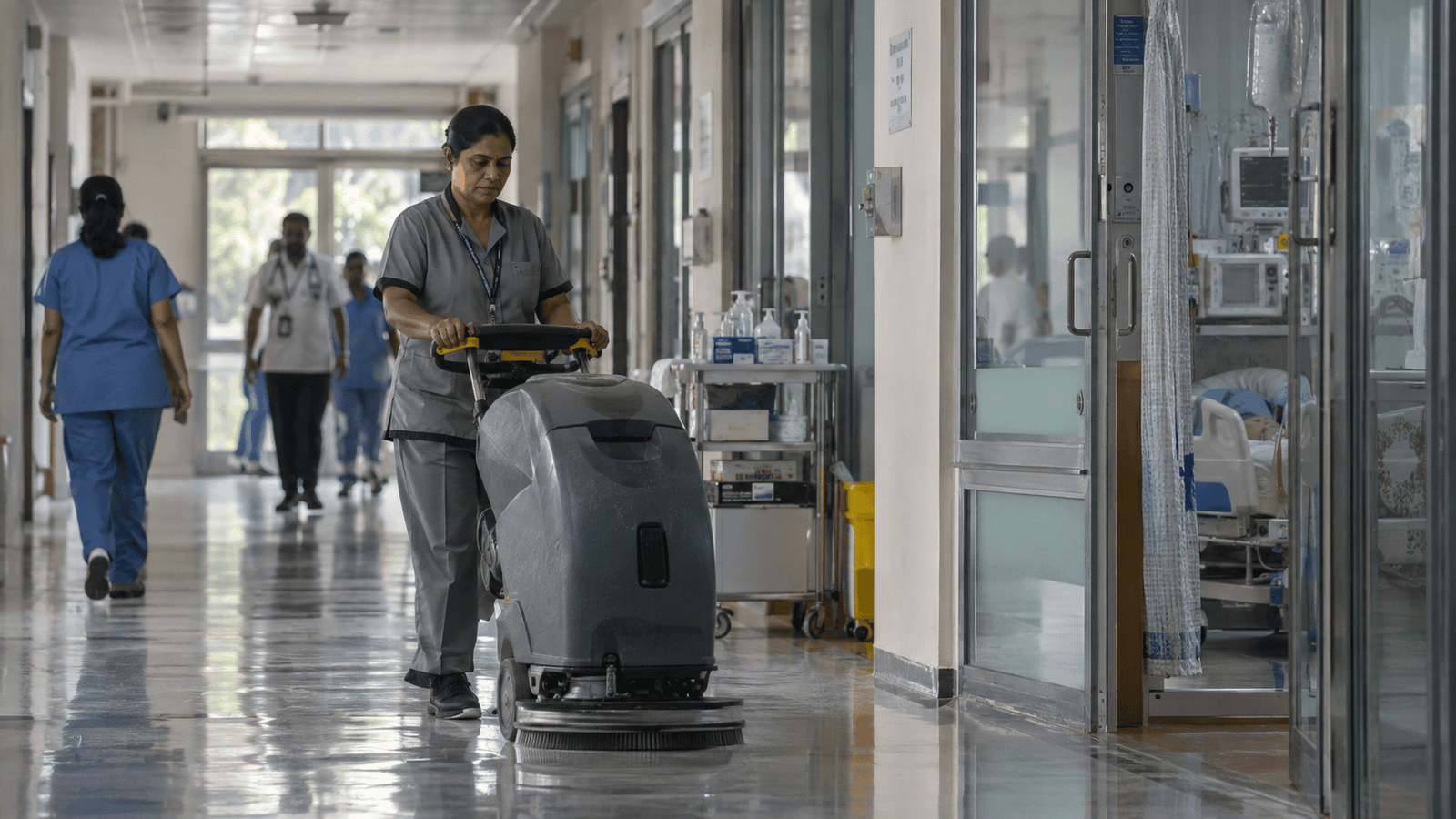
Mechanisation attracts attention because it is visible. A scrubber-drier replacing part of a manual floor-cleaning operation looks like modernisation. A ride-on machine can be budgeted, counted and inspected.
Haryana’s June 2026 announcement is useful precisely because it contains both sides of the argument. The state announced mechanised cleaning and sanitation through PPP arrangements at the district hospitals of Gurugram, Jind and Kurukshetra, with roughly ₹3–3.5 crore to be spent annually across the three hospitals. But the same announcement also called for robust monitoring, regular inspections, accountability and round-the-clock supervision. Haryana Government release.
That distinction matters. Mechanisation can standardise parts of physical execution: scrub pressure, water recovery, equipment speed and coverage of large floor areas. It cannot independently establish that the hygiene system worked.
A machine does not necessarily know that the wrong chemistry was selected, that the concentration was incorrect, that an isolation-room protocol was missed, that a cloth crossed risk zones, that a disinfectant failed to achieve its required wet contact time, or that a key chemical will be out of stock tomorrow.
So the useful transition is not manual → mechanised. It is activity → controlled execution.
Mechanisation can reduce variation in motion. It does not eliminate variation in method.
“Outcome” has several layers — and they should not be collapsed into one
The farther a metric sits from the cleaning process, the more additional factors influence it. That is why outcome-based hygiene needs a hierarchy of evidence.
Interpretive note. An outcome-based cleaning contract should not automatically be read as a contract for reduced infection rates. In current practice, “outcome based” often refers to defined service outputs, performance conditions and verification rather than direct clinical attribution.
Kayakalp already contains the logic of a more mature hygiene system
The strongest evidence of this shift is not the word “outcome.” It is what the assessment frameworks actually inspect.
The Kayakalp Guidelines 2024 treat sanitation and hygiene as more than visual presentation. The framework examines cleanliness across patient-care and support areas, standard cleaning materials and equipment, standard cleaning methods and the monitoring of cleanliness activities. Infection Prevention and Control is assessed separately.
This begins to separate appearance from process integrity. A floor can look clean while the underlying process remains weak. Conversely, a controlled process can be verified even when the facility is managing high occupancy and rapid turnover.
Once a quality system starts asking whether the right material was available, whether the method was standardised, whether schedules existed, whether staff understood the process and whether somebody monitored the result, housekeeping stops being an invisible support function. It becomes an auditable operating system.
Four implications for hospital hygiene
The policy direction matters because it changes what a capable hygiene system has to make visible.
Cleaning is becoming traceable
Hospital cleaning has always contained a visibility problem. The physical act disappears almost immediately after it happens. A cleaner enters a ward, performs a task and leaves. Unless someone directly observes the process, the organisation may later know little more than that the roster says the task should have happened.
That model becomes increasingly inadequate once quality assurance demands evidence.
A mature hygiene system should increasingly be able to reconstruct a simple chain:
Specify
What needed cleaning, what risk category applied, and what procedure governed the task?
Prepare
What chemistry, dilution, tools and consumables were required, and were they actually available?
Execute
Who completed the process, when, and according to which method?
Verify
What evidence showed the task met the required standard rather than merely being marked complete?
Correct
What happened when a deviation, stock issue, missed task or failed check was identified?
Record
Could management see recurring failure patterns rather than discovering the same problem at the next inspection?
Notice what happens in this model. The chemical container is only one node. So is the machine. So is the housekeeping employee. The outcome emerges from the chain.
NQAS places hygiene inside a wider quality architecture
The National Quality Assurance Standards are organised around eight areas of concern: Service Provision, Patient Rights, Inputs, Support Services, Clinical Care, Infection Control, Quality Management and Outcome.
That architecture is significant because it prevents several concepts from being treated as interchangeable. Inputs are not outcomes. Infection control is not the same thing as visual cleanliness. Quality management is not the same thing as completing a cleaning round.
MoHFW’s 2024–25 annual report also shows how the assurance infrastructure is becoming more digital. The Ministry launched virtual NQAS assessment for Ayushman Arogya Mandirs in June 2024 and introduced an ODK-based IPHS compliance tool and dashboard. As of 11 December 2024, the report said 89% of public health facilities had carried out IPHS self-assessment, and 54% of assessed facilities had a compliance score above 50%. MoHFW Annual Report 2024–25.
The policy significance is not that digital assessment guarantees better cleaning. It is that public healthcare increasingly has infrastructure for defining, observing, documenting and reassessing quality. Housekeeping will eventually be judged inside that same logic.
The supplier is becoming part of the execution architecture
The traditional institutional chemical model is transactional: quotation → purchase order → drum → invoice → repeat.
That model is sufficient when the buyer’s concern ends with obtaining a product at a specified price. It becomes weaker when the institution starts caring about verified execution.
Then different questions appear. Can operators identify the correct dilution? Is product documentation accessible at the point of use? Is the chemistry compatible with the surface and process? Can consumption be compared with expected usage? Is stock approaching depletion? Are different departments improvising different concentrations?
These are not necessarily failures of chemistry. They are failures of the operating system around chemistry.
That is why outcome-oriented procurement could gradually change competition in institutional hygiene. The relevant capability is no longer only formulation strength or price per litre. It increasingly becomes:
Can this product be integrated into a controlled, auditable and repeatable cleaning process?
There is a risk: outcome-based hygiene can become outcome-labelled housekeeping
Terminology should not impress us too easily.
A contract can say “outcome based” while daily management still revolves around attendance, square metres and cleaning frequency. A hospital can install machines while chemical preparation remains uncontrolled. A facility can maintain signed checklists that are completed mechanically. A dashboard can show compliance without proving execution quality.
This is a familiar problem in management systems: measurement can create evidence of the measurement rather than evidence of the outcome.
If contractors are judged only on cleaning rounds, cleaning rounds will be recorded. If they are judged on machines deployed, machines will be deployed. If they are judged on checklist completion, checklists will become complete.
None of those indicators is useless. None independently proves hygiene performance.
The real outcome is controlled variance
Hospitals are not static environments. Occupancy changes. Emergency volumes change. Staff change. Products change. Water chemistry changes. An isolation room is not a corridor. A toilet does not behave like an operating theatre. A spill event does not behave like routine floor maintenance.
The central enemy of institutional hygiene is therefore often uncontrolled variation.
Define acceptable execution
Specify the method, chemistry, concentration, frequency, zoning and evidence required for each cleaning context.
Make deviations visible
Separate a completed task from a correctly completed task. The system should reveal where practice differs from protocol.
Close the loop
A missed round, dilution error or stock-out should trigger corrective action, not simply become another line in an audit report.
Use repeated deviations as management data
If the same ward, product or shift repeatedly fails, the response should move from supervision to system redesign.
India may be building a hygiene accountability stack
Viewed separately, GeM service categories, Kayakalp, NQAS, IPHS dashboards and state-level mechanisation programmes can look like unrelated administrative initiatives.
Viewed together, they begin to form something more coherent.
- Procurement defines the service. What is expected becomes more explicit than simply supplying manpower.
- Standards define acceptable practice. Cleaning becomes part of a wider quality and infection-control architecture.
- Assessment verifies performance. Evidence becomes more important than the assumption that a scheduled task was correctly completed.
- Digital systems make gaps visible at scale. Verification can move from episodic inspection toward continuous management.
The system is not complete. Implementation will vary between states, hospitals and contractors. “Outcome based” does not yet mean that environmental service providers are directly contracted against infection-rate reduction, and clinical outcomes remain multifactorial.
But the direction matters. India does not need another decade in which professional hospital hygiene is defined primarily by the number of cleaners on a roster and the litres of chemical on a purchase order.
The harder question is now available:
Can the facility prove that the cleaning system it purchased was actually executed as intended?
Once procurement starts asking for that evidence, the definition of a hygiene company changes with it. It is no longer enough to supply what cleaning requires. The system increasingly has to help make correct cleaning repeatable, visible and verifiable.
Evidence & sources
Sources & methodology
- National Health Systems Resource Centre — National Quality Assurance StandardsOfficial description of NQAS and its eight Areas of Concern, including Infection Control, Quality Management and Outcome.
- National Health Mission — Kayakalp Guidelines 2024Official 2024 framework used for analysis of sanitation, hygiene, infection control and monitoring in public health facilities.
- Ministry of Health & Family Welfare — Annual Report 2024–25Source for virtual NQAS assessment, the IPHS ODK/dashboard initiative and public-facility self-assessment figures.
- Haryana Government — Mechanised Cleaning System for Three District Hospitals, 17 June 2026Source for the Gurugram, Jind and Kurukshetra initiative, annual spending range and the emphasis on monitoring, inspections and accountability.
- Government procurement document — GeM outcome-based cleaning SLAReference for the service-delivery logic behind outcome-based cleaning, sanitation and disinfection procurement.
- GeM bid reference GEM/2026/B/8010622 — healthcare outcome-based cleaningCurrent procurement signal showing continued use of the healthcare-specific outcome-based service category in September 2026.
This article is an editorial analysis of policy and operating-system signals. It does not claim that all Indian public hospitals have adopted the same model, that outcome-based contracts directly purchase reduced HAI rates, or that mechanisation alone improves clinical outcomes.