Dishwashing at Scale at Om Shanti Retreat Centre
At Om Shanti Retreat Centre, dishwashing sits inside a much larger operating system: a residential and training campus, a high-volume community kitchen, variable visitor demand and a hands-on washing process. This case looks at how concentrated dishwashing chemistry is prepared, used and supplied within that setting.
The interesting part of this case is not the detergent alone. It is the system around it: bulk preparation, repeated handling, self-service washing, campus-wide demand and a supply relationship that has become routine.
Alle’s ClinX has supplied Om Shanti Retreat Centre since September 2024. The kitchen account sits alongside pH-neutral floor care and other housekeeping requirements across the wider campus, with quantities increasing during busier periods.
A kitchen where scale is built into the operation
Om Shanti Retreat Centre is a Brahma Kumaris learning and training campus in Gurugram spread across more than 28 acres. ORC’s own material describes a permanent residential population, multiple training and event spaces, and a 2,300-seat auditorium. That creates a baseline of daily operations alongside a much more variable population of retreat participants, professional groups and visitors.
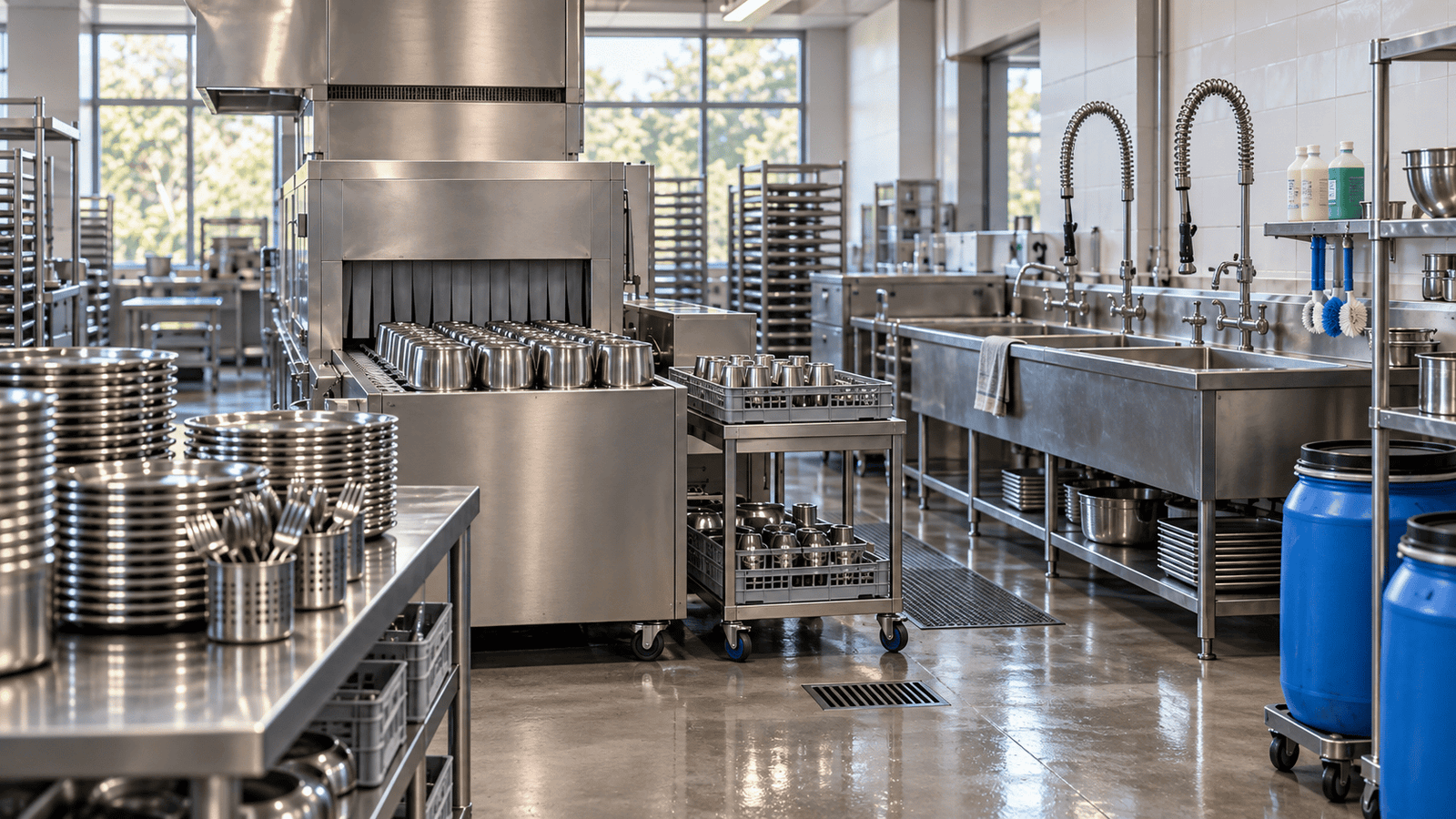
The Mega Community Kitchen is one of the clearest expressions of that scale. ORC’s 2022 newsletter describes it as the biggest kitchen in the region, serving more than 9 lakh people annually and operating through 11 departments. A separate peer-reviewed study of ORC’s solar thermal cooking system documents capacity for about 6,000 meals per day, with food prepared three times daily when the system is in operation.
“Their work has integrated seamlessly with our operations.”Om Shanti Retreat Centre, Letter of Appreciation, 16 September 2025
Dishwashing therefore cannot be treated as a small back-of-house task. It has to fit into the rhythm of a community kitchen that prepares food in institutional volumes, supports large groups and depends on cleaning routines that can continue through changing levels of activity.
The 200-litre batch is the operating unit
A concentrated product becomes a much larger working volume on site, which makes preparation discipline part of the cleaning system itself.
Operating note. This visual represents the preparation method described for ORC: a 50-litre quantity is added to approximately 150 litres of water in a 200-litre blue drum. It is a volumetric operating illustration, not a laboratory statement of active-ingredient concentration.
Key insights
Four operating patterns stand out. The common thread is that chemistry performs inside a system of preparation, people, demand and supply continuity.
How the dishwashing system is approached
The process is simple on paper, but each step affects how the chemistry enters the kitchen’s daily routine.
Concentrate arrives in institutional pack sizes
For the Mega Community Kitchen, concentrated dishwashing chemistry is supplied in 50-litre cans rather than only as a ready-to-use liquid.
A larger working batch is made on site
A 50-litre quantity is introduced into roughly 150 litres of water in a 200-litre drum, producing approximately 200 litres of working solution.
The prepared solution moves into the washing operation
The drum functions as a central preparation point before the solution is used or distributed across the relevant washing areas.
Feedback comes from the people handling it repeatedly
Because staff and other users interact directly with the washing process, day-to-day observations about handling and comfort become useful qualitative operating feedback.
When dishwashing chemistry is handled by people, not hidden inside a machine
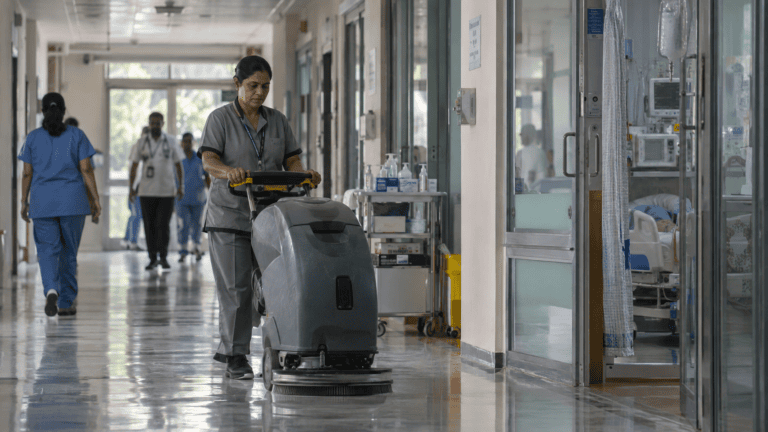
In an automated warewashing system, most users never encounter the cleaning chemistry directly. ORC’s self-service and hands-on washing environment changes that relationship. The working solution may be handled repeatedly by people who spend significant time around the washing process, while large numbers of users can also interact with the same system during busy periods.
Staff responsible for dishwashing have reported that, compared with their earlier experience, their hands no longer become as itchy or cracked during routine use. The case treats this as first-hand operating feedback from people who work inside the process.
This staff feedback is not a dermatological finding or a universal skin-safety claim. Product safety and occupational handling remain governed by the relevant product documentation, dilution instructions and workplace procedures.
The distinction matters. In high-contact institutional cleaning, a formulation can be judged not only by whether it removes soil, but by whether it can be incorporated into a repeatable process that staff are willing and able to use consistently.
A supply relationship that extends across the campus
The kitchen is only one layer of the ORC account. Alle’s ClinX also supplies a pH-neutral floor cleaner and other housekeeping products for different parts of the campus. The mix reflects a basic institutional reality: kitchen soil, floor maintenance and general housekeeping do not create the same chemical requirement even when they sit under one procurement relationship.
Quantities also change with activity. ORC combines a permanent residential base with retreats, seminars, conferences and visiting groups, so the chemical requirement is not static. In peak periods, the amount supplied rises with the intensity of operations.
The relationship has also developed a logistical dimension. Dadi Gulzar Shanti Upavan, a separate Brahma Kumaris property in Manesar about a ten-minute drive from ORC and spread over four acres, forms part of the wider operating context. In practice, associated centres have at times asked Alle’s ClinX to leave their chemical requirements at ORC as an established receiving point.
This should not be read as a formal distribution arrangement. It is better understood as a sign of operational familiarity: once a supplier relationship becomes dependable, the receiving point itself can become useful to nearby or associated teams.
The relationship over time
Regular supply begins
Alle’s ClinX begins the continuing ORC supply relationship described in this case.
The account expands across operating needs
Concentrated dishwashing chemistry, pH-neutral floor care and other housekeeping requirements are supplied according to department and usage.
Volumes rise with campus activity
Supply quantities increase when visitor and programme activity raises the cleaning load.
ORC issues a letter of appreciation
The letter acknowledges QR-guided protocols, resource-conscious practices, reliable supply, on-time deliveries and confidence in the quality and reliability of Alle’s ClinX solutions.
The supply relationship continues
Alle’s ClinX remains a regular supplier to ORC, with the relationship operating as part of the centre’s routine hygiene procurement.
What changed in practice
The clearest outcome is continuity rather than a headline percentage. The supply relationship has remained active since September 2024; ORC’s September 2025 appreciation letter specifically described the supply chain as reliable and deliveries as consistently on time. Staff in the dishwashing operation also reported a better day-to-day hand-use experience than with the previous chemistry.
- Institutional dilution is an operating system. Pack size, preparation volume, storage and distribution all influence how the product actually performs in use.
- Human factors matter where chemistry is handled manually. User feedback cannot replace testing, but it can reveal whether a process is workable day after day.
- Demand planning should reflect occupancy and event cycles. A residential campus with large programmes naturally carries both baseline and peak cleaning demand.
- Reliability becomes part of the hygiene system. A chemical formulation only creates value when it is available, prepared correctly and integrated into the facility’s routine.
Sources & methodology
- Om Shanti Retreat Centre — About UsOfficial ORC information on the 28-acre campus, learning and training facilities, and institutional setting.
- ORC Reporter, April 2022Official ORC newsletter covering the Mega Community Kitchen, 9 lakh+ annual reach, 11 departments, 150 permanent residents, the 2,300-seat auditorium and Dadi Gulzar Shanti Upavan.
- Solar Energy — Performance analysis of ORC’s Scheffler cooking systemPeer-reviewed technical context documenting a 6,000-meal-per-day system, 28 collectors and three daily cooking cycles when operational.
- pv magazine India — ORC solar microgridIndependent context on the scale and continuity requirements of ORC’s campus infrastructure.
- Om Shanti Retreat Centre, Letter of Appreciation, 16 September 2025Client-supplied document acknowledging QR-guided protocols, resource-conscious practices, reliable supply, on-time delivery and confidence in Alle’s ClinX.
- Alle’s ClinX operating records and relationship notesPrimary source for the September 2024 supply start, product mix, described 50 L + 150 L preparation method, peak-period demand and qualitative staff feedback.
Where public sources establish ORC’s scale and infrastructure, they are used as contextual evidence. Claims about Alle’s ClinX supply routines come from the client relationship and internal operating information. Qualitative observations are identified separately from measured or independently verified outcomes.