Quaternary Ammonium Compounds: What They Are and How They Are Used in Disinfection
A facility-focused guide to quaternary ammonium compounds (QACs): their chemical structure, disinfectant uses, benzalkonium chloride, limitations, hard-water effects, cloth compatibility and how to specify a QAC product correctly.
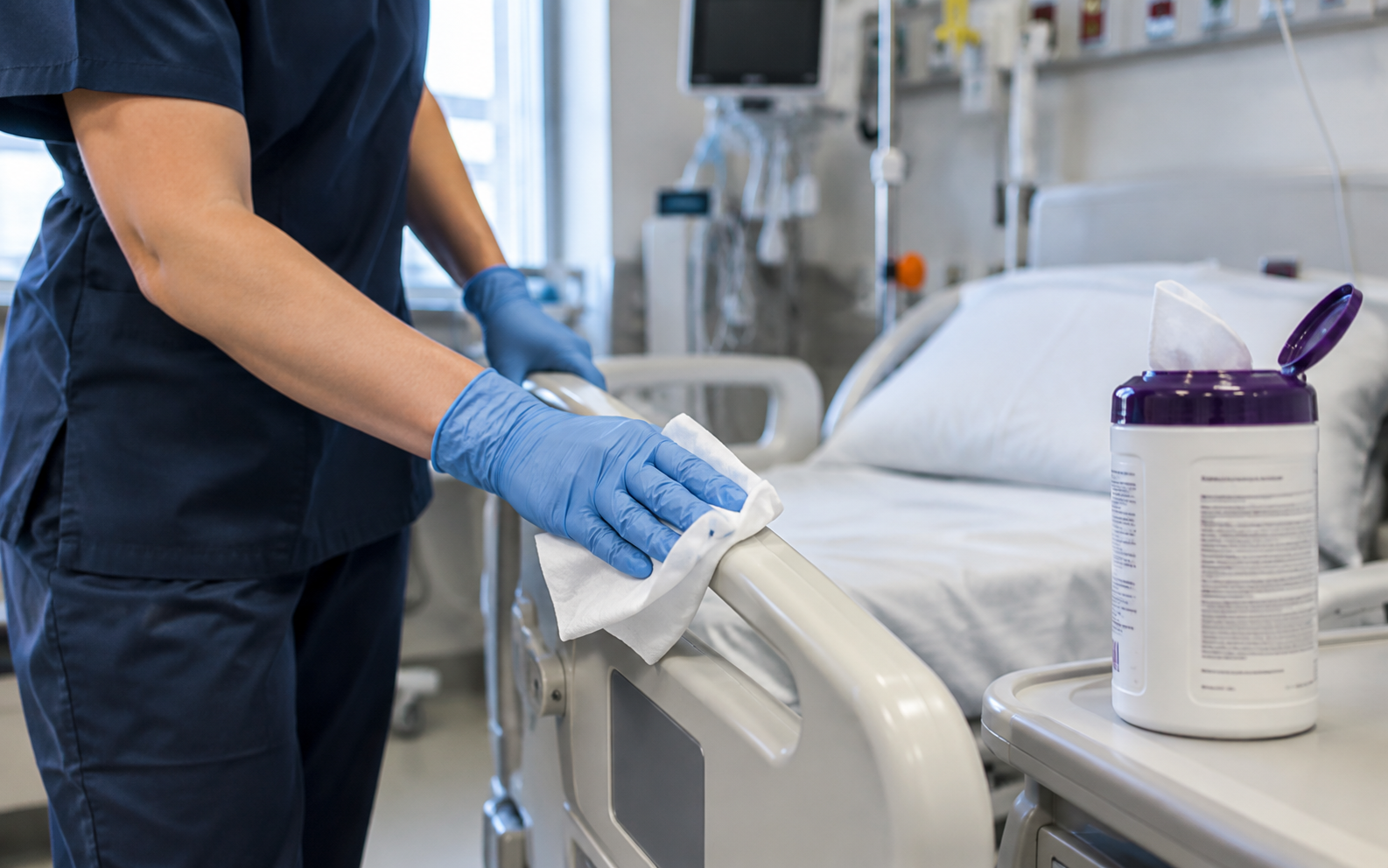
CDC notes two easily overlooked QAC variables: high water hardness can reduce microbicidal activity, and cotton or gauze can absorb quaternary ammonium active ingredients.
Quaternary ammonium compounds are among the most common low-level disinfectant chemistries used on environmental surfaces. But “quat”, “QAC” and “benzalkonium chloride” are often treated as interchangeable names when they describe different levels of chemical specificity.
A QAC is a chemical class. Benzalkonium chloride is one well-known member of that class. A finished disinfectant may use one QAC, multiple QACs or a formulation in which the quaternary active is only one part of the performance system.
What is a quaternary ammonium compound?
A quaternary ammonium compound contains a positively charged nitrogen atom bonded to four organic groups. A simplified structural representation is:
R4N+ X−
The four R groups can vary, which is why QACs are a broad family rather than one chemical. The counter-ion X− is commonly chloride or another anion.
Why are QACs used in disinfectants?
QACs are cationic surfactants. Their positively charged portion can interact with microbial cell surfaces and membranes, while their surfactant character also contributes to wetting and cleaning behaviour in formulated products.
CDC classifies quaternary ammonium compounds as low-level disinfectants and notes that they are commonly used for ordinary environmental sanitation of noncritical surfaces such as floors, furniture and walls.
Is benzalkonium chloride a QAC?
Yes. Benzalkonium chloride is a quaternary ammonium compound, but not every QAC is benzalkonium chloride.
This distinction matters in specifications. A tender that says “QAC disinfectant” defines a broad active class. A specification that says “benzalkonium chloride” identifies a narrower chemistry, although even BKC itself may contain a mixture of alkyl-chain homologues.
Where are QAC disinfectants used?
According to CDC, QAC formulations are widely used on noncritical environmental surfaces. EPA-registered QAC products can also be labelled for selected noncritical medical equipment that contacts intact skin, depending on the product.
Typical institutional use areas can include:
- floors and walls in suitable healthcare or institutional zones;
- furniture and other hard, nonporous environmental surfaces;
- selected high-touch surfaces where the specific product label permits use;
- some noncritical equipment surfaces, subject to manufacturer compatibility instructions.
What organisms do QACs work against?
Performance varies by formulation, concentration and test claim. CDC describes QACs as generally bactericidal, fungicidal and virucidal against enveloped viruses, but also notes important limitations.
QACs are not generally sporicidal, and CDC describes them as not tuberculocidal or reliably mycobactericidal under ordinary low-level-disinfectant use conditions. That makes organism-specific claims important.
Procurement rule: “contains QAC” is not an efficacy claim. The finished product should be selected against the organisms and test standards relevant to the facility.
Why hard water can reduce QAC performance
Water quality can change disinfectant behaviour. CDC notes that high water hardness can reduce the microbicidal activity of some quaternary ammonium compounds because calcium and magnesium ions can interact with the disinfectant.
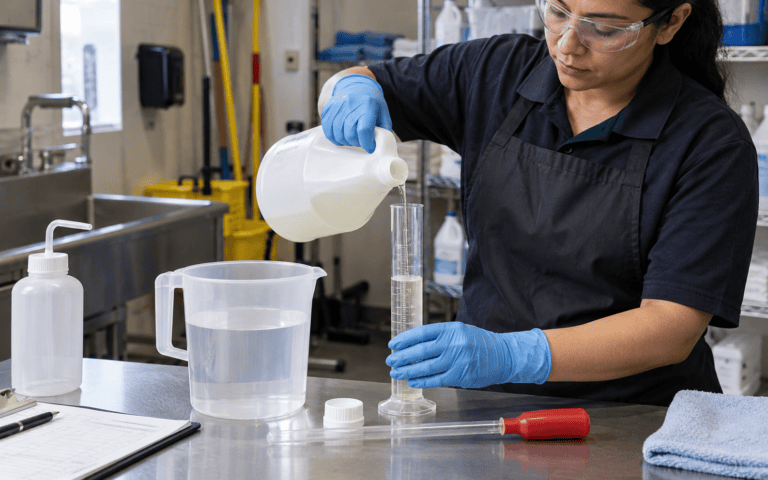
This creates a practical issue for concentrated products. Two facilities using the same dilution ratio may not produce chemically identical working conditions if one has soft water and the other has very hard water.
Why cotton and gauze can matter
CDC also reports that cotton and gauze materials can absorb quaternary ammonium active ingredients. In practical terms, the wiping material can remove some active chemistry from the solution before it reaches the surface.
This is why professional disinfection programmes should verify compatibility not only with the surface but also with the cloth, wipe or mop system used to apply the product.
How pH affects QAC activity
CDC’s disinfection-efficacy guidance notes that an increase in pH can improve the antimicrobial activity of some disinfectants, including quaternary ammonium compounds. That is one reason a finished QAC formulation cannot be understood from active percentage alone.
Builders, surfactants, pH adjustment and other formulation components can influence cleaning behaviour, wetting, stability and antimicrobial performance.
Are QACs cleaners or disinfectants?
They can be part of products that do both, but the distinction depends on the formulation and label. A QAC active has surfactant properties, yet a finished disinfectant still needs to meet the required efficacy claim and use instructions.
Where a one-step cleaner-disinfectant is validated for the target soil conditions, a separate detergent step may not always be required. Where heavy organic soil is present, pre-cleaning may still be necessary.
QACs compared with chlorine disinfectants
| Characteristic | QAC disinfectants | Hypochlorite disinfectants |
|---|---|---|
| Typical level | Often low-level environmental disinfection | Broad chlorine disinfection depending on concentration |
| Water hardness | Can reduce activity of some QACs | CDC notes hypochlorites are not affected by water hardness |
| Organic soil | Product-specific; pre-cleaning often important | Free chlorine is consumed by organic matter |
| Metal compatibility | Often relatively suitable for routine hard surfaces, product-dependent | Higher chlorine concentrations can be corrosive to metals |
| Spores | Routine QACs are not sporicidal | High chlorine concentrations can have sporicidal applications under defined conditions |
Why contact time still matters
A QAC disinfectant does not become effective the instant the surface is wiped. The product needs to remain in contact with the surface for the time specified by its efficacy claim.
If a facility changes from a spray-and-wipe routine to pre-saturated wipes, mop application or another delivery system, it should confirm that enough solution is applied to maintain the required wet contact time.
Can QACs leave residue?
Because QACs are surface-active chemicals, repeated use can leave residue on some surfaces depending on formulation, dose and rinsing practice. In some facilities, residue becomes a visual or operational issue on floors, glass-like surfaces or equipment.
The solution is not automatically to stop using QACs; it is to use the correct concentration and cleaning schedule, and to include periodic residue-removal cleaning where needed.
How facilities should specify a QAC disinfectant
- Active chemistry: identify the QAC or QAC blend rather than writing only “disinfectant”.
- Use concentration: specify the in-use concentration or manufacturer dilution.
- Microbial claims: match the product claim to the organisms of concern.
- Contact time: confirm the required wet dwell period.
- Water-quality limits: consider hardness where the product is diluted on site.
- Wipe compatibility: check cloth, mop and wipe materials.
- Surface compatibility: verify against flooring, coatings, plastics and equipment.
- Residue management: define whether rinsing or periodic restorative cleaning is required.
Related: Benzalkonium Chloride (BKC): What It Is, Uses, Formula and Solution Types
The practical takeaway
Quaternary ammonium compounds are useful because they combine surface activity with low-level disinfectant performance in many routine institutional applications. Their limitations are equally important: hard water and some wiping materials can reduce delivered activity, and routine QACs do not cover every microorganism.
For procurement, the mature question is not “Is this a quat?” but “Which QAC system, at what concentration, with what claim, on which surface and using which application method?”
Frequently asked questions
What are quaternary ammonium compounds?
QACs are positively charged nitrogen-containing compounds with four organic groups attached to the nitrogen. Many are cationic surfactants used in disinfectant formulations.
Is benzalkonium chloride a quaternary ammonium compound?
Yes. Benzalkonium chloride is one type of QAC, but the QAC class includes many other structures.
Are QAC disinfectants sporicidal?
Routine low-level QAC disinfectants are generally not sporicidal.
Does hard water affect quaternary ammonium disinfectants?
Yes. CDC notes that high water hardness can reduce the microbicidal activity of some QACs.
Can cotton cloth reduce QAC concentration?
CDC reports that cotton and gauze can absorb quaternary ammonium active ingredients, which can reduce the amount available for disinfection.
Sources
CDC — Chemical Disinfectants: Quaternary Ammonium Compounds.
CDC — Factors Affecting the Efficacy of Disinfection and Sterilization.
CDC — Environmental Cleaning and Disinfection.
Image: David Shay, Wikimedia Commons, CC BY-SA 3.0.