Sodium Hypochlorite: What It Is, Formula, Uses and Disinfection Applications
A technical guide to sodium hypochlorite (NaClO): its formula, available chlorine, disinfectant action, common institutional uses, limitations, storage issues and safety precautions.
Sodium hypochlorite has the molecular formula NaClO and a molecular weight of 74.44 g/mol; CDC notes that hypochlorite working solutions can also lose substantial free available chlorine during storage.
Sodium hypochlorite is one of the most widely used chlorine-releasing disinfectants. It is inexpensive, fast acting and effective against a broad range of microorganisms — but its usefulness depends on concentration, organic load, contact time, storage and the material being treated.
In institutional cleaning, “bleach”, “chlorine solution” and “sodium hypochlorite” are often used as if they mean exactly the same thing. They do not. Sodium hypochlorite is the chemical; bleach is a formulated aqueous product that contains it at a stated concentration.
What is sodium hypochlorite?
Sodium hypochlorite is an inorganic sodium salt of hypochlorous acid. PubChem gives the molecular formula as NaClO (also written NaOCl) and a molecular weight of 74.44 g/mol.
In water, hypochlorite chemistry exists in equilibrium with hypochlorous acid. The balance between those species depends strongly on pH, which in turn influences antimicrobial behaviour and chemical stability.
What is the chemical formula of sodium hypochlorite?
The formula is:
NaClO
It consists of sodium (Na+) and hypochlorite (ClO−) ions. Commercial sodium-hypochlorite products are supplied as aqueous solutions rather than as pure dry NaClO under ordinary facility use.
What does “available chlorine” mean?
Disinfection guidance often expresses chlorine strength as available chlorine rather than only as percentage sodium hypochlorite. The distinction matters because facilities may compare products by percent, grams per litre or parts per million (ppm).
As a practical concentration relationship, a solution containing 0.05% available chlorine corresponds to about 500 ppm, 0.1% corresponds to about 1,000 ppm and 0.5% corresponds to about 5,000 ppm.
Why sodium hypochlorite is widely used as a disinfectant
CDC describes hypochlorites as the most widely used chlorine disinfectants and notes several reasons for their continued use: they have broad-spectrum antimicrobial activity, act quickly, are inexpensive and are not affected by water hardness.
That combination is useful in hospitals and other institutional environments where large hard-surface areas may need a chlorine-based disinfectant.
Where sodium hypochlorite is used
Depending on the finished product, concentration and local SOP, chlorine-based solutions may be used on selected environmental surfaces, sanitary fittings, blood/body-fluid contamination and other hygiene-critical tasks.
WHO environmental-cleaning guidance describes chlorine-based disinfectant solution as an option after cleaning for sanitary fittings such as toilets, sinks, showers, basins, baths, taps and fixtures, as well as for terminal cleaning and selected procedural areas.
India’s National Guidelines for Infection Prevention and Control in Healthcare Facilities likewise include sodium hypochlorite for environmental disinfection and blood/body-fluid contamination, with concentration determined by the task.
Cleaning should usually come before chlorine disinfection
Sodium hypochlorite is a disinfectant, not a substitute for soil removal. CDC notes that hypochlorites are inactivated by organic matter. Blood, mucus, food residue and other soil can therefore consume active chlorine and interfere with the process.
For routine environmental disinfection, the more reliable sequence is to remove visible soil first, then apply the chlorine solution at the required working concentration and contact time.
What concentrations are used?
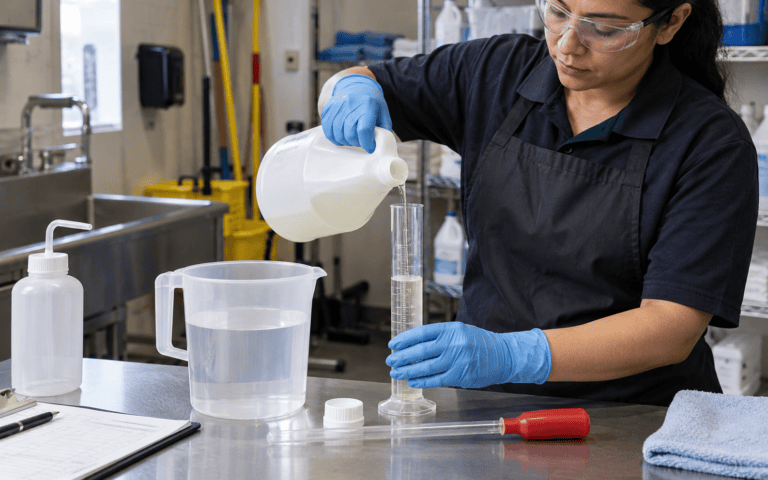
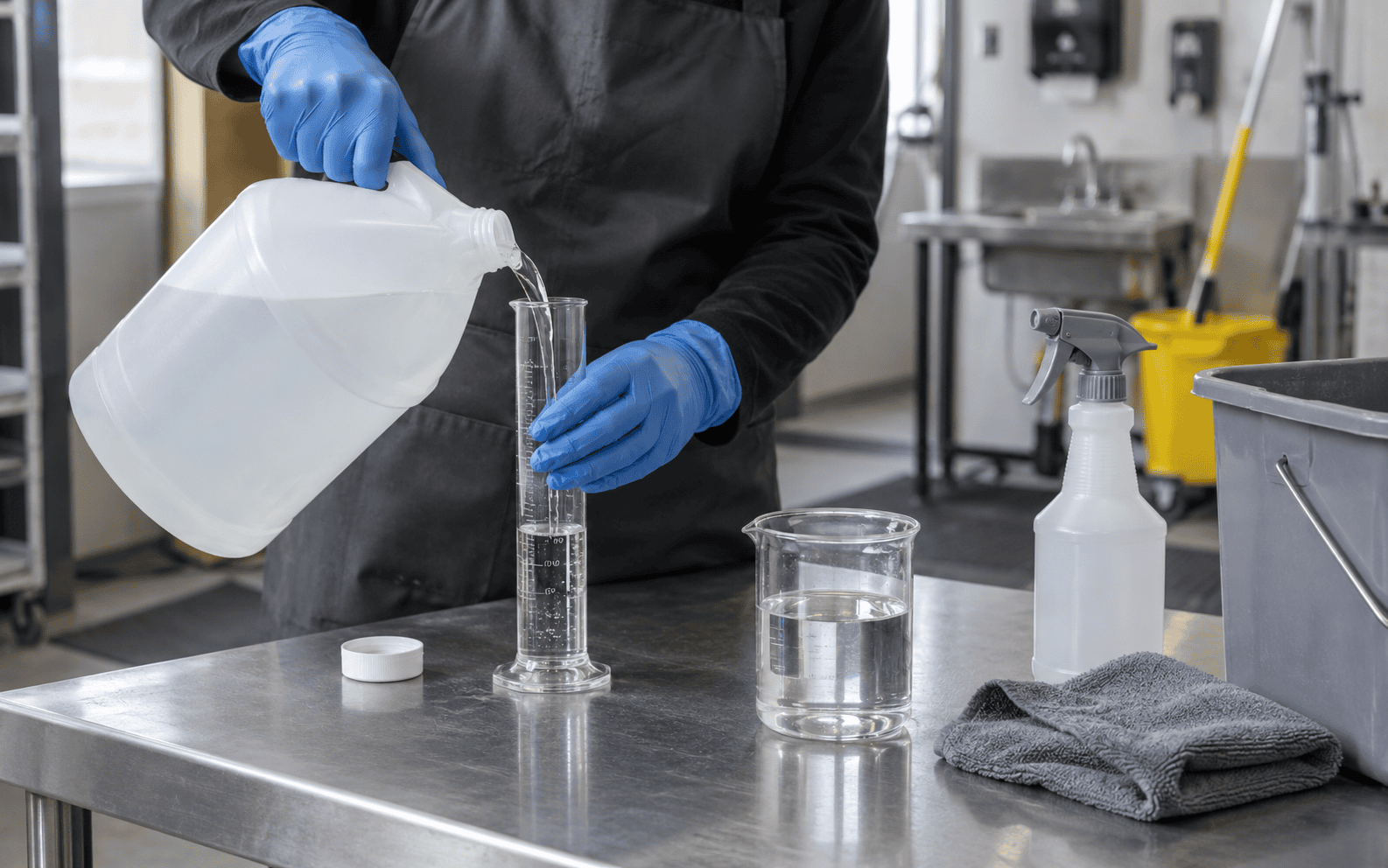
There is no single universal sodium-hypochlorite concentration for every task. Concentration depends on the organism, soil load, product label, regulatory guidance and surface.
| Available chlorine | Approx. ppm | Example context in guidance |
|---|---|---|
| 0.05% | 500 ppm | Some routine disinfection guidance uses concentrations in this range |
| 0.1% | 1,000 ppm | Commonly cited for selected environmental disinfection protocols |
| 0.5% | 5,000 ppm | Used in some higher-soil or body-fluid decontamination protocols |
| 1% | 10,000 ppm | Used in some healthcare protocols for blood/body-fluid contamination |
These values are not a universal dosing chart. Facilities should follow the product label, manufacturer instructions and applicable national or sector guidance.
How powerful is sodium hypochlorite?
CDC cites laboratory evidence showing activity of free chlorine at relatively low ppm levels against a range of organisms under controlled conditions. It also notes that a 5,000 ppm chlorine solution can inactivate high levels of Clostridioides difficile spores under specific test conditions.
The operational lesson is not that every surface should receive 5,000 ppm. It is that chlorine concentration must match the microbial target and contamination conditions.
Why organic matter matters
Chlorine is chemically reactive. That is useful for disinfection, but it also means chlorine can be consumed by organic contamination before it reaches the microorganisms of interest.
This is one reason pre-cleaning matters. A visibly dirty surface and a pre-cleaned surface may require different chlorine conditions even if they are made from the same material.
Sodium hypochlorite and metal corrosion
CDC lists corrosiveness to metals as an important disadvantage of hypochlorites, particularly at higher concentrations. Repeated chlorine exposure can damage certain metals, finishes and equipment components.
Where chlorine is required on metal surfaces, product compatibility, concentration, contact time and rinsing instructions should be explicitly defined.
Why sodium hypochlorite can lose strength in storage
Hypochlorite solutions are not perfectly stable. CDC reports that hypochlorite in tap water stored at room temperature in closed opaque plastic containers can lose substantial free available chlorine over time — in one cited condition, up to 40–50% over one month.
That is why many institutional protocols call for freshly prepared working solutions and why concentrated stock should be stored according to the manufacturer’s requirements, protected from heat and light.
Procurement point: the concentration printed on a stock container is only useful if the product has been stored correctly and the working solution is prepared and used within its validated life.
Never mix sodium hypochlorite with acids or ammonia
This is one of the most important chemical-safety rules in cleaning operations. CDC warns that hypochlorite can release toxic chlorine gas when mixed with acids. Mixing bleach with ammonia can also produce dangerous chloramine gases.
In facilities, the practical control is segregation: separate storage, dedicated labelled dilution containers and staff training that prohibits chemical mixing.
Does bleach work better when stronger?
No. Higher concentration can increase corrosion, material damage, odour and exposure risk. It can also be unnecessary for the intended microbial claim.
A disinfectant concentration should be treated as an operating specification, not a variable to be increased by the cleaner. The correct strength is the one supported by the product label or institutional protocol for that task.
Sodium hypochlorite vs hypochlorous acid
These terms are related but not interchangeable. Sodium hypochlorite dissolves in water and participates in an equilibrium that includes hypochlorous acid. Hypochlorous-acid products are formulated differently and often operate at different pH ranges and use concentrations.
The product label and validated claim — not just the presence of “chlorine” — determine how each solution should be used.
Related: Benzalkonium Chloride (BKC): What It Is, Uses, Formula and Solution Types
The practical takeaway
Sodium hypochlorite remains important because it combines broad antimicrobial activity with low raw-material cost and simple dilution. Its limitations are equally important: organic matter reduces activity, higher concentrations can corrode metals, working solutions lose strength and incompatible chemical mixing can create toxic gas.
In institutional use, chlorine works best when treated as a controlled specification: clean first where required, dilute accurately, respect contact time, protect incompatible materials and never improvise chemical mixtures.
Frequently asked questions
What is the formula of sodium hypochlorite?
The molecular formula is NaClO, also commonly written NaOCl.
What is sodium hypochlorite used for?
It is used as a bleaching agent and chlorine-releasing disinfectant in applications including selected environmental surfaces and contamination-control tasks.
Is 1% sodium hypochlorite equal to 10,000 ppm?
When expressed as available chlorine on the same concentration basis, 1% corresponds to approximately 10,000 ppm.
Why does bleach lose strength over time?
Hypochlorite decomposes during storage, with loss accelerated by factors such as heat, light, time and solution conditions.
Can sodium hypochlorite be mixed with acid?
No. Acidifying hypochlorite can release toxic chlorine gas.
Sources
PubChem — Sodium Hypochlorite (NaClO).
CDC — Chemical Disinfectants: Chlorine and Chlorine Compounds.
WHO — Environmental cleaning and infection prevention and control in health care facilities.
NCDC, Ministry of Health & Family Welfare, Government of India — National Guidelines for Infection Prevention and Control in Healthcare Facilities.