How to Clean Marble, Granite and Natural Stone Without Damaging It
A practical guide to cleaning marble, granite, limestone, travertine and other natural stone — including acid sensitivity, neutral cleaners, sealing, stain removal and the mistakes that permanently damage stone.
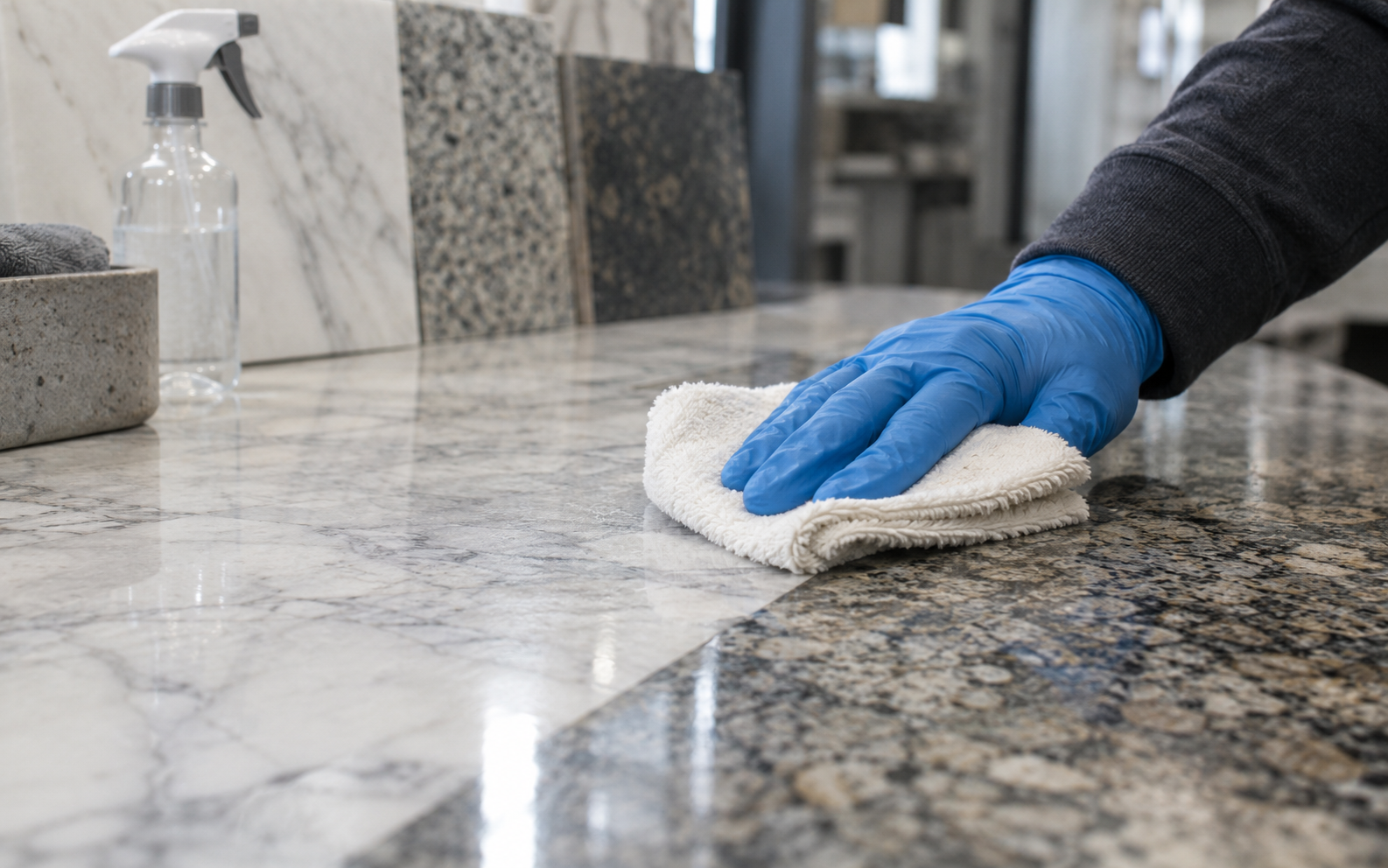
Natural Stone Institute guidance states that calcareous stone is composed mainly of calcium carbonate and is acid-sensitive; it also warns that hydrofluoric acid can attack siliceous stones including granite and quartzite.
Natural stone is often cleaned as though it were one material. It is not. Marble, limestone and travertine are chemically different from granite and quartzite, and the wrong cleaner can turn a routine housekeeping task into permanent surface damage.
The most important step is therefore not choosing a “stone cleaner”. It is identifying what kind of stone is actually installed and understanding whether that stone is calcareous or siliceous.
Why marble and granite need different cleaning chemistry
The Natural Stone Institute separates natural stone into broad chemical groups. Calcareous stone is composed mainly of calcium carbonate. Marble, limestone and travertine fall into this category and are sensitive to acidic solutions.
Siliceous stones are composed primarily of silicate minerals such as quartz, feldspar and mica. Granite and quartzite are common examples. They are generally more resistant to acids encountered in ordinary environments, but the Institute still advises against acidic cleaners because trace minerals, finishes and treatments may be acid-sensitive.
What cleaner is safest for natural stone?
For routine maintenance, the safest default is usually a neutral cleaner specifically approved for natural stone, stone soap or a mild detergent used at the correct concentration. The Natural Stone Institute recommends neutral cleaning and warns that excessive soap or cleaner can leave film and streaks.
That is an important operational point for facilities: more concentrate does not necessarily mean more cleaning. Overdosing can create residue, alter slip behaviour and make a polished floor look dull even when the stone itself has not been damaged.
Why vinegar, lemon and acidic washroom cleaners can damage marble
Acid reacts with calcium carbonate. On marble, limestone and other calcareous stone, this reaction can dissolve microscopic parts of the surface and create etching — a dull, lighter or rougher patch that cannot simply be wiped away.
This is why vinegar is not a “natural safe cleaner” for marble. It may remove mineral deposits or soap residues while simultaneously attacking the surface beneath them.
A cleaner can remove the soil and still damage the stone. Cleaning performance and material compatibility are separate questions.
What is etching?
Etching is chemical surface damage, not a stain sitting on top of the stone. On polished marble, an etched area often appears as a dull spot because the acid has altered the polished surface structure.
Once etching occurs, ordinary cleaning will not restore the original polish. Depending on severity, the area may require honing, polishing or professional stone restoration.
How to clean marble safely
- Remove dry grit first. Dust, sand and tracked particles can scratch polished stone when dragged under a mop or cloth.
- Use a pH-neutral stone cleaner. Follow the manufacturer’s dilution rather than using an improvised acid or alkaline mix.
- Use a soft mop or cloth. Avoid abrasive pads unless specifically approved for that finish.
- Do not flood the surface. Excess water can enter joints, edges and unsealed areas.
- Rinse if the product requires it. Residue can create haze or streaking.
- Dry the surface. Particularly on polished stone where water spotting is visible.
How to clean granite safely
Granite is generally more chemically resistant than marble, but routine care should still be conservative. Use a neutral cleaner, soft cloth or clean mop, and avoid products containing harsh acids, strong alkalis or abrasive powders unless the stone supplier specifically approves them.
Why the caution if granite is siliceous? Because a floor or countertop is not simply “granite”. It may contain acid-sensitive accessory minerals, resin, sealers, grout, adhesives, metal trim or surface treatments.
What about limestone and travertine?
Limestone and travertine are calcareous materials and should be treated with the same acid caution as marble. In washrooms, this becomes particularly important because conventional limescale remover is often acidic.
A hard-water deposit on limestone creates a difficult chemistry problem: the deposit may contain calcium carbonate, but so does the stone. A descaler that dissolves the scale can also etch the substrate. Stone-specific products or professional restoration may be required.
Can natural stone be disinfected?
Yes, but the disinfectant must be compatible with the stone, finish, seal treatment and surrounding materials. The hygiene requirement should also be justified. In many low-risk areas, routine detergent cleaning is the main task; disinfection should not be added simply because a stronger chemical sounds more hygienic.
Where disinfection is required, use a product whose label and technical documentation support the surface and intended microbial claim. Avoid uncontrolled use of acidic or highly alkaline chemistry on sensitive stone.
Does sealing make marble or granite stain-proof?
No. The Natural Stone Institute makes an important distinction: stone “sealers” used in the industry are commonly impregnators. They act as repellents and make stone more stain-resistant, but they do not make the surface stain-proof.
This matters for procurement and maintenance. Sealing does not remove the need for rapid spill response, correct cleaning chemistry or periodic inspection.
Facility rule: treat sealing as a stain-resistance measure, not as permission to use harsher cleaners.
How should spills be handled on natural stone?
Blot liquid spills rather than spreading them. Remove the contaminant quickly, then clean with a compatible product. If a stain remains after normal cleaning, identify the stain type before selecting a treatment.
Oil, rust, organic stains, paint and biological staining do not respond to the same chemistry. Stone stain removal often uses poultices or specialised agents chosen for both the stain and the stone.
Why abrasive powders are risky
The Natural Stone Institute warns that scouring powders and creams may contain abrasives that scratch some stone surfaces. On a polished floor, microscopic scratching gradually reduces gloss and makes the area appear dirty even after cleaning.
Facilities should therefore specify pad grade and tool type in the SOP. “Scrub until clean” is not an acceptable instruction for polished stone.
A surprising exception: hydrofluoric acid can attack granite too
It is tempting to think “granite resists acid, therefore any acid is safe”. That is false. The Natural Stone Institute specifically warns that some commercial rust removers contain hydrofluoric acid, which attacks silicates. All stones, including granite and quartzite, can be attacked by hydrofluoric acid.
This is a useful reminder that a product name such as “rust remover” does not tell you whether the chemistry is compatible with stone.
Natural stone cleaning by material
| Stone | General chemistry | Main cleaning risk |
|---|---|---|
| Marble | Neutral stone cleaner | Acid etching, abrasion |
| Limestone | Neutral stone cleaner | Acid attack, staining |
| Travertine | Neutral stone cleaner | Acid etching, damage to filled voids |
| Granite | Neutral cleaner; verify specialised chemistry | Residue, seal/finish damage, HF attack |
| Quartzite | Neutral cleaner; verify specialised chemistry | Trace-mineral sensitivity, HF attack |
What institutional stone-care SOPs should include
- Stone identification: record the material used in each zone.
- Approved cleaner: define product, dilution and method.
- Prohibited chemistry: list acids, alkalis or abrasives that must not be used.
- Spill response: especially for acidic food, drinks and washroom products.
- Pad and mop specification: control mechanical abrasion.
- Sealer status: note whether the stone is treated and when it was last assessed.
- Escalation point: define when a stain or etched area moves from housekeeping to specialist restoration.
Related: Cleaning Chemical Compatibility: How to Prevent Surface and Material Damage
The practical takeaway
Natural stone care is a material-compatibility discipline. Marble and limestone are chemically vulnerable to acids; granite is more resistant but still not immune to unsuitable products or treatments.
The safest institutional rule is: identify the stone first, use neutral chemistry for routine care, and treat stains or deposits as separate problems rather than reaching for a stronger general cleaner.
Frequently asked questions
Can vinegar be used to clean marble?
No. Marble is a calcareous stone containing calcium carbonate, which is sensitive to acidic solutions such as vinegar and can etch.
What is the safest routine cleaner for natural stone?
A pH-neutral cleaner designed for natural stone, stone soap or a mild compatible detergent is generally the safest routine approach.
Is granite safe from all acids?
No. Granite is generally more acid-resistant than marble, but acidic cleaners are still not routinely recommended, and hydrofluoric acid can attack silicates including granite and quartzite.
Does sealing make natural stone stain-proof?
No. Stone impregnators make many stones more stain-resistant, but the Natural Stone Institute notes that they do not make stone stain-proof.
What is etching on marble?
Etching is chemical surface damage caused when acid reacts with the calcium-carbonate stone, often leaving a dull or lighter patch.
Sources
Natural Stone Institute — Care & Cleaning of Natural Stone.
Natural Stone Institute — Removing Stains from Stone Applications.