Hard Water Stains: What Causes Them and How Facilities Remove Them
Learn what causes hard-water stains and limescale, how water hardness is measured, why calcium deposits form, and how facilities remove mineral scale without damaging surfaces.
USGS classifies 0–60 mg/L as CaCO₃ as soft, 61–120 mg/L as moderately hard, 121–180 mg/L as hard, and more than 180 mg/L as very hard.
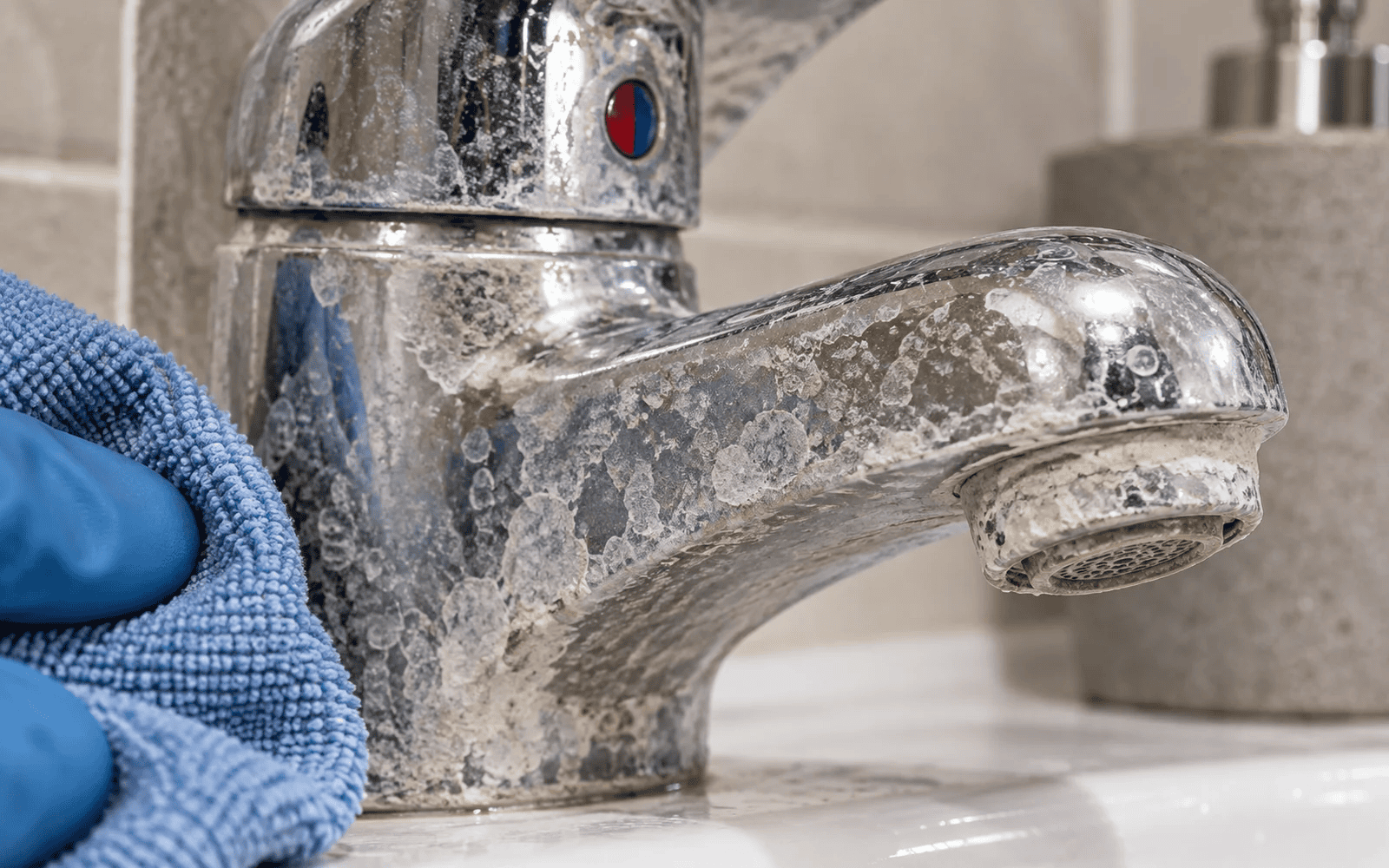
Hard-water stains are not simply “dirt”. They are the visible residue of dissolved minerals left behind as water evaporates, splashes repeatedly or is heated. That is why ordinary detergent often removes the surrounding soil but leaves the white or chalky deposit itself.
For facilities, the distinction matters. Mineral scale on taps, shower glass, washroom tiles, heat exchangers or kitchen equipment is a chemistry problem. It needs to be identified correctly before a cleaner is selected.
What is hard water?
Water hardness is mainly a measure of dissolved calcium and magnesium. The concentration is commonly expressed as milligrams per litre of calcium carbonate equivalent — written as mg/L as CaCO3.
The U.S. Geological Survey classifies water with 0–60 mg/L as CaCO3 as soft, 61–120 mg/L as moderately hard, 121–180 mg/L as hard and more than 180 mg/L as very hard.
Hardness itself is not a stain. The visible problem appears when those dissolved minerals form deposits on surfaces or react with cleaning products.
What causes hard-water stains?
When droplets of hard water dry on a surface, the water leaves but the dissolved minerals do not. Repeated wetting and drying can build a visible film. Heating can accelerate a related scaling process: USGS notes that when hard water is heated, solid deposits of calcium carbonate can form.
This is why scale is common around taps, showerheads, boilers, hot-water equipment and other locations where water repeatedly evaporates or is heated.
Hard-water stain, limescale or soap scum?
These terms are often used interchangeably, but they are not exactly the same.
| Deposit | Typical cause | What it often looks like |
|---|---|---|
| Hard-water spotting | Minerals left after droplets evaporate | White spots, rings or haze |
| Limescale | Accumulated mineral scale, often rich in calcium carbonate | Chalky, crusted or rough white deposits |
| Soap scum | Soap reacting with calcium and magnesium ions plus body oils or soil | Dull grey-white film, often greasy or waxy |
| Iron staining | Iron present in water | Yellow, orange or reddish-brown staining |
The cleaning method should match the deposit. A degreaser is useful for oily soil but is not necessarily the right chemistry for calcium-carbonate scale.
Why acids remove many hard-water deposits
Calcium carbonate is acid-sensitive. Chemistry demonstrations and water-treatment guidance show that acidic conditions can dissolve calcium-carbonate deposits by converting the solid carbonate into more soluble species.
Related: Institutional Cleaning Chemicals: Types, Names and Where They Are Used
That is the principle behind many professional descalers. The acid strength, acid type, inhibitors and dwell time are adjusted for the intended surface and level of scale.
However, the same chemistry that removes limescale can damage surfaces that themselves contain calcium carbonate.
Material warning: the Natural Stone Institute notes that marble and other calcareous stones are sensitive to acidic solutions. Do not treat an acid-sensitive stone floor or vanity with the same descaler used on compatible ceramic or metal fixtures.
How facilities remove hard-water stains from compatible surfaces
For acid-compatible hard surfaces, a typical professional descaling sequence is:
- Identify the substrate. Confirm whether the surface is chrome, stainless steel, ceramic, glass, polymer, stone or another material.
- Remove loose soil first. Dust, grease and soap residue can block the descaler from reaching the mineral deposit.
- Apply the correct descaler at the specified dilution. Do not increase concentration simply because the deposit is heavy.
- Allow the stated dwell time. The chemistry needs time to react with scale.
- Agitate with a non-scratch tool. Use a pad or brush compatible with the finish.
- Rinse thoroughly. Remove dissolved mineral residues and residual acid.
- Dry the surface. Drying reduces immediate re-deposition from residual droplets.
How to remove hard-water stains from glass
Glass commonly develops white spotting where water is allowed to dry repeatedly. A compatible acidic descaler can dissolve the mineral fraction, but heavy deposits may need several controlled applications rather than aggressive abrasion.
Avoid assuming that every “glass” installation is bare glass. Coated architectural glass, shower coatings, films and adjacent metal hardware may have their own chemical restrictions.
How to remove hard-water deposits from taps and fixtures
Chrome-plated and stainless fixtures can accumulate scale around aerators, joints and the base of fittings. The safest method is usually controlled contact with a compatible descaler followed by gentle agitation and thorough rinsing.
Leaving a strong acid in prolonged contact can attack plating, grout, sealants or nearby finishes. Facilities should therefore define dwell time and application method in the SOP rather than relying on “leave until clean”.
Why marble and limestone need a different approach
Marble, limestone and travertine are calcareous stones. Their mineral composition includes calcium carbonate — the same broad mineral chemistry that many acidic descalers are designed to dissolve.
Natural Stone Institute guidance warns that lemon, vinegar and other acids can dull or etch calcareous stone. On these surfaces, mineral-deposit removal should use a stone-compatible method or professional restoration process instead of routine acidic descaling.
Never mix acid descaler with bleach
This is a critical facility-safety rule. CDC states that hypochlorite bleach can release toxic chlorine gas when mixed with acids. Acid descaler and chlorine disinfectant must therefore be segregated operationally and never combined in the same bucket, bottle or cleaning step.
Colour coding, labelled dilution bottles and staff training are practical controls for preventing this error.
Why hard water can increase cleaning-chemical consumption
Hardness affects more than appearance. USGS notes that soap reacts with calcium in hard water to form soap scum and that more soap or detergent may be needed to achieve cleaning.
In a large facility, this can show up as higher chemical consumption, residue on glassware or fixtures, repeated descaling and shorter maintenance intervals for water-using equipment.
Preventing hard-water stains in facilities
- Remove standing droplets. Squeegeeing and drying glass, fixtures and wet-area surfaces reduces mineral deposition.
- Control water hardness where economically justified. Water softening can reduce scale formation in high-use systems.
- Use the correct detergent dose. Water quality should be considered when setting dilution and laundry or warewashing programmes.
- Descale on a schedule. Light recurring deposits are easier to remove than thick mineral crusts.
- Protect sensitive surfaces. Keep acidic descalers away from marble, limestone, terrazzo containing calcareous aggregate and acid-sensitive metals.
- Measure the water. Knowing hardness in mg/L as CaCO3 gives procurement and maintenance teams a better basis for chemical dosing and scale-control decisions.
The practical takeaway
Hard-water staining is a deposit problem, not simply a “stronger cleaner” problem. Calcium and magnesium in water create predictable cleaning effects, and mineral scale requires chemistry chosen for both the deposit and the surface beneath it.
The most useful facility rule is: identify the deposit, identify the substrate, then select the least aggressive chemistry that can remove the scale reliably.
Frequently asked questions
What causes hard-water stains?
Hard-water stains form when water containing dissolved minerals, mainly calcium and magnesium, dries or is heated and leaves mineral residues behind.
What level of water hardness is considered hard?
USGS classifies 121–180 mg/L as CaCO3 as hard water and more than 180 mg/L as very hard.
Does acid remove limescale?
Many limescale deposits contain calcium carbonate, which is acid-sensitive. Acidic descalers can dissolve it on compatible surfaces.
Can you use acid descaler on marble?
Generally no. Marble and other calcareous stones are sensitive to acid and can etch or lose their finish.
Can acid descaler be mixed with bleach?
No. Hypochlorite bleach can release toxic chlorine gas when mixed with acids.
Sources
U.S. Geological Survey — Hardness of Water.
U.S. Geological Survey — Quality of Ground Water.
U.S. Geological Survey — Water hardness classifications and effects.
Natural Stone Institute — Care & Cleaning of Natural Stone.
CDC — Chemical Disinfectants: chlorine compounds and incompatibilities.