Description
Best suited for. Final-rinse conditioning of cotton, poly-cotton, synthetics, institutional linen and uniforms.
Choose this when. You want softer hand-feel and controlled conditioning during the rinse stage.
Choose another product when. You are processing microfibre cloths, moisture-wicking technical fabrics, or need a detergent for the wash stage.
Highlights
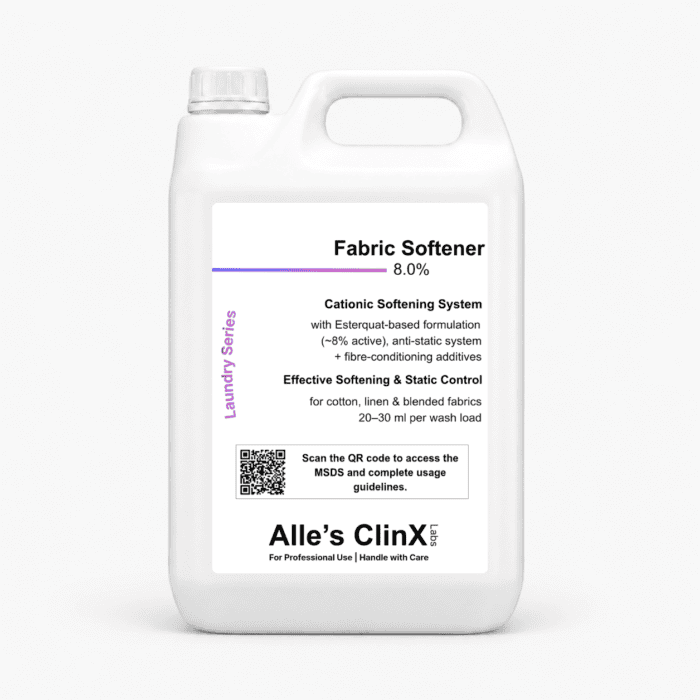
Cationic fibre conditioning. Cationic conditioning reduces inter-fibre friction and is intended to improve softness and handling during drying and ironing.
Fabric conditioning. Cationic conditioning supports softness and fabric handling during the rinse cycle.
Neutral pH 6.5–7.5. Intended for cotton, poly-cotton, synthetics, institutional linen and uniforms; avoid microfibre and moisture-wicking technical fabrics as specified.
20–30 ml per load. Precise rinse-cycle dosing for institutional laundry cost management and procurement planning.
Reduces static. Cationic conditioning can help reduce static and fabric cling during folding and distribution.
How to use & dilute
Standard 5–7 kg load. Use approximately 20–30 ml in the final-rinse / softener compartment.
Automatic dosing. Calibrate the softener line against dry-linen weight; a professional reference range of roughly 3–5 ml/kg is consistent with this standard-load dose.
Control. Do not pour concentrate directly onto dry linen and do not overdose to chase fragrance.
Equipment & dispenser compatibility
Compatible equipment. Washing-machine softener compartments and calibrated liquid-laundry dosing systems such as compatible peristaltic pumps.
Use conditions. Dose into the final-rinse or softener line only, using a dedicated line calibrated to the stated ml-per-load requirement.
Not intended for. Do not feed through the detergent line or spray the concentrate directly onto dry textiles.
The chemistry
How does cationic fabric conditioning work at the fibre level?
Fabric fibres — particularly cotton and cotton-blend institutional linen — carry a net negative surface charge as a result of the carboxylate and hydroxyl groups on the cellulose polymer surface.
Usage economy
Approximate pack yield. A 5 L pack provides about 167–250 standard-load doses across the 20–30 ml range.
Dose basis. For larger commercial machines, calculate dose from kilograms of dry linen rather than a fixed household-style load.
Measured dosing. The 20–30 ml standard-load range is suitable for controlled final-rinse dosing; larger machines should be set by dry-linen weight.
Product specifications
Active system
Cationic conditioning agent — quaternary ammonium compound
pH
6.5–7.5 (neutral)
Specific gravity
1.00–1.02 at 25°C
Formulation type
Aqueous rinse-cycle conditioner
Appearance
Opaque white to cream liquid
Fragrance
Light fresh — institutional laundry appropriate
Dose per load
Approx. 20–30 ml per standard 5–7 kg load; about 3–5 ml/kg dry linen for scale-up
Application
Fabric softener compartment or rinse cycle addition
Typical compatible surfaces
Cotton, poly-cotton, synthetics, institutional linen and uniforms
Avoid on
Microfibre cloths, moisture-wicking technical fabrics
PPE
None
Shelf life
18 months from date of manufacture, unopened
Pack size
5 L
HSN Code
38091000
Manufactured by
Champaran Innovatives Private Limited, India
Caution & storage
Dosing caution. Add through the final-rinse or softener compartment; avoid pouring concentrated softener directly onto dry fabric, where spotting can occur.
Fabric limits. Use cautiously on microfibre and moisture-wicking textiles where softener can affect absorbency or performance.
Storage. Keep the container tightly closed and protected from heat, direct sunlight and contamination. Clean dosing equipment regularly.
Safety & procurement
Safety data / product-specific documentation. care@allesclinx.com
Bulk & institutional procurement. procurement@allesclinx.com