Description
Highlights—
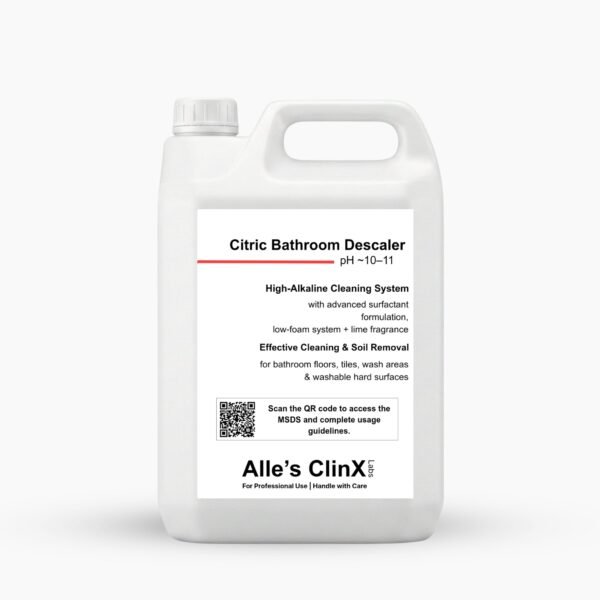
Alkaline pH 10–11. directly targets calcium stearate — the molecular structure of soap scum — dissolving it on contact without aggressive scrubbing in daily cleaning cycles.
Ready-to-use formulation. eliminates dilution, measurement, and concentration errors by rotating housekeeping staff — consistent chemistry on every application, every shift.
Daily-frequency effective. formulated to prevent soap scum and hard-water deposit build-up from becoming chronic — the maintenance approach that eliminates the need for periodic intensive intervention.
Lime fragrance. provides the immediate post-clean washroom freshness signal that is a compliance and reputation variable in healthcare, educational, and industrial facilities.
5-litre institutional bulk. fewer product change events per shift in high-frequency institutional cleaning schedules — reduced supply chain management overhead.
The chemistry—
What is soap scum, and why does alkaline chemistry dissolve it when neutral cleaners cannot? Soap scum is calcium stearate — a compound formed when the calcium and magnesium ions in hard water react with the fatty acid components of soap, body wash, and shampoo products. The reaction is: calcium ions (Ca²⁺) + stearate anions (from soap) → calcium stearate (insoluble precipitate). Calcium stearate is insoluble in water and forms the characteristic white, waxy film on tiles, shower surfaces, and bathroom fixtures.
Its insolubility in water is the reason that rinsing with water alone — or cleaning with neutral products — does not remove it. Calcium stearate is, however, soluble in alkaline solutions. The mechanism is the reversal of the formation reaction: alkaline hydroxide ions (OH⁻) react with calcium stearate to reform the original water-soluble stearate salt and displace the calcium ions back into solution. At pH 10–11, the hydroxide ion concentration is sufficient to drive this dissolution reaction during the contact time of a routine cleaning application — typically 2–5 minutes.
The soap scum dissolves chemically, requiring only minimal mechanical wipe to remove the dissolved products. This chemistry explains the diagnostic observation that an alkaline bathroom cleaner requires significantly less scrubbing effort than a neutral one on soap-scum-affected surfaces: the alkaline product is chemically dissolving the deposit while the neutral product is mechanically attempting to dislodge it. On a freshly deposited, light layer of soap scum, the mechanical approach may succeed with effort. On chronic institutional build-up in high-use shower facilities, it does not — and the only effective remediation is the correct alkaline chemistry.
Did you know—
Soap scum is calcium stearate — formed when the calcium in hard water reacts with fatty acids from soap and body products. It’s chemically bonded to the tile surface, not just sitting on top. Alkaline cleaners at pH 10–11 re-dissolve calcium stearate by breaking the bond between calcium and the fatty acid chain. That’s why an alkaline bathroom cleaner outperforms neutral alternatives on soap scum every time. The chemistry is targeting the exact molecular structure of the stain.
Application & usage—
Daily maintenance apply directly to tile surfaces, fixtures, sinks, and shower trays. Allow 2–3 minutes contact.
Wipe with a cloth or mop. Rinse tiles and fixtures with water.
Usage economy—
5 litres ready to use. 500 spray applications. Every washroom.
Every shift. A single 5-litre ready-to-use pack delivers approximately 500 spray applications at standard use.
For a healthcare facility or educational institution with 30 washrooms cleaned twice daily, one pack lasts approximately 8–10 days of continuous maintenance programme deployment. The prevention economics versus periodic intervention: daily alkaline cleaning of 30 washrooms prevents the soap scum accumulation that would otherwise require bi-weekly heavy-duty treatment — a per-facility cost reduction that compounds across the annual cleaning budget. For industrial facilities with high-volume shift washrooms, the ready-to-use format eliminates the dilution error risk associated with concentrates in environments where multiple products are used and labelling confusion can lead to incorrect dilution ratios.
Product specifications—
Formulation
Alkaline surfactant blend — bathroom and tile cleaner
pH
10.0–11.0 (alkaline)
Specific gravity
1.01–1.03 at 25°C
Formulation type
Ready to use
Appearance
Clear to slightly hazy liquid
Fragrance
Lime — institutional washroom grade
Dilution
Ready to use — no dilution required
Application
Spray or pour — cloth / mop / non-scratch pad
Safe on
Ceramic tiles, porcelain, bathroom fixtures, sinks, shower trays, WC exteriors
Avoid on
Toilet bowl interior (use Toilet Cleaner) · Natural marble and acid-sensitive stone
Rinse after use
Rinse tiles and fixtures with water after application
PPE
None at standard use
Shelf life
24 months from date of manufacture, unopened
Pack size
5 Litres
MSDS / TDS
QR code on label · Available on request
Caution & storage—
- Alkaline formulation.
- Avoid contact with eyes and prolonged skin contact.
- In case of eye contact, rinse immediately with copious water for 15 minutes.
- Do not use on acid-sensitive natural stone such as marble or limestone — alkaline pH causes surface etching on calcium carbonate-based stone.
- Do not mix with acid-based cleaners.
- Keep out of reach of children.
- Store in original sealed container below 30°C, away from direct sunlight and heat sources.
- Keep container tightly closed when not in use.
- Shelf life 24 months from manufacture date, unopened.
Resources & documentation—
Material Safety Data Sheets (MSDS) and Technical Data Sheets (TDS) are available on request and accessible via the QR code printed on the product label. These documents provide full hazard classification, first-aid procedures, disposal guidance, and technical performance data for compliance and audit purposes.
MSDS / TDS requests: care@allesclinx.com
Bulk & institutional supply enquiries: procurement@allesclinx.com