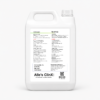
Description
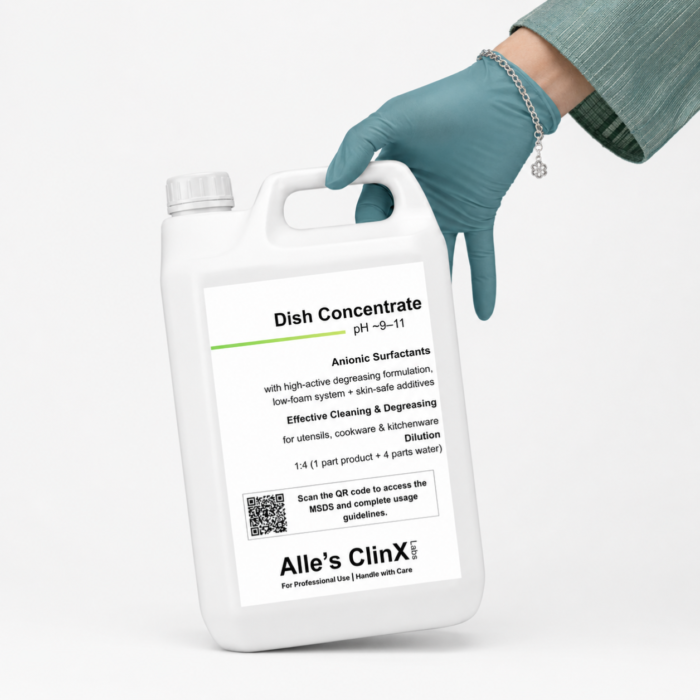
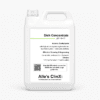
Best suited for. High-volume manual washing of cookware, crockery, cutlery and serving equipment.
Choose this when. You need an alkaline dishwashing concentrate with stronger grease-cutting performance.
Choose another product when. You need neutral-pH manual dishwashing or extended soaking of anodised aluminium.
Highlights
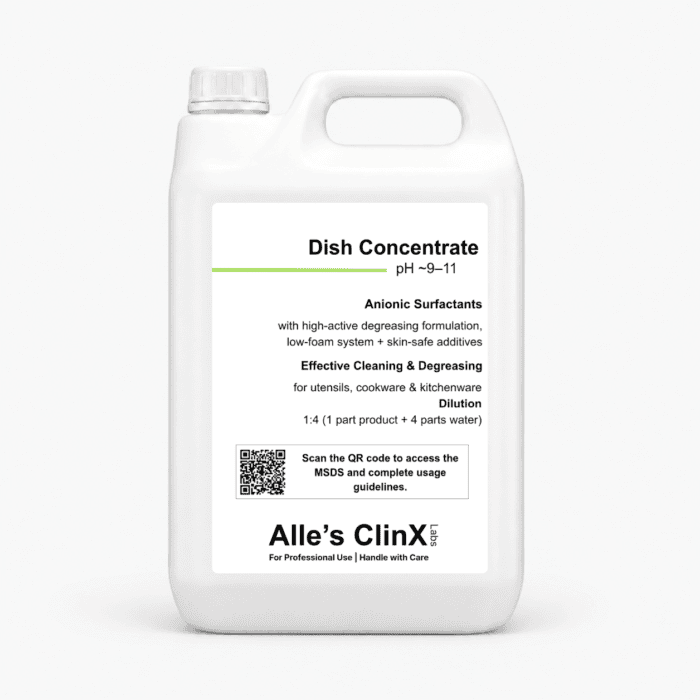
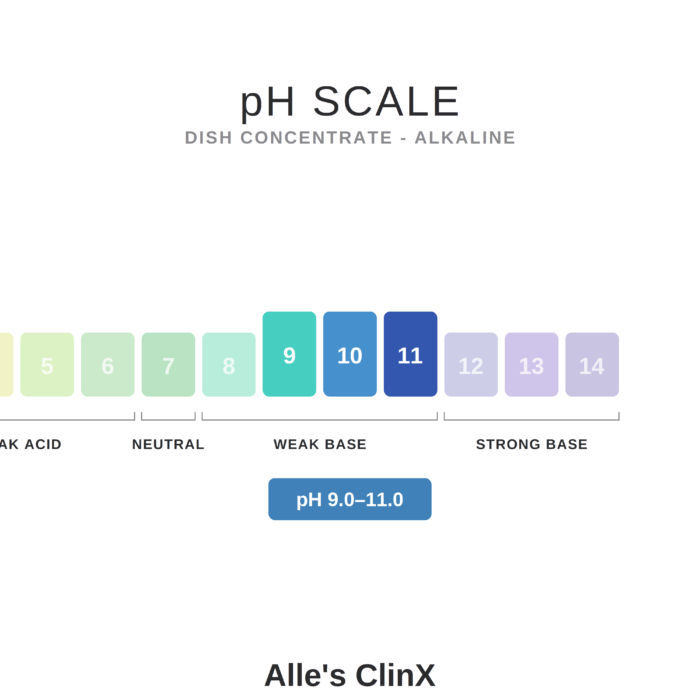
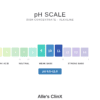
Alkaline pH 9–11. Supports saponification of fats and oils before manual agitation in high-volume kitchen operations.
Anionic + non-ionic surfactant blend. Supports grease emulsification across common cookware, crockery, utensils and serving equipment.
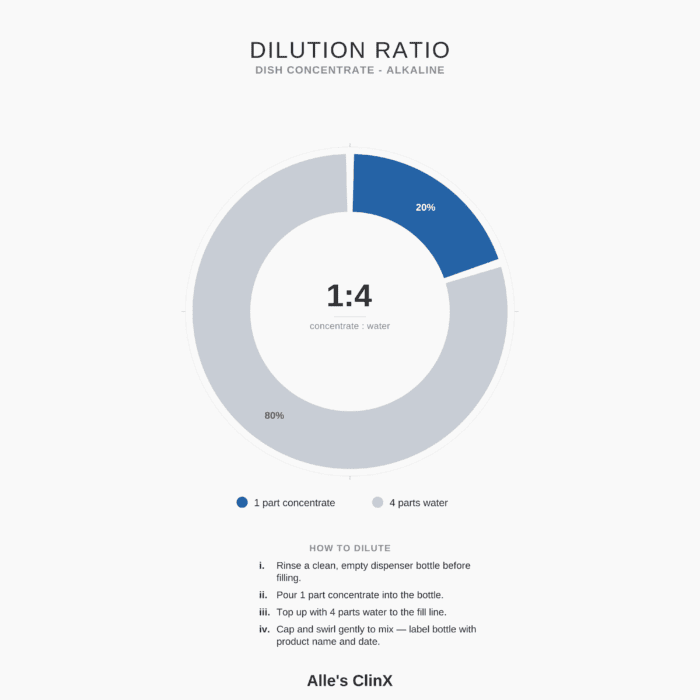
Approx. 5–10 ml/L routine. Use approximately 5–10 ml/L for routine manual washing and increase toward 10–15 ml/L only for unusually heavy grease.
Controlled low-foam profile. Designed for controlled foam in institutional washing; machine-assisted use should follow the equipment manufacturer’s chemical guidance.
Water quality. Performance can vary with local water hardness. Use the lowest effective dose and follow site water-treatment guidance where hard water causes residue, weak cleaning or excess product use.
How to use & dilute
5 L sink. Start at approximately 25–50 ml concentrate.
10 L sink. Use approximately 50–100 ml for routine washing; increase toward 100–150 ml only for unusually greasy ware.
Control. Pre-scrape food soil and replenish the wash solution when it becomes dirty. Do not compensate for an exhausted sink by repeatedly free-pouring more detergent.
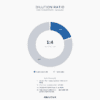
For batch planning, calculate concentrate for your batch using approved product inputs. The dosage calculator uses concentrate per litre of final working solution.
Equipment & dispenser compatibility
Compatible equipment. Manual wash basins, compatible machine-assisted wash reservoirs and calibrated wall-mounted or pump dosing systems set to the stated approx. 5–10 ml/L routine-use benchmark.
Use conditions. Machine use is appropriate only where the equipment manufacturer permits a low-foam alkaline detergent and the rinse stage is correctly configured.
Not intended for. This product is a detergent, not a rinse aid; do not connect it to a rinse-aid line or an incompatible chemical feed.
The chemistry
What is saponification, and why does alkaline pH reduce dishwashing labour in high-volume kitchens?
Saponification is a chemical reaction between a fat or oil (a triglyceride) and an alkali that produces glycerol and fatty acid salts — compounds that are water-soluble and surface-active.
Usage economy
Approximate prepared yield. At 5–10 ml/L, a 5 L pack can dose about 500–1,000 litres of wash water; heavy-grease dosing reduces that yield.
Why dosing matters. Manual dish rooms are particularly prone to overuse, so a pump or calibrated wall dispenser is preferable to free-pouring.
Machine use. Treat this primarily as a manual-wash concentrate unless a specific machine programme has been checked for foam and rinse suitability for foam and rinse performance.
Product specifications
Active system
Anionic + non-ionic surfactant blend with alkaline builder
pH
9.0–11.0 (alkaline)
Specific gravity
1.03–1.06 at 25°C
Formulation type
Aqueous concentrate
Appearance
Clear to slightly hazy amber liquid
Fragrance
Raw lime
Dilution
Approx. 5–10 ml/L routine; 10–15 ml/L heavy grease — approximate starting range
Application
Manual wash basin or machine-assisted kitchen operations
Foam profile
Controlled low-foam — machine compatible
Typical compatible surfaces
Washable utensils, cookware, crockery, cutlery and serving equipment; avoid extended soaking of anodised aluminium
Avoid
Anodised aluminium over extended soak periods
Rinse after use
Rinse all items thoroughly with clean water — mandatory
PPE
Gloves for prolonged skin contact
Shelf life
24 months from date of manufacture, unopened
Pack size
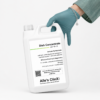
5 L concentrate
HSN Code
34029099
Manufactured by
Champaran Innovatives Private Limited, India
Water quality
Performance can vary with local water hardness. Use the lowest effective dose and follow site water-treatment guidance where hard water causes residue, weak cleaning or excess product use.
Caution & storage
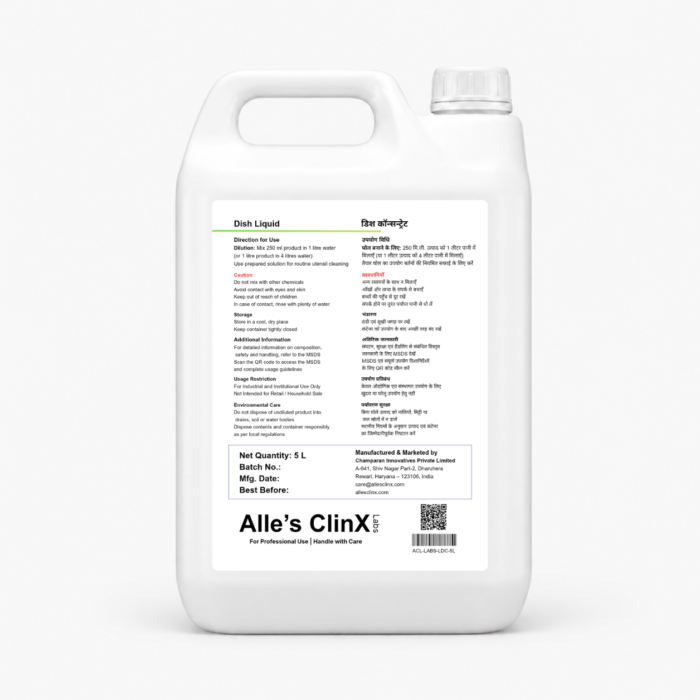
Skin and eye contact. Avoid eye contact and prolonged contact with the alkaline concentrate; gloves are recommended for extended manual washing.
Material compatibility. Avoid extended soaking of anodised aluminium and test sensitive cookware finishes. Do not mix with acids, bleach or other cleaning concentrates.
Storage. Keep tightly closed and upright in a cool, shaded area. Store separately from acidic cleaners and chlorine products.
Safety & procurement
Safety data / product-specific documentation. care@allesclinx.com
Bulk & institutional procurement. procurement@allesclinx.com