Description
Highlights—
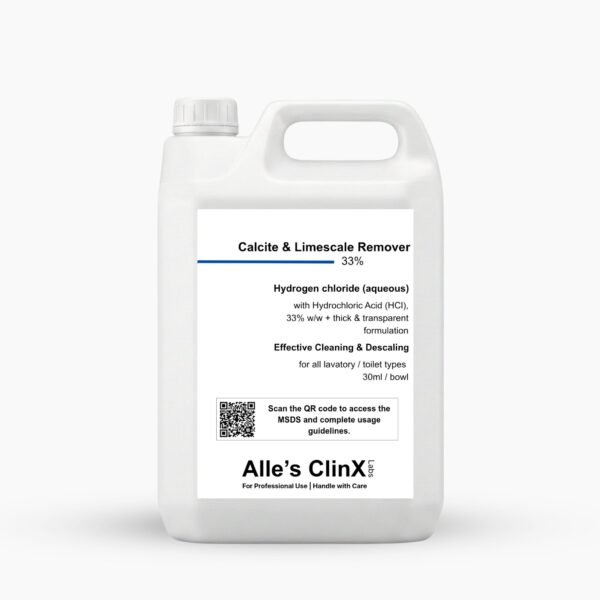
HCl 33% w/w. industrial-strength hydrochloric acid in a precision gel delivery system — the concentration used in professional descaling operations, accessible at institutional procurement scale.
pH 1.5–2.0. aggressive calcium carbonate and uric scale dissolution at a single 30 ml application — effective where weekly maintenance has failed to prevent chronic build-up.
Thick gel formulation. clings to under-rim and vertical bowl surfaces rather than draining immediately — contact time is where descaling happens, and the gel ensures that contact time.
Dye-free and transparent. no staining risk on grout, porcelain, or ceramic surrounds — visual application control that housekeeping supervisors can verify without specialist equipment.
Designed for high-use washrooms. healthcare, industrial, and educational toilet blocks where daily user volume makes standard maintenance cleaners insufficient.
The chemistry—
What is the chemistry of acid descaling, and why does HCl outperform other acid cleaners for institutional washrooms? Limescale in toilet bowls is primarily calcium carbonate (CaCO₃), deposited from hard water as it evaporates. Uric scale — the yellow-brown staining characteristic of high-use male urinals and toilet bowls — is a complex of uric acid, calcium, and protein compounds.
Both are alkaline or neutral in pH. The only effective removal mechanism is acid dissolution: introducing a strong acid that reacts with these deposits to form soluble products. Hydrochloric acid reacts with calcium carbonate in a straightforward neutralisation reaction: CaCO₃ + 2HCl → CaCl₂ + H₂O + CO₂.
The products — calcium chloride, water, and carbon dioxide — are all soluble or gaseous, meaning the deposit is completely dissolved rather than redistributed. At 33% w/w concentration and pH 1.5–2.0, this reaction proceeds rapidly even on dense, long-standing scale accumulations. HCl is preferred over organic acids (citric, phosphoric) for institutional descaling applications for two reasons: reaction rate and cost. At equivalent pH, HCl achieves faster and more complete calcium carbonate dissolution than organic acids because it is a strong acid that fully dissociates in solution, delivering the maximum available hydrogen ion concentration for the dissolution reaction. For high-use institutional washrooms where turnaround time between cleaning sessions is constrained, this reaction speed is operationally significant.
Did you know—
The transparency is a deliberate design decision. Most toilet cleaners use blue or green dyes for visual appeal. We removed them entirely. Dye-free means you can see exactly where product has been applied, there is zero staining risk on grout or porcelain, and flushing is faster with less water. Every detail on a product label is a choice.
Application & usage—
Application Squeeze approximately 30 ml under the toilet rim and across the bowl surface using the squeeze bottle applicator.
Ensure product reaches under-rim deposits and waterline staining.
Usage economy—
30 ml per bowl. One 5-litre pack. 166 complete descaling sessions.
At 30 ml per bowl application, a single 5L pack delivers 166 full toilet bowl descaling treatments. For a healthcare facility or educational campus with 20 toilet bowls on a weekly descaling protocol, one pack covers more than 8 weeks of scheduled washroom maintenance.
For high-use industrial washroom blocks running twice-weekly treatment, the same pack provides 4 weeks of coverage. The commercial case for acid descaling versus increasing neutral cleaner frequency: one weekly 30 ml acid application prevents the chronic build-up that requires expensive periodic deep-clean interventions. Prevention cost versus remediation cost, at institutional volume, is not close.
Product specifications—
Active ingredient
Hydrochloric Acid (HCl) 33% w/w
Active class
Strong inorganic acid — descaling and disinfecting
pH
1.5–2.0 (strongly acidic)
Specific gravity
1.15–1.18 at 25°C
Formulation type
Thick gel — viscosity-modified for vertical surface adhesion
Appearance
Clear to slightly viscous transparent gel
Fragrance
Dye-free, no added fragrance
Dose per bowl
30 ml
Contact time
10–20 minutes depending on scale severity
Safe on
Ceramic toilet bowls, porcelain, vitreous china, urinals
Avoid on
Marble, granite, natural stone, stainless steel, acid-sensitive surfaces
Rinse after use
Flush thoroughly — mandatory
PPE
Gloves and eye protection mandatory. Never mix with bleach.
Shelf life
24 months from date of manufacture, unopened
Pack size
5 Litres
MSDS / TDS
QR code on label · Available on request
Caution & storage—
- DANGER — strong acid.
- Contains Hydrochloric Acid 33% w/w.
- Never mix with bleach, ammonia, or alkaline cleaners — mixing with hypochlorite produces toxic chlorine gas.
- Causes severe eye and skin burns on contact with concentrate.
- Wear chemical-resistant gloves and eye protection at all times during application.
- Ensure adequate ventilation in enclosed washrooms.
- Keep out of reach of children.
- Store in original sealed container below 30°C, away from metals, alkaline materials, and heat sources.
- Do not store in metal containers — HCl corrodes ferrous metals.
- Keep container tightly sealed when not in use — HCl is volatile and fumes can damage surrounding materials.
- Shelf life 24 months from manufacture date, unopened.
- In case of spillage, neutralise with sodium bicarbonate solution and flush with water.
Resources & documentation—
Material Safety Data Sheets (MSDS) and Technical Data Sheets (TDS) are available on request and accessible via the QR code printed on the product label. These documents provide full hazard classification, first-aid procedures, disposal guidance, and technical performance data for compliance and audit purposes.
MSDS / TDS requests: care@allesclinx.com
Bulk & institutional supply enquiries: procurement@allesclinx.com