Description
Highlights—
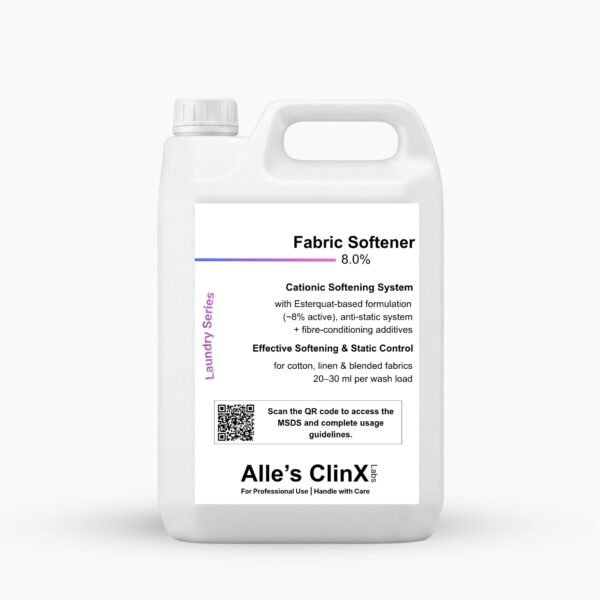
Cationic fibre conditioning. electrostatic attachment to individual fabric fibres reduces inter-fibre friction during drying and ironing — measurable throughput improvement in institutional ironing operations.
Extends linen lifespan. reduced fibre degradation per wash cycle translates to more wash cycles before replacement — a direct procurement cost reduction over a linen programme’s lifecycle.
Neutral pH 6.5–7.5. compatible with all institutional cotton, poly-cotton, and synthetic fabric types without surface chemistry interaction.
20–30 ml per load. precise rinse-cycle dosing for institutional laundry cost management and procurement planning.
Reduces static. measurable reduction in fabric cling during folding and distribution — small but compounding productivity gain in high-volume linen handling operations.
The chemistry—
How does cationic fabric conditioning work at the fibre level? Fabric fibres — particularly cotton and cotton-blend institutional linen — carry a net negative surface charge as a result of the carboxylate and hydroxyl groups on the cellulose polymer surface. This negative charge is enhanced after washing with anionic detergents, which leave residual negative charge on the fibre surface.
Fabric softener actives are cationic — positively charged — quaternary ammonium compounds that are electrostatically attracted to this negative fibre surface. On contact during the rinse cycle, the cationic conditioning molecules align with their charged head groups attached to the fibre surface and their long hydrocarbon tail chains projecting outward. This orientation creates a lubricious outer layer on each fibre — analogous to the wax coat on a polished surface — that reduces the coefficient of friction between adjacent fibres.
The result is a fabric that feels smoother (reduced inter-fibre friction perceived by touch), dries with less fibre-to-fibre abrasion, and requires less mechanical force to iron flat. The critical operational point is that this lubrication layer is not permanent — it is redeposited with each softener application and washes out partially with each detergent wash. The conditioning benefit compounds over successive treatment cycles as the layer builds on the fibre surface, which is why the lifespan benefit of fabric softener use is most pronounced in linen programmes that apply it consistently across every wash cycle rather than intermittently.
Did you know—
Wool fibres have a protein structure called keratin — the same protein as human hair. High-alkalinity detergents break down keratin bonds, causing the fibre cuticle to lift and interlock with neighbouring fibres. That interlocking is felting. A near-neutral pH of 6.5–7.0 leaves the keratin structure intact. Your cashmere survives the wash. The chemistry is that simple — and that critical.
Application & usage—
Dosing Add 20–30 ml to the fabric softener compartment of the washing machine or directly to the rinse cycle for commercial washers without a dedicated compartment.
Usage economy—
25 ml per load. One 5-litre pack. 200 rinse-cycle treatments.
At 25 ml per load average, a single 5L pack delivers 200 complete rinse-cycle treatments. For a hospital laundry running 35 loads daily, one pack covers approximately 5–6 days.
The linen lifespan extension benefit is the long-term value: a 10–15% increase in wash cycles before replacement across a 500-item hospital linen programme reduces annual linen procurement cost by a percentage that is multiples of the annual softener cost. For industrial uniform services where garment lifespan directly affects the cost of service contracts, conditioning-extended fabric life is a demonstrable service quality differentiator.
Product specifications—
Active system
Cationic conditioning agent — quaternary ammonium compound
pH
6.5–7.5 (neutral)
Specific gravity
1.00–1.02 at 25°C
Formulation type
Aqueous rinse-cycle conditioner
Appearance
Opaque white to cream liquid
Fragrance
Light fresh — institutional laundry appropriate
Dose per load
20–30 ml (add to rinse cycle only)
Application
Fabric softener compartment or rinse cycle addition
Safe on
Cotton, poly-cotton, synthetics, institutional linen and uniforms
Avoid on
Microfibre cloths, moisture-wicking technical fabrics
PPE
None
Shelf life
18 months from date of manufacture, unopened
Pack size
5 Litres
MSDS / TDS
Available on request
Caution & storage—
- Do not add to the main wash cycle — add to rinse cycle only.
- Mixing with anionic detergents reduces efficacy of both products.
- Avoid contact with eyes — rinse immediately with water if contact occurs.
- Keep out of reach of children.
- Store in original sealed container below 30°C, away from direct sunlight.
- Keep container tightly closed when not in use.
- Shelf life 18 months from manufacture date, unopened.
Resources & documentation—
Material Safety Data Sheets (MSDS) and Technical Data Sheets (TDS) are available on request and accessible via the QR code printed on the product label. These documents provide full hazard classification, first-aid procedures, disposal guidance, and technical performance data for compliance and audit purposes.
MSDS / TDS requests: care@allesclinx.com
Bulk & institutional supply enquiries: procurement@allesclinx.com