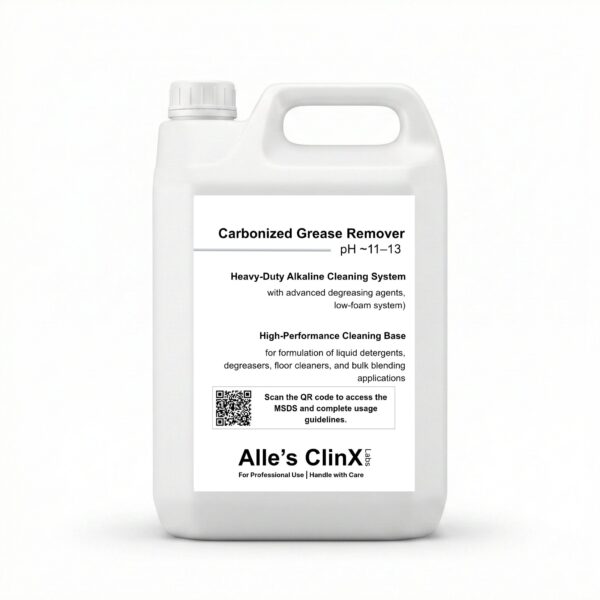
Carbonized Grease Remover / कार्बोनाइज्ड ग्रीस रिमूवर
→ An industrial cleaner for burnt and stubborn grease.
Burnt-on carbonised grease is not a cleaning problem. It is a chemistry problem. Address the chemistry.
Highlights
- pH 12–13 caustic-enhanced formula — high-alkalinity caustic base penetrates and breaks down the cross-linked polymer matrix of carbonised grease — the chemical state that standard alkaline degreasers at pH 11–12 cannot effectively dissolve.
- Gel delivery system — viscosity-modified to cling to vertical oven walls, hood surfaces, grill grates, and overhead extraction surfaces — contact time is where carbonised grease dissolution happens, and the gel ensures that contact time regardless of surface orientation.
- Dual-mechanism action — saponification converts fat residues to water-soluble compounds; caustic hydrolysis breaks polymerised carbon chains — together addressing both the grease matrix and the carbonised crust in a single application.
- Designed for scheduled deep-clean cycles — weekly or bi-weekly application to commercial kitchen equipment prevents the carbonised accumulation that creates fire risk and compromises food safety audit compliance.
- Mandatory rinse protocol — high-alkalinity residue must be thoroughly rinsed from all food-contact surfaces before operation — the rinse step is a food safety requirement, not optional.
Product overview
Grease accumulation on commercial kitchen equipment progresses through three chemically distinct stages that require progressively stronger intervention: fresh grease, which is liquid or semi-solid and removable with standard alkaline cleaners; polymerised surface film, which has partially oxidised and requires stronger alkalinity to dissolve; and carbonised deposits, which are the end state — hardened, cross-linked, chemically bonded to metal surfaces and resistant to all standard degreasing chemistry.
Alle’s ClinX Labs Carbonized Grease Remover targets stage three directly. The caustic-enhanced pH 12–13 formulation provides the hydroxide ion concentration required for the hydrolysis of cross-linked carbon-grease polymer chains — the specific chemistry that distinguishes a carbonised grease remover from a standard kitchen degreaser. The gel delivery system ensures the product maintains contact with the target surface for the dwell time required to complete that chemistry, rather than running off vertical and overhead surfaces before the reaction can proceed.
In commercial kitchen environments operating under food safety compliance requirements, carbonised grease accumulation in extraction hoods and ducts is both a hygiene failure and a fire risk. Regular scheduled chemical treatment with the correct active chemistry is the only practical prevention strategy — deep manual scrubbing cannot match the penetration depth of caustic hydrolysis on established carbonised layers.
The chemistry +
| What makes carbonised grease chemically different from ordinary grease, and why does it require a different product?
Fresh cooking grease is primarily triglycerides — esters of glycerol and fatty acids. Standard alkaline degreasers at pH 9–12 saponify these esters, converting them to soluble glycerol and soap-like fatty acid salts that rinse away with water. This mechanism is effective on fresh and lightly aged grease deposits. Carbonised grease is a different material. Under sustained heat exposure — oven temperatures above 180°C, grill surfaces, and extraction hood hot spots — triglycerides undergo pyrolysis and polymerisation. The fatty acid chains cross-link, form aromatic carbon ring structures, and bond covalently to the metal surface. The result is no longer a fat — it is a polymer-ceramic composite material that standard saponification cannot penetrate. At pH 12–13, the concentrated hydroxide ion concentration performs alkali hydrolysis on both the residual fat component and the polymer backbone, breaking cross-links and solubilising the deposit progressively from the surface contact point outward. Extended dwell time — 20–30 minutes — is required for this reaction to penetrate the full depth of established carbonised layers. |
Did you know +
Fact Carbonised grease accumulation in commercial kitchen extraction ducts and hoods is classified as a fire hazard by fire safety standards. A 3mm layer of polymerised grease in an extraction system has an ignition temperature of approximately 250–300°C — well within the operating temperature range of a commercial kitchen. Chemical degreasing is not housekeeping. It is fire safety maintenance.
Application & usage +
- Surface preparation Remove loose debris. Ensure the surface is at ambient temperature — do not apply to hot surfaces above 40°C.
- Application Apply gel directly to carbonised surface using a brush, sponge, or squeeze applicator. Ensure complete coverage of affected areas.
- Dwell time Allow 20–30 minutes for moderate carbonised deposits. Allow up to 60 minutes for heavy or long-standing accumulation. Do not allow to dry on surface.
- Agitation Agitate with a stiff brush or non-scratch scouring pad after dwell. The loosened deposit should lift with moderate scrubbing effort.
- Rinse Rinse all surfaces thoroughly with clean water. Mandatory on all food-contact surfaces before equipment operation. Confirm pH neutrality of rinse water before resuming use.
Product specifications +
| Active system | Caustic-enhanced high-alkalinity saponification |
| pH | 12.0–13.0 (strongly alkaline) |
| Formulation type | Viscosity-modified gel — vertical surface adhesion |
| Appearance | Thick opaque gel |
| Dwell time | 20–60 minutes depending on deposit severity |
| Rinse after use | Yes — mandatory, especially on food-contact surfaces |
| Safe on | Stainless steel, cast iron, enamel-coated surfaces, ceramic tiles, concrete |
| Avoid on | Aluminium, galvanised surfaces, soft metals — caustic attacks these substrates |
| PPE | Chemical-resistant gloves and eye protection — mandatory |
| Shelf life | 24 months from date of manufacture, unopened |
| Pack size | 5 Litres |
| MSDS / TDS | QR code on label · Available on request |
Caution & storage +
| DANGER — strongly alkaline. For professional and institutional use only.
Causes severe skin burns and eye damage on contact with concentrate. Wear chemical-resistant gloves and eye protection at all times during handling and application. Do not apply to hot surfaces. Never mix with acid-based cleaners — reaction generates heat and may cause dangerous spattering. Keep out of reach of children. Store in original sealed container below 30°C, away from acids, heat sources, and direct sunlight. Do not store in aluminium containers — caustic attacks aluminium. Keep container tightly sealed. Shelf life 24 months from manufacture date, unopened. In case of skin contact, flush immediately with copious water for 15–20 minutes. |
Resources & documentation +
| Material Safety Data Sheet | QR code on product label · Request at care@allesclinx.com |
| Technical Data Sheet (TDS) | Available on request — Alle’s ClinX Labs trade desk |
| Bulk & institutional supply | allesclinx.com · Institutional pricing available |
| B2B & procurement enquiries | procurement@allesclinx.com |