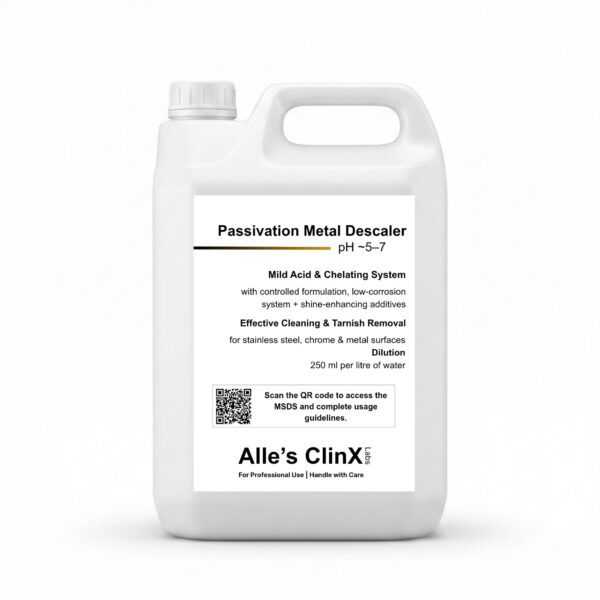
Passivation Metal Descaler
Mineral deposits on metal surfaces are a chemistry problem. Neutral cleaners are the wrong tool.
Highlights
- Mild acid chemistry — dissolves calcium carbonate, hard-water scale, and surface oxidation through targeted chemical reaction — no abrasive action, no micro-scratching, no polished surface damage.
- Non-abrasive formulation — preserves the passive chromium oxide layer on stainless steel that provides corrosion resistance — aggressive abrasive cleaning destroys this layer, accelerating long-term metal degradation.
- 1:4 dilution — 5L yields 20 litres — cost-effective for large-area metal maintenance across institutional kitchen equipment inventories and architectural metalwork.
- Compatible with FSSAI food safety requirements — rinse protocol after application on food-contact metal surfaces supports kitchen hygiene compliance in institutional catering environments.
- Institutional substrate range — stainless steel, chrome, and treated aluminium — the core metal surface types in healthcare, industrial, and educational catering facilities.
Product overview
Metal surface management in institutional environments involves a chemistry constraint that most cleaning programmes do not adequately address: the deposits that cause progressive discolouration, scale build-up, and surface degradation on stainless steel, chrome, and aluminium are mineral compounds — primarily calcium carbonate and magnesium silicate from hard water, and metal oxides from heat and atmospheric exposure. These compounds are chemically insoluble in neutral and alkaline cleaners. Attempting to remove them with neutral products using increased scrubbing pressure damages the polished metal surface without removing the deposit.
Alle’s ClinX Labs Metal Surface Cleaner Concentrate resolves this through targeted acid chemistry. The mild acid formulation reacts with mineral deposits on contact, converting calcium carbonate and metal oxide compounds to soluble salts that rinse away cleanly. The action is entirely chemical — there is no abrasive component, so the polished surface finish is preserved rather than degraded. The passive chromium oxide layer that protects stainless steel from corrosion remains intact, meaning the metal continues to provide its designed corrosion resistance after cleaning.
The 1:4 dilution system is calibrated for institutional metal maintenance economics: one 5-litre concentrate provides 20 litres of working solution for large-area applications across extensive kitchen equipment inventories in healthcare catering departments, industrial food processing facilities, and educational mess halls where stainless steel surface maintenance is a daily operational requirement.
The chemistry +
| Why does mild acid restore stainless steel brightness, and what is the passive layer that makes this possible?
Stainless steel’s corrosion resistance depends on a passive layer — a microscopically thin (2–5 nm) film of chromium oxide (Cr₂O₃) that forms spontaneously on the steel surface when exposed to oxygen. This layer is chemically inert to most substances at ambient temperature and physically separates the steel substrate from the corrosive environment. When stainless steel appears dull, discoloured, or scaled, it is because mineral deposits and surface oxidation products have accumulated on top of this passive layer — not within it. Mild acid cleaning removes these surface deposits by dissolving them: calcium carbonate reacts with the acid to form soluble calcium salts and carbon dioxide; iron oxides (rust-like discolouration) react to form soluble iron salts; silicate and sulphate scale is partially dissolved and partially loosened for mechanical removal. The mild acid — at carefully controlled concentration — does not dissolve the chromium oxide passive layer itself, because chromium oxide has higher acid resistance than the calcium and iron compounds being targeted. This is the chemical selectivity that makes mild acid metal cleaning restorative rather than damaging. The distinction from abrasive cleaning is fundamental: abrasive pads and powders physically scrape the surface, removing deposits and the passive layer simultaneously. The passive layer then requires time to reform, during which the steel surface is more susceptible to staining and corrosion. Repeated abrasive cleaning thins the passive layer progressively, reducing the stainless steel’s long-term corrosion performance. Acid cleaning preserves the passive layer by removing deposits through chemistry rather than mechanical force. |
Did you know +
Fact Stainless steel doesn’t rust in the traditional sense — it maintains a thin chromium oxide layer that protects the steel beneath. When you see discolouration or dullness, it is mineral deposits sitting on top of that protective layer. Mild acid removes the deposits without disturbing the chromium oxide — which is why the shine returns without damaging the metal.
on & usage +
- Dilution 250 ml of concentrate per litre of water (1:4 ratio). Apply with a soft cloth or spray bottle — do not use abrasive pads or steel wool.
- Application apply in the direction of the metal grain on brushed stainless steel to avoid cross-grain residue lines.
- Contact time allow 1–2 minutes for moderate hard-water deposits and light oxidation. Allow up to 5 minutes for heavy scale or persistent discolouration.
- Agitation light wiping with a soft cloth during contact time accelerates deposit dissolution. Do not scrub with abrasive materials.
- Rinsing rinse thoroughly with clean water after application — mandatory on food-contact surfaces (FSSAI kitchen compliance requirement). Test on inconspicuous area for non-standard alloys.
Usage economy +
| 250 ml per litre. One 5-litre pack. 20 litres of working metal cleaner.
At 1:4 dilution, a single 5L concentrate produces 20 litres of working solution. For a hospital dietary department with 50 sq metres of stainless steel kitchen equipment surfaces cleaned weekly, one 5L pack covers approximately 3–4 months of regular metal maintenance. The surface condition improvement from converting abrasive to acid-clean protocol is cumulative — polished surfaces maintained without abrasive damage retain their passive layer and resist future staining, reducing cleaning frequency requirement over time. |
Product specifications +
| Active system | Mild inorganic acid + surfactant — mineral deposit dissolution |
| pH | Mild acidic (3.5–5.5) |
| Specific gravity | 1.02–1.05 at 25°C |
| Formulation type | Aqueous concentrate |
| Appearance | Clear to slightly amber liquid |
| Fragrance | Neutral |
| Dilution | 250 ml per litre of water (1:4) |
| Application | Soft cloth or spray — direction of metal grain |
| Safe on | Stainless steel, chrome, treated aluminium, architectural metalwork |
| Avoid on | Copper, brass, reactive metals — test before use |
| Rinse after use | Mandatory on food-contact surfaces — thorough water rinse |
| PPE | Gloves recommended |
| Shelf life | 24 months from date of manufacture, unopened |
| Pack size | 5 Litres concentrate |
| MSDS / TDS | QR code on label · Available on request |
Caution & storage +
| For professional and institutional use.
Mild acid — avoid prolonged skin contact and eye contact. Wear chemical-resistant gloves during application. In case of eye contact, rinse immediately with copious water for 15 minutes and seek medical advice. Do not use on copper, brass, or reactive metals without prior testing — acid contact with reactive metals may cause surface discolouration or damage. Do not mix with alkaline cleaners or bleach. Store in original sealed container below 30°C, away from metal storage equipment, alkaline materials, and heat sources. Keep container tightly closed when not in use — acid vapours can corrode surrounding metals. Shelf life 24 months from manufacture date, unopened. In case of spillage, neutralise with sodium bicarbonate solution. |
Resources & documentation +
| Material Safety Data Sheet | QR code on product label · Request at care@allesclinx.com |
| Technical Data Sheet (TDS) | Available on request — Alle’s ClinX Labs trade desk |
| Bulk & institutional supply | allesclinx.com · Institutional pricing available |
| B2B & procurement enquiries | procurement@allesclinx.com |