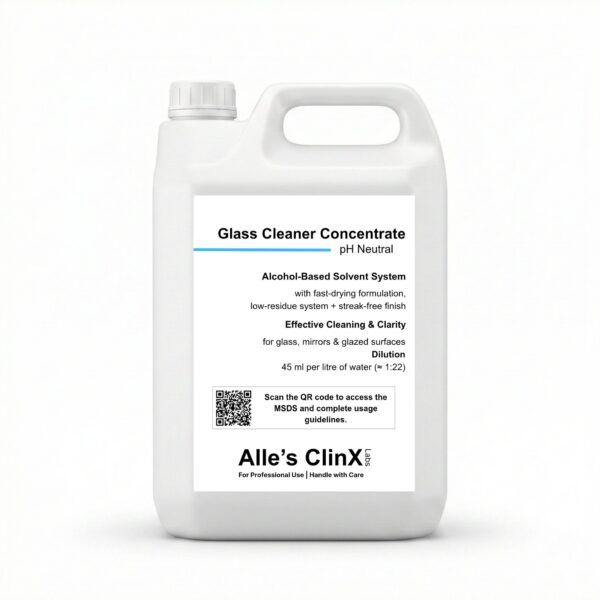
Glass Cleaner Concentrate
In institutional environments, glass surfaces are the most visible measure of cleaning quality. They cannot afford a streak.
Highlights
- Fast-evaporating solvent system — physically pulls surfactant residue off the glass surface as it evaporates — the streak cannot form because the chemistry is designed to leave nothing behind.
- Neutral pH — safe on all standard glass, mirror, chrome fixture, and acrylic panel surfaces without surface chemistry risk.
- 45 ml per litre dilution — one 5L concentrate fills 110+ litres of working solution — a 70–80% cost reduction versus equivalent ready-to-use products at institutional volume.
- Single-pass clean — consistent streak-free results regardless of operator experience level — critical in institutional environments with rotating housekeeping teams.
- Automated equipment compatible — suitable for spray application, microfibre wipe systems, and automated window-cleaning equipment deployed in multi-storey institutional buildings.
Product overview
In the daily assessment of institutional cleaning quality — the informal evaluation that healthcare administrators, industrial facility managers, and educational principals make when they walk their buildings — glass surfaces carry disproportionate weight. A clean floor is noticed in the absence of dirt. A streaked window is noticed by its presence. The asymmetry is relevant to cleaning programme design.
Alle’s ClinX Labs Glass & Mirror Cleaner Concentrate is formulated for the institutional reality: large glass surface areas cleaned by rotating teams at varying skill levels, with the requirement for consistent streak-free results that does not depend on operator technique. The fast-evaporating solvent carrier is the functional mechanism: as it evaporates from the glass surface, it actively carries residual surfactant compounds away with it, preventing the thin-film formation that causes streaking. The result is a single-pass clean that works correctly whether the glass is cleaned by an experienced operator or a new member of staff on their first shift.
At 45 ml per litre, the concentrate economics are significant at institutional scale: a single 5-litre pack fills over 110 litres of working solution, refilling a standard 500 ml spray bottle more than 220 times. For a large educational campus, healthcare facility, or industrial complex with hundreds of glass surfaces requiring daily cleaning, the cost reduction versus ready-to-use alternatives is material.
The chemistry +
| Why do glass cleaners streak, and how does solvent-to-water ratio solve the problem?
Glass cleaning streaks are not caused by dirt — they are caused by the residual surfactant film left on the glass surface when the water carrier evaporates before wiping is complete. When a surfactant-in-water solution is applied to glass and the water evaporates faster than the operator can wipe, the surfactant compounds concentrate at the evaporation boundary and deposit as a thin, optically visible film. This is the streak. The solution is not removing the surfactant — it is controlling the evaporation sequence. A fast-evaporating organic solvent added to the formulation at a precise ratio evaporates from the glass surface more rapidly than water while physically carrying the surfactant molecules with it in solution. As the solvent front recedes, it takes the surfactant with it rather than leaving it deposited on the glass. The glass surface is left clean and dry before optical deposition can occur. The ratio is critical: too little solvent and the water evaporation dominates, leaving surfactant residue. Too much solvent and the formulation evaporates before it has performed the cleaning function. The 45 ml per litre dilution of this concentrate is calibrated to deliver the correct solvent-to-water ratio in working solution — a ratio that produces streak-free results across standard institutional glass cleaning speeds and ambient temperatures. This is why industrial-grade glass cleaners outperform consumer spray products on large glass surfaces: the formulation engineering is more precise. |
Did you know +
Fact Most streaks on glass aren’t from dirt — they’re from the thin surfactant film left behind when a cleaner doesn’t evaporate fast enough before wiping. The solvent-to-water ratio in the formulation is precision-engineered. Getting it wrong by 5% produces streaks on every surface, every time. Getting it right means one wipe and done.
Application & usage +
- Preparation Dilute 45 ml of concentrate per litre of clean water in a spray bottle.
- Application Spray lightly and evenly onto the glass surface from 20–30 cm distance. Do not over-wet.
- Wiping Wipe with a clean, lint-free microfibre cloth using overlapping strokes working top to bottom. No buffing or second pass required.
- Cloth management Change microfibre cloth when visibly soiled — redeposition from a dirty cloth is the most common cause of streaking in field conditions.
- Large panes Work in sections on large glass areas to prevent the solution from drying before wiping. Complete each section before moving to the next.
Usage economy +
| 45 ml per litre. One 5-litre pack. 110 litres of working solution. 220 spray bottles filled.
At 45 ml per litre, a single 5L concentrate fills over 110 litres of working glass cleaner — enough to refill a 500 ml spray bottle 220 times. For a hospital or educational campus with 200 glass surfaces cleaned daily, one pack covers approximately 3 weeks of full-facility glass maintenance. Versus ready-to-use glass cleaner at equivalent volume, the concentrate format delivers a 70–80% reduction in per-litre cost and a 95% reduction in packaging volume. |
Product specifications +
| Active system | Solvent + surfactant blend — fast-evaporating glass formulation |
| pH | 6.5–7.5 (neutral) |
| Specific gravity | 0.98–1.01 at 25°C |
| Formulation type | Solvent-aqueous concentrate |
| Appearance | Clear, water-white liquid |
| Fragrance | Neutral — no added fragrance |
| Dilution | 45 ml per litre of water |
| Application | Spray bottle + microfibre cloth / automated window equipment |
| Safe on | Glass, mirrors, chrome fixtures, acrylic panels, glazed tiles |
| Avoid on | Anti-reflective optical coatings — test first |
| Rinse after use | Not required |
| PPE | None |
| Shelf life | 24 months from date of manufacture, unopened |
| Pack size | 5 Litres concentrate |
| MSDS / TDS | QR code on label · Available on request |
Caution & storage +
| For professional and institutional use.
Contains organic solvents. Keep away from open flames and ignition sources during use. Ensure adequate ventilation in enclosed spaces during application. Avoid prolonged inhalation of spray mist in poorly ventilated areas. In case of eye contact, rinse immediately with water. Keep out of reach of children. Store in original sealed container below 30°C, away from direct sunlight and heat sources. Keep away from flammable materials. Container should be kept tightly closed when not in use — solvent components are volatile. Shelf life 24 months from manufacture date, unopened. |
Resources & documentation +
| Material Safety Data Sheet | QR code on product label · Request at care@allesclinx.com |
| Technical Data Sheet (TDS) | Available on request — Alle’s ClinX Labs trade desk |
| Bulk & institutional supply | allesclinx.com · Institutional pricing available |
| B2B & procurement enquiries | procurement@allesclinx.com |