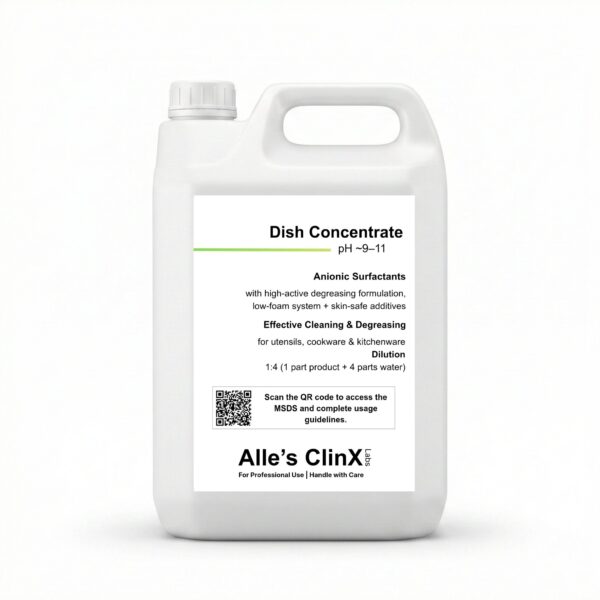
Dish Concentrate – Alkaline
A high-volume kitchen is a logistics operation. The dishwash chemistry should reflect that.
Highlights
- Alkaline pH 9–11 — triggers saponification of fats and oils before scrubbing begins — the chemistry reduces labour time per cover in high-volume kitchen operations.
- Anionic + non-ionic surfactant blend — rapid grease emulsification across cookware, crockery, utensils, and serving equipment regardless of food type or soil level.
- 1:4 dilution — one 5L yields 20 litres — precise, auditable dosing for institutional kitchen cost management and procurement planning.
- Controlled low-foam profile — compatible with machine-assisted washing operations without overflow or additional antifoam additive requirement.
- Hard water stable — maintains full surfactant performance in facilities supplied with water above 500 ppm TDS — the standard across most Indian cities.
Product overview
An institutional kitchen’s dishwashing operation is measured in three numbers: rewash rate, labour time per cover, and chemical cost per cycle. Everything else is secondary. The cleaning chemistry that drives all three is not glamorous — but it is precise, and it is the difference between a kitchen that runs and one that doesn’t.
Alle’s ClinX Labs Liquid Dishwash Concentrate addresses all three metrics simultaneously. The alkaline pH of 9–11 initiates saponification — the chemical conversion of dietary fats and oils into water-soluble soap-like compounds — before mechanical scrubbing begins. This means the surfactant system receives substantially pre-treated soil rather than intact grease, which translates directly into faster cleaning, higher first-pass clean rates, and reduced labour per item.
The anionic-nonionic surfactant combination is formulated for institutional soil profiles: the anionic component handles electrostatic soil attraction and emulsification, while the nonionic component provides hard water stability and substrate penetration across the range of materials — stainless steel, ceramic, melamine, polycarbonate — found in healthcare, industrial, and educational catering operations. The controlled low-foam profile eliminates the machine overflow problem without requiring a separate antifoam addition, simplifying the chemical management programme.
The chemistry +
| What is saponification, and why does alkaline pH reduce dishwashing labour in high-volume kitchens?
Saponification is a chemical reaction between a fat or oil (a triglyceride) and an alkali that produces glycerol and fatty acid salts — compounds that are water-soluble and surface-active. In dishwashing chemistry, the alkaline pH of the working solution initiates this reaction with dietary fats on soiled utensils and cookware before any mechanical action occurs. The fat is chemically converted into a soap-like compound that is already partially solubilised by the time scrubbing or mechanical washing begins. At pH 9–11, the saponification rate is sufficient to process the fat content of standard institutional food soiling — cooking oils, animal fats, dairy residues — within the contact time of a standard wash basin soak or machine pre-rinse cycle. This means that the mechanical energy required to achieve a clean result — scrubbing force, spray pressure in machines — is substantially reduced compared to neutral or mildly alkaline products operating below the saponification threshold. The practical consequence in a high-volume kitchen is measurable: items that require 60 seconds of scrubbing with a neutral product may require 15–20 seconds with an alkaline concentrate operating in the saponification pH range. Across hundreds of covers per service, this difference compounds into significant daily labour and water savings, and drives down the rewash rate that is the most expensive single variable in institutional dishwashing operations. |
Did you know +
Fact The alkaline pH of 9–11 does most of the heavy lifting before you even pick up a sponge. At this pH, fats and oils undergo saponification — they chemically convert into soap-like compounds that begin lifting off surfaces on their own. Your scrubbing is just finishing the job that chemistry already started.
Application & usage +
- Dilution Add 250 ml of concentrate to 1 litre of water (1:4 ratio) in a wash basin or machine reservoir.
- Manual washing For heavily soiled items, soak for 2–3 minutes before scrubbing. Rinse all utensils thoroughly with clean running water.
- Machine-assisted Follow equipment manufacturer dosing guidelines. Verify foam compatibility with equipment specifications before deployment.
- Solution management Replace working solution when visibly contaminated. Do not add concentrate to old, greasy wash water — prepare fresh solution for each session.
- Hard water adjustment In facilities with very high TDS (above 800 ppm), increase concentration slightly or use a water softener pre-treatment for optimal performance.
Usage economy +
| One 5-litre concentrate. Twenty litres of working detergent. One kitchen that runs on schedule.
At 1:4 dilution, a single 5L pack yields 20 litres of working detergent — enough for a kitchen running 500 covers per day with 3 wash basin changes per service for approximately 10–12 days of continuous operation. The saponification mechanism reduces average scrubbing time per item, translating a chemical cost into a measurable labour efficiency gain at scale. For hospital dietary departments and educational institutional kitchens operating under FSSAI food safety guidelines, the documented dilution protocol and ingredient transparency of this concentrate support audit trail requirements for cleaning chemical management. |
Product specifications +
| Active system | Anionic + non-ionic surfactant blend with alkaline builder |
| pH | 9.0–11.0 (alkaline) |
| Specific gravity | 1.03–1.06 at 25°C |
| Formulation type | Aqueous concentrate |
| Appearance | Clear to slightly hazy amber liquid |
| Fragrance | Raw lime |
| Dilution | 250 ml per litre of water (1:4) |
| Application | Manual wash basin or machine-assisted kitchen operations |
| Foam profile | Controlled low-foam — machine compatible |
| Safe on | All washable utensils, cookware, crockery, cutlery, serving equipment |
| Avoid | Anodised aluminium over extended soak periods |
| Rinse after use | Rinse all items thoroughly with clean water — mandatory |
| PPE | Gloves for prolonged skin contact |
| Shelf life | 24 months from date of manufacture, unopened |
| Pack size | 5 Litres concentrate |
| MSDS / TDS | QR code on label · Available on request |
Caution & storage +
| For professional and institutional use.
Alkaline concentrate. Avoid prolonged contact with skin and eyes. In case of eye contact, rinse immediately with copious clean water for 15 minutes. Do not ingest. Keep out of reach of children. Not suitable for use on anodised aluminium surfaces — extended contact causes surface degradation. Store in original sealed container below 30°C, away from direct sunlight and incompatible materials. Keep container closed when not in use. Do not store in metal containers. Shelf life 24 months from manufacture date, unopened. |
Resources & documentation +
| Material Safety Data Sheet | QR code on product label · Request at care@allesclinx.com |
| Technical Data Sheet (TDS) | Available on request — Alle’s ClinX Labs trade desk |
| Bulk & institutional supply | allesclinx.com · Institutional pricing available |
| B2B & procurement enquiries | procurement@allesclinx.com |