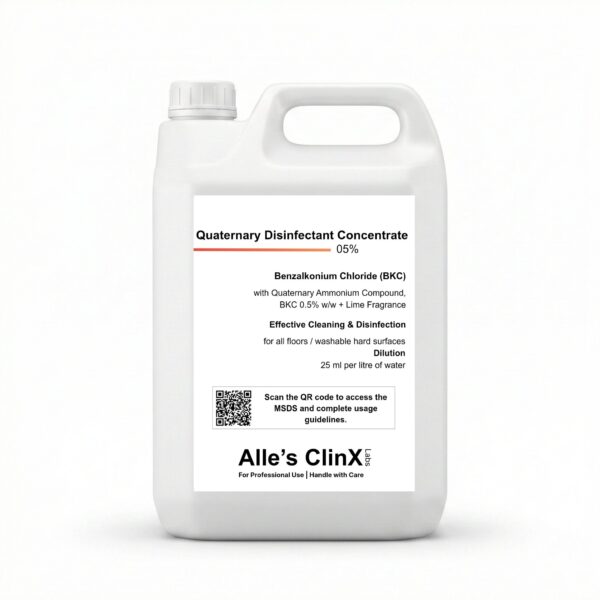
Quaternary Disinfectant Concentrate – BKC / क्वाटरनरी डिसइन्फेक्टेंट कॉन्सन्ट्रेट – बीकेसी (बेंज़ालकोनियम क्लोराइड)
→ A hospital-grade surface sanitizer for high-level microbial control.
Quaternary ammonium disinfection. Calibrated for environments where people never leave.
Highlights
- BKC 0.5% w/w — quaternary ammonium antimicrobial — the active class used in surgical scrubs, pharmaceutical disinfection, and medical device sterilisation, deployed at institutional floor scale.
- Occupied-space compatible — lime fragrance replaces chemical odour entirely — suitable for active hospital wards, school classrooms, and industrial food-prep areas without disrupting occupancy.
- pH 8–10 — near-neutral to mildly alkaline — compatible with a wider range of floor substrates than strongly alkaline alternatives and safe under repeated daily use.
- No rinsing required — working solution deposits a thin antimicrobial film on the floor surface during air-drying, extending residual efficacy between mop passes.
- NABH and JCI housekeeping protocol compatible — formulated to meet the chemical specification requirements of accredited healthcare facility environments.
Product overview
The standard institutional disinfectant was designed for empty spaces. Apply, evacuate, ventilate, reoccupy. In a hospital ward that is never empty, an industrial canteen running three shifts, or a school corridor used from 7am to 8pm, that design assumption fails completely.
Alle’s ClinX Labs Quaternary Disinfectant Concentrate – BKC was built around the operational reality of continuous-occupancy environments. Powered by Benzalkonium Chloride at 0.5% w/w — a quaternary ammonium compound used in surgical hand scrubs, contact lens solutions, and pharmaceutical clean-room disinfection — it delivers clinical-grade antimicrobial performance without the chemical signature that makes standard phenolic products incompatible with occupied spaces.
The chemistry +
| How does Benzalkonium Chloride (BKC) work as a disinfectant, and why does it outperform phenolics in occupied environments?
Benzalkonium Chloride belongs to the quaternary ammonium compound (QAC) family — cationic surfactants characterised by a positively charged nitrogen atom bonded to four organic groups. This positive charge is the mechanism of antimicrobial action: bacterial cell membranes carry a net negative surface charge, and BKC is electrostatically attracted to the membrane surface. On binding, it disrupts the phospholipid bilayer, causing membrane permeabilisation, loss of intracellular integrity, and rapid cell death. At pH 8–10, the formulation maintains BKC in its most active cationic state while counteracting the efficacy-reducing effect of hard water calcium and magnesium ions. The alkaline pH also enhances the solubilisation of surface organic deposits, complementing the disinfection mechanism with a cleaning action that keeps floor surfaces in the condition required for optimal antimicrobial performance. |
Did you know +
Fact BKC (Benzalkonium Chloride) is in the same chemical class as the active in your eye drops and contact lens solution. At the correct dilution on your floors, you’re using a pharmaceutical-grade antimicrobial at housekeeping scale. Most people never know.
Application & usage +
- Preparation Fill a clean mop bucket with the required volume of water. Add concentrate after water.
- Standard dilution 25 ml per litre of water for routine daily cleaning of occupied institutional floors.
- Heavy-soil dilution 45 ml per litre for high-risk zones, post-incident cleaning, or areas with elevated contamination load.
- Dwell & dry Allow to air-dry. No rinsing required. Working solution effective for up to 4 hours in a sealed bucket. Replace when contaminated.
Product specifications +
| Active ingredient | Benzalkonium Chloride (BKC) 0.5% w/w |
| Active class | Quaternary ammonium compound (QAC) |
| pH | 8.0–10.0 (near-neutral to mildly alkaline) |
| Specific gravity | 1.01–1.03 at 25°C |
| Fragrance | Lime — calibrated for continuous-occupancy environments |
| Dilution — standard | 25 ml per litre of water (1:40) |
| Dilution — heavy soil | 45 ml per litre of water (1:22) |
| Rinse after use | Not required |
| PPE | Gloves recommended for concentrate handling |
| Shelf life | 24 months from date of manufacture, unopened |
| Pack size | 5 Litres concentrate |
| MSDS / TDS | QR code on label · Available on request |
Caution & storage +
| For professional and institutional use.
Do not mix with anionic detergents, soaps, or incompatible cleaning chemicals. Avoid contact with eyes and prolonged skin exposure to concentrate. In case of eye contact, rinse immediately with copious clean water for 15 minutes. Keep out of reach of children. Store in original sealed container below 30°C, away from direct sunlight and heat sources. Shelf life 24 months from manufacture date, unopened. |
Resources & documentation +
| Material Safety Data Sheet | QR code on product label · Request at care@allesclinx.com |
| Technical Data Sheet (TDS) | Available on request — Alle’s ClinX Labs trade desk |
| Bulk & institutional supply | allesclinx.com · Institutional pricing available |
| B2B & procurement enquiries | procurement@allesclinx.com |