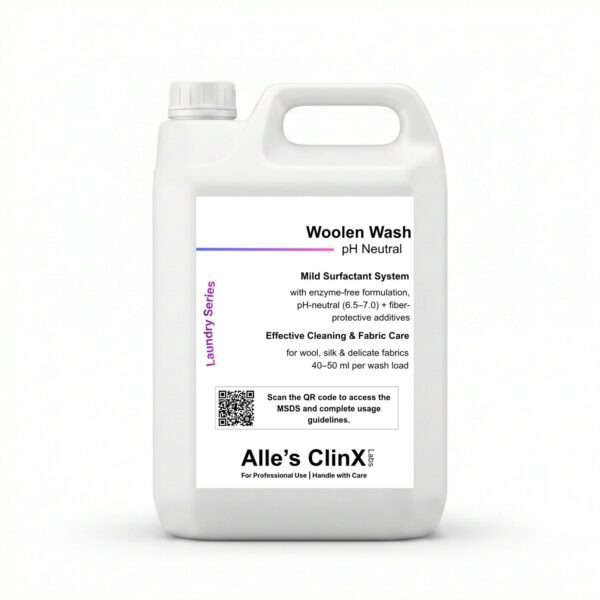
Woollen wash(gentle fabric care)
Premium fabric assets require chemistry that understands protein.
Highlights
- Near-neutral pH 6.5–7.0 — preserves the keratin protein bond structure of wool and cashmere fibres — prevents the fibre cuticle lifting that causes irreversible felting.
- Enzyme-free formulation — no protease activity that degrades natural protein fibre structure — the critical distinction from standard institutional laundry detergents.
- 40–45 ml per load — calibrated for both machine delicate cycles and hand washing protocols used in institutional premium fabric care.
- Prevents shrinkage and felting — the failure modes that make wool garment replacement necessary — and that are entirely preventable with correct detergent chemistry.
- Extends premium asset lifespan — measurable reduction in wool and cashmere garment replacement frequency — direct procurement cost reduction for institutional fabric asset programmes.
Product overview
The cost of an institutional wool asset failure is asymmetric: the detergent saving of using standard alkaline laundry detergent on a wool blanket or structured uniform is negligible. The replacement cost of a cashmere-blend hospital blanket or tailored wool uniform jacket after one incorrect wash is significant. The risk-reward calculation for wool-specific detergent in institutional fabric management is not close.
Alle’s ClinX Labs Woollen Wash (Gentle Fabric Care) is formulated around the specific chemistry of natural protein fibres. Wool and cashmere fibres have a surface structure of overlapping keratin protein scales — the cuticle — that lies flat under normal conditions. When subjected to alkaline pH, heat, or mechanical agitation, these scales lift and interlock with the scales of adjacent fibres in a one-way ratchet mechanism called felting. Once locked, the fibres cannot be separated — the garment has permanently shrunk and will not return to its original dimensions.
The near-neutral pH of 6.5–7.0 keeps the keratin protein bonds intact and the cuticle scales lying flat. The enzyme-free formulation removes the protease activity present in standard institutional detergents that would otherwise digest the protein matrix of the wool fibre itself. The gentle surfactant system provides effective soil removal from the fibre surface without the mechanical or chemical stress that initiates the felting mechanism.
The chemistry
| Why does wool shrink and felt in standard laundry detergent, and what chemistry prevents it?
Wool fibre is composed of keratin — a fibrous structural protein also found in human hair and nails. The fibre surface consists of overlapping protein scales (the cuticle) that point from root to tip, creating a directional surface texture. Under normal dry conditions, these scales lie flat and the fibre moves freely. The problem begins when three conditions coincide: alkaline pH, heat, and mechanical agitation. Alkaline conditions above pH 8 cause two adverse reactions in keratin: they break the disulphide cross-links that maintain the three-dimensional structure of the protein, weakening the fibre; and they cause the cuticle scales to swell and lift away from the fibre surface. Once lifted, agitation causes adjacent fibres’ scales to interlock — the directional surface texture creates a ratchet effect where fibres can move closer together but not apart. This interlocking is felting, and it is irreversible because the disulphide bonds reform in the new interlocked position. Standard institutional laundry detergents compound the problem with protease enzymes — biological catalysts specifically designed to break peptide bonds in protein molecules. Protease is highly effective at removing protein stains (blood, food) but is equally reactive with the keratin protein of the wool fibre itself, causing progressive fibre degradation and weakening with each enzyme-containing wash cycle. A near-neutral pH formulation with no protease enzyme is not simply a gentler version of standard detergent — it is a chemically distinct product that protects protein fibre structure rather than attacking it. |
Did you know
Fact Wool fibres have a protein structure called keratin — the same protein as human hair. High-alkalinity detergents break down keratin bonds, causing the fibre cuticle to lift and interlock with neighbouring fibres. That interlocking is felting. A near-neutral pH of 6.5–7.0 leaves the keratin structure intact. Your cashmere survives the wash. The chemistry is that simple — and that critical.
Application & usage
- Machine washing add 40–45 ml to the detergent compartment. Select wool or delicate cycle — 30°C maximum, low spin speed. Do not use high spin — centrifugal force causes scale interlocking.
- Hand washing dissolve 40 ml in a basin of cool water. Gently knead the garment for 3–5 minutes. Do not wring, scrub, or agitate vigorously.
- Rinsing rinse in cool water at the same temperature as the wash — temperature shock between wash and rinse water causes rapid fibre swelling and scale interlocking. Same-temperature rinsing is critical.
- Drying lay flat on a clean towel and reshape to original dimensions while wet. Do not hang — hanging causes wet wool to stretch and distort under its own weight. Do not tumble-dry.
- Frequency wool and cashmere garments require less frequent washing than cotton — spot cleaning between full washes extends garment life and reduces total wash cycle count.
Usage economy
| 42 ml per load. One 5-litre pack. 119 gentle fabric treatments.
At 42 ml average per load, a single 5L pack delivers approximately 119 complete delicate fabric treatments. For a healthcare facility managing premium wool blankets, fine-knit staff cardigans, and structured wool uniform components on a bi-weekly rotation, one pack covers approximately 3 months of dedicated delicate fabric care. The replacement cost avoidance of a single felted cashmere blanket or wool uniform jacket exceeds the cost of a full 5-litre pack. For educational institutions managing academic gown collections, wool-blend ceremonial items, and staff uniform garments, a documented wool-specific washing protocol reduces insurance and replacement claims associated with laundry damage. |
Product specifications
| Formulation | Enzyme-free mild surfactant blend — protein fibre safe |
| pH | 6.5–7.0 (near-neutral) |
| Specific gravity | 1.00–1.01 at 25°C |
| Appearance | Clear to slightly hazy liquid |
| Fragrance | Light, neutral — minimal scent to avoid fragrance deposit on delicate fibres |
| Dose per load | 40–45 ml |
| Application | Machine delicate / wool cycle or hand wash |
| Wash temperature | 30°C maximum — cold water preferred |
| Safe on | Wool, cashmere, angora, silk, fine knits, blended delicates |
| Avoid on | Regular cotton or synthetic institutional loads |
| PPE | None |
| Shelf life | 24 months from date of manufacture, unopened |
| Pack size | 5 Litres concentrate |
| MSDS / TDS | Available on request |
Caution & storage
| For professional and institutional use.
For use on delicate protein-fibre fabrics only. Not suitable as a general institutional laundry detergent. Do not use on silk items requiring dry-clean only care. Always check individual garment care labels before washing. In case of eye contact, rinse with water. Keep out of reach of children. Store in original sealed container below 30°C, away from direct sunlight. Keep container tightly closed when not in use. Shelf life 24 months from manufacture date, unopened. |
Resources & documentation
| Material Safety Data Sheet | QR code on product label · Request at care@allesclinx.com |
| Technical Data Sheet (TDS) | Available on request — Alle’s ClinX Labs trade desk |
| Bulk & institutional supply | allesclinx.com · Institutional pricing available |
| B2B & procurement enquiries | procurement@allesclinx.com |