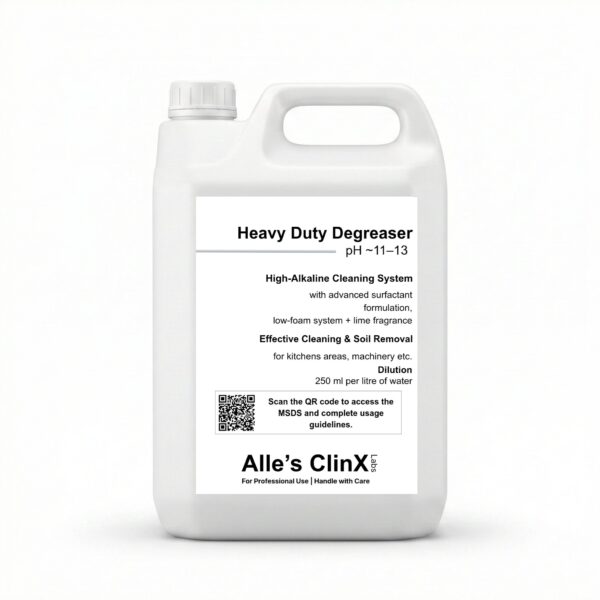
Heavy duty degreaser (concentrate)
Grease accumulates. Standards slip. pH 11–12 ends the cycle.
Highlights
- pH 11–12 saponification system — converts fats and oils into water-soluble soap-like compounds on contact — the chemistry that makes carbonised grease deposits soluble rather than simply loosened.
- Effective on the full soiling spectrum — fresh cooking grease, polymerised surface films, and carbonised baked-on deposits — the three stages of grease accumulation that require progressively stronger treatment.
- Concentration flexibility — standard 1:4 dilution for scheduled maintenance cleaning — near-undiluted for deep-clean intervention on severe accumulation — one product, two operational modes.
- Fire safety compliance — grease accumulation in extraction systems is a primary cause of commercial kitchen fires — regular chemical degreasing is a fire safety maintenance requirement, not a housekeeping preference.
- Mandatory rinse protocol — formulated as part of a structured cleaning programme — alkaline residue documentation and rinse compliance support food safety audit trail requirements.
Product overview
Commercial kitchen grease accumulation is categorised by chemists in three stages that require progressively different treatment approaches: fresh grease — liquid or semi-solid, recently deposited, easily removed; polymerised surface film — partially oxidised and cross-linked, requiring alkaline chemistry for saponification; and carbonised deposits — fully oxidised, baked on at high temperature, with a glassy surface that resists penetration. Healthcare kitchen infrastructure, industrial canteen extraction systems, and educational mess hall cooking equipment accumulate all three simultaneously in a stratified layer structure.
Alle’s ClinX Labs Heavy Duty Degreaser (Concentrate) is formulated to address all three stages within a single product at adjustable concentration. The pH 11–12 high-alkalinity system initiates saponification — the chemical conversion of triglyceride fats and oils into water-soluble glycerol and fatty acid salts — on fresh and polymerised deposits on contact. For carbonised accumulations, the high alkalinity penetrates the oxidised surface layer over extended dwell time, initiating the same chemical conversion from beneath the carbonised layer. The result is deposit dissolution rather than mechanical displacement.
The concentration flexibility is operationally critical: scheduled maintenance cleaning at 1:4 dilution maintains extraction systems and cooking equipment surfaces in the condition required to prevent carbonised deposit formation; emergency deep-clean intervention at higher concentration restores surfaces where maintenance frequency has been insufficient. One product covers the entire maintenance and remediation spectrum without requiring separate product procurement or storage.
The chemistry
| What is saponification, and why does pH 11–12 convert grease into something that washes away?
Saponification is the alkaline hydrolysis of a triglyceride (fat or oil) to produce glycerol and the sodium or potassium salts of the component fatty acids. The reaction is: triglyceride + 3 NaOH → glycerol + 3 sodium fatty acid salts. The sodium fatty acid salts produced are the compounds we call soap — surface-active, water-soluble, and capable of being rinsed away with water. The saponification reaction has been used intentionally for soap-making since antiquity; in degreasing chemistry, it happens on contact between the grease deposit and the alkaline cleaning solution. At pH 11–12, the hydroxide ion (OH⁻) concentration is sufficient to drive saponification at a practical rate in cleaning contact times. Below pH 9, the reaction rate is too slow to be operationally useful — the grease is partially saponified on the surface but not converted completely, leaving a soapy film rather than a clean surface. At pH 11–12, the reaction proceeds rapidly enough that fresh grease deposits are converted to water-soluble products within minutes of contact, and polymerised surface films are softened sufficiently for mechanical removal within 10–15 minutes. Carbonised deposits present an additional challenge: the oxidation and cross-linking that occurs during high-temperature cooking converts the outer layer of the deposit to a glassy, highly resistant matrix that must be chemically penetrated before saponification can begin on the underlying fat. This is why extended dwell time at high concentration is required for carbonised accumulations — the hydroxide must diffuse through the carbonised surface layer before the saponification reaction can reach the fat substrate. The practical protocol — apply, dwell 15–20 minutes, agitate with stiff brush — reflects this chemistry. |
Did you know
Fact At pH 11–12, alkaline degreasers trigger saponification — the same chemical reaction used to manufacture soap since antiquity. Fats and oils literally convert into soap-like compounds on contact with the high-pH solution. You are not just removing grease — you are chemically converting it into the very substance that makes it water-soluble and washable. Ancient chemistry. Industrial results.
Application & usage
- Routine maintenance (1:4 dilution) dilute 250 ml per litre of water. Apply by spray or brush. Allow 5–10 minutes contact. Wipe or rinse.
- Deep clean — moderate accumulation apply at 1:2 dilution or stronger. Allow 10–15 minutes contact with periodic agitation using a stiff brush.
- Deep clean — heavy carbonised deposits apply near-undiluted or undiluted for severe accumulations. Allow 15–20 minutes contact. Agitate with a stiff-bristle brush to break through the carbonised surface layer. Rinse thoroughly with hot water.
- Ventilation use in well-ventilated areas — high-alkalinity vapour in enclosed spaces can cause respiratory irritation.
- Rinse protocol rinse thoroughly after all applications — alkaline residue on food-contact surfaces is a food safety compliance issue. Mandatory rinse documentation is required for FSSAI audit compliance in healthcare and educational catering.
Usage economy
| One 5-litre concentrate. Twenty litres at maintenance dilution. Or 5 litres of full-strength deep-clean intervention.
At standard 1:4 dilution, a single 5L concentrate produces 20 litres of maintenance degreaser — sufficient for a commercial kitchen with 50 sq metres of extraction and equipment surface area on weekly maintenance cleaning for approximately 6–8 weeks. At full-strength application for emergency deep-clean intervention, the same pack provides 5 litres of maximum-concentration solution for severe carbonised accumulation remediation. For healthcare kitchen facilities operating under NABH dietary standards and educational catering operations under FSSAI licensing, documented chemical degreasing schedules with product specification and dilution records form part of the required kitchen hygiene audit trail. |
Product specifications
| Active system | High-alkalinity surfactant + saponification system |
| pH | 11.0–12.0 (strongly alkaline) |
| Specific gravity | 1.04–1.07 at 25°C |
| Formulation type | Aqueous concentrate |
| Appearance | Clear to slightly hazy liquid |
| Fragrance | Neutral |
| Dilution — maintenance | 250 ml per litre (1:4) |
| Dilution — deep clean | Higher concentration or undiluted for severe accumulations |
| Contact time | 5–10 minutes maintenance · 15–20 minutes heavy carbonised deposits |
| Application | Spray / brush / soak |
| Safe on | Kitchen extraction systems, cooking equipment, plant floors, industrial machinery, loading docks |
| Avoid on | Aluminium, painted surfaces, soft metals — high pH causes etching and discolouration |
| Rinse after use | Thorough rinse mandatory — especially on food-contact surfaces |
| PPE | Gloves + eye protection mandatory. Use in ventilated areas. |
| Shelf life | 24 months from date of manufacture, unopened |
| Pack size | 5 Litres concentrate |
| MSDS / TDS | QR code on label · Available on request |
Caution & storage
| For professional and institutional use.
CAUTION — strongly alkaline concentrate. Causes skin burns and serious eye damage on contact with concentrate. Wear chemical-resistant gloves and full eye protection during application. Use in well-ventilated areas — alkaline vapour in enclosed spaces causes respiratory irritation. Do not use on aluminium, anodised aluminium, or painted surfaces — causes irreversible surface etching. Do not mix with acid cleaners — violent exothermic reaction. Store in original sealed container below 30°C, away from acid products, aluminium containers, and heat sources. Keep container tightly closed when not in use. In case of spillage, neutralise with dilute acid solution (vinegar) and flush with water. Shelf life 24 months from manufacture date, unopened. |
Resources & documentation
| Material Safety Data Sheet | QR code on product label · Request at care@allesclinx.com |
| Technical Data Sheet (TDS) | Available on request — Alle’s ClinX Labs trade desk |
| Bulk & institutional supply | allesclinx.com · Institutional pricing available |
| B2B & procurement enquiries | procurement@allesclinx.com |